

Published by Zhuhai Biori Biotechnology Co., Ltd.
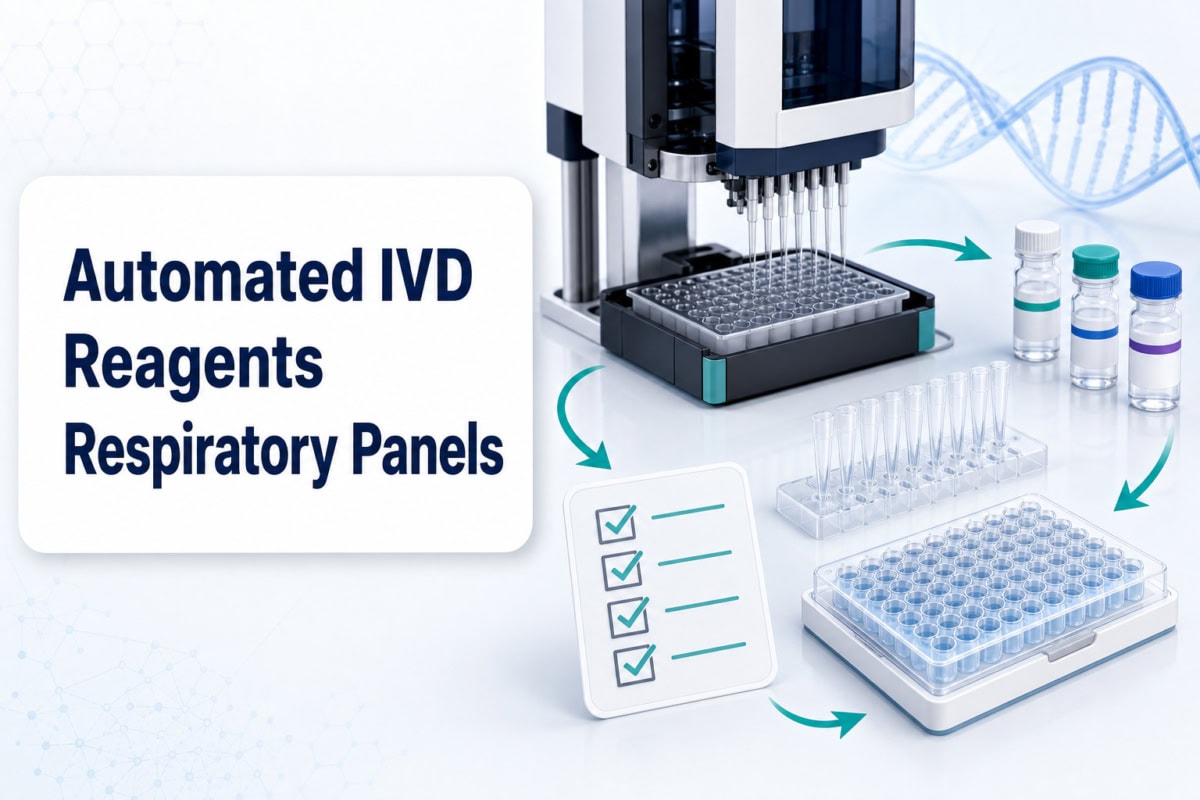
Recent respiratory diagnostics news has put automated IVD reagents back in focus. Applied BioCode announced FDA clearance for KingFisher™ nucleic acid extraction with its BioCode® Respiratory Pathogen Panel for IVD use, while GenomeWeb reported the expanded 510(k) clearance for the multiplex respiratory pathogen test. For assay developers and OEM partners, the message is practical: platform compatibility, reagent robustness and documentation quality are now central to respiratory panel commercialization.
Why automated IVD reagents matter for respiratory panels
Respiratory pathogen panels often need to combine high-throughput extraction, multiplex amplification and automated detection in one validated workflow. When laboratories evaluate a new platform combination, the reagent system must remain consistent across sample types, extraction chemistry, instrument handling and downstream PCR or molecular detection conditions.
This is why automated IVD reagents are not simply “manual reagents placed on an instrument.” They need to be designed and controlled for:
- extraction carryover and inhibitor tolerance;
- lot-to-lot enzyme and buffer consistency;
- liquid-handling compatibility and dead-volume control;
- multiplex amplification balance across targets;
- stability during transport, storage and routine lab operation;
- documentation that supports verification, validation and release review.
What the Applied BioCode news signals for assay developers
The reported clearance connects a respiratory pathogen panel with an automated nucleic acid preparation platform. That is commercially important because many clinical laboratories want respiratory testing workflows that reduce hands-on time, increase throughput and fit existing automation footprints.
For reagent and kit developers, this type of news reinforces three product-development priorities:
1. Extraction-to-amplification compatibility
Nucleic acid extraction chemistry, elution conditions and carryover profiles can affect reverse transcription, PCR efficiency and multiplex balance. Reagent developers should evaluate enzymes, buffers and stabilizers under realistic extracted-sample conditions rather than only with purified templates.
2. Automation-ready formulation control
Automated workflows impose practical requirements on viscosity, foaming, evaporation, mixing, pipetting tolerance and freeze-thaw behavior. Glycerol-free or reduced-glycerol enzyme formats, premixed systems and lyophilized formats can help simplify automation and shipping when they are properly developed and validated.
3. Documentation for regulated pathways
IVD teams need batch records, CoA data, QC release criteria, change-control records and traceability packages that match the risk profile of the assay. Documentation is especially important when a workflow crosses multiple instruments, consumables and software-controlled steps.
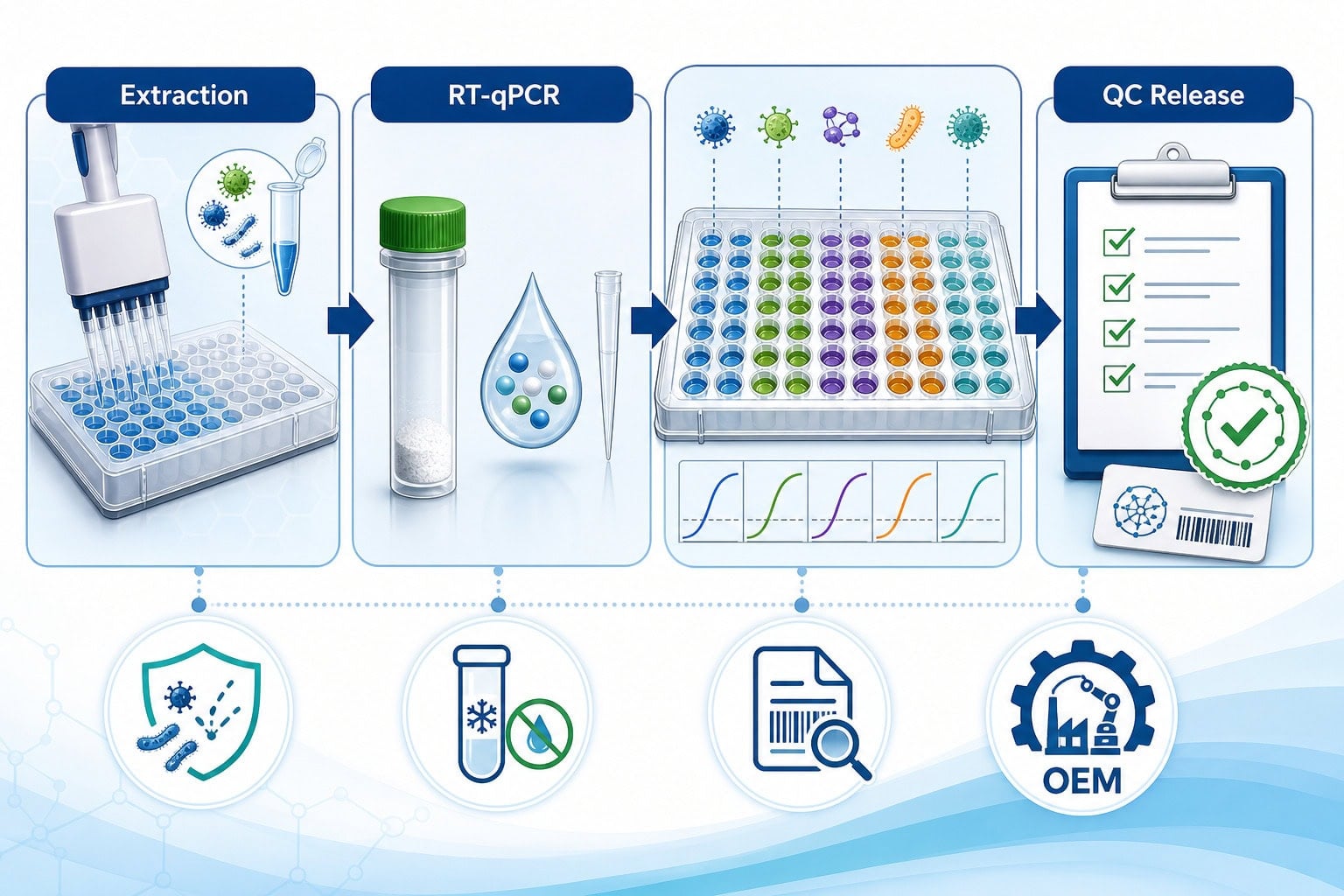
Reagent checklist for automated respiratory panel development
| Development area | Key question | Typical reagent implication |
|---|---|---|
| Nucleic acid extraction | Does the eluate inhibit RT-qPCR or multiplex PCR? | Use inhibitor-tolerant enzymes and validated buffer conditions. |
| Multiplex detection | Are low-copy and high-copy targets balanced? | Optimize polymerase, reverse transcriptase, primers, probes and Mg²⁺ conditions. |
| Automation handling | Can reagents be pipetted reliably by the instrument? | Control viscosity, surfactants, glycerol content and fill volume. |
| Stability | Will performance remain consistent through shipment and storage? | Consider stabilizers, lyophilization or glycerol-free enzyme formats. |
| Quality release | Can each lot be reviewed and traced? | Define QC assays, acceptance criteria, CoA fields and retain-sample policies. |
Where Biori can support automated IVD reagent projects
Biori supports overseas customers developing molecular diagnostic and biomanufacturing workflows with enzyme raw materials, reagent formulation and OEM/custom manufacturing services. Relevant capabilities include PCR/RT-qPCR enzymes and master mixes, nucleic acid extraction-related reagents, NGS library preparation enzymes, lyophilized and glycerol-free formulations, and ISO-managed manufacturing and quality documentation.
For teams moving from assay development to regulated manufacturing, Biori can also support Biori OEM and custom manufacturing services, lyophilization service for molecular diagnostics, molecular diagnostics reagent selection and manufacturing and quality documentation.
For adjacent mRNA and biomanufacturing programs, Biori provides a complete portfolio of GMP-grade IVT raw materials for mRNA manufacturing, including key enzymes and workflow reagents, with OEM/customization support. Teams working on vaccine, antibody, cell and gene therapy workflows may also review Biori’s HCD/HCP and biopharma QC solutions and HCD/HCP custom assay development services.
Practical OEM questions before scaling an automated assay
- Which extraction platforms and sample matrices must be verified?
- What inhibition controls and internal controls will be used?
- Should the reagent format be liquid, glycerol-free, lyophilized bead or full premix?
- Which QC assays are needed for enzyme activity, multiplex performance and stability?
- What documentation package is expected by the customer’s regulatory and quality teams?
- How will formulation, packaging and labeling changes be controlled over time?
FAQ: automated IVD reagents for respiratory panels
What are automated IVD reagents?
Automated IVD reagents are molecular diagnostic reagents formulated, tested and documented for use on automated extraction, liquid-handling, amplification or detection platforms. They must meet both biochemical and instrument-handling requirements.
Why is nucleic acid extraction compatibility important?
Extraction buffers, magnetic beads, residual ethanol, salts or sample inhibitors can affect reverse transcription and PCR. Compatibility testing helps ensure that the final assay remains sensitive and reproducible.
Can lyophilized reagents support automated respiratory testing?
Yes, when properly developed. Lyophilized or bead-based formats can simplify storage and transport, but they still need platform-specific testing for reconstitution, mixing, reaction performance and stability.
How can an OEM partner help with respiratory panel reagents?
An experienced OEM partner can support enzyme selection, formulation, pilot manufacturing, QC release testing, lyophilization development, documentation and scale-up for customer-specific assay requirements.
References
- Applied BioCode announcement on FDA clearance for KingFisher nucleic acid extraction with BioCode Respiratory Pathogen Panel
- FDA 510(k) Premarket Notification database
Discuss your next automated IVD reagent project
If your team is developing respiratory panels, extraction-compatible PCR/RT-qPCR systems, lyophilized diagnostics reagents or OEM molecular diagnostic kits, contact Biori to discuss enzyme raw materials, formulation development, GMP/ISO-managed manufacturing options and custom QC documentation needs.
Explore more BIORI technical resources: Browse selection guides, workflow pages, product data and documentation in the BIORI Technical Resources center.