

Published by Zhuhai Biori Biotechnology Co., Ltd.
Next-generation sequencing (NGS) has transformed genomics, oncology research, infectious disease testing, reproductive health, and precision medicine. However, sequencing performance depends not only on the instrument itself, but also on the quality of library preparation.
Among the major innovations in this field, enzyme-based library preparation has become one of the most important workflow advances. By replacing traditional physical DNA fragmentation methods with enzymatic reactions, this strategy simplifies the workflow, improves automation compatibility, and supports more efficient processing of precious or low-input samples.
In this article, we explore how enzyme-based library preparation works, why it matters, and how it is helping drive the evolution of modern NGS workflows.
What Is Enzyme-Based Library Preparation?
Enzyme-based library preparation is an NGS workflow in which enzymes are used to fragment DNA, repair ends, add A-tails, and support downstream amplification and cleanup steps required for sequencing library construction.
Compared with traditional sonication-based workflows, enzyme-based methods can reduce hands-on time, eliminate the need for specialized fragmentation instruments, and provide a more streamlined path from input nucleic acid to sequencing-ready libraries.
Why Traditional Library Preparation Has Limitations
Traditional NGS library preparation often relies on physical fragmentation methods such as ultrasonication. While physical shearing can generate relatively random DNA fragments, it also introduces several practical challenges for routine lab workflows.
High Equipment Cost
Physical DNA fragmentation usually requires dedicated instrumentation, which increases capital cost and maintenance burden for the laboratory.
Workflow Complexity
Traditional fragmentation often adds extra handling steps, making the process more labor-intensive and harder to standardize.
Sample Loss Risk
For precious samples such as low-input DNA, FFPE tissue, or liquid biopsy specimens, every purification and transfer step can increase sample loss.
Lower Automation Flexibility
Physical fragmentation systems are not always easy to integrate into automated liquid-handling workflows, which can limit throughput and scalability.
How Enzymatic Fragmentation Changes the Workflow
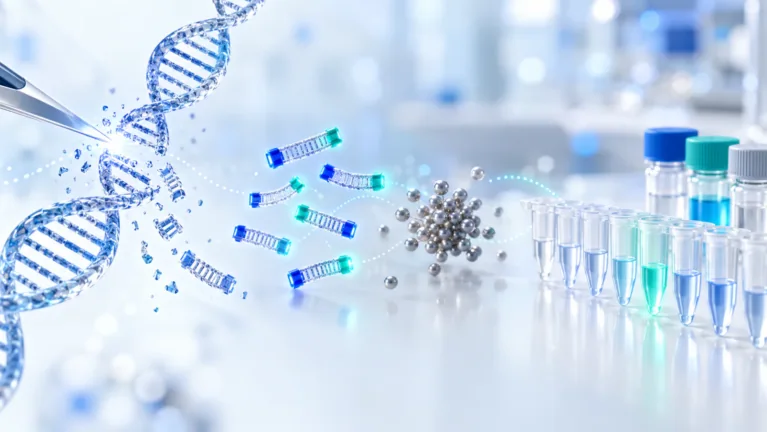
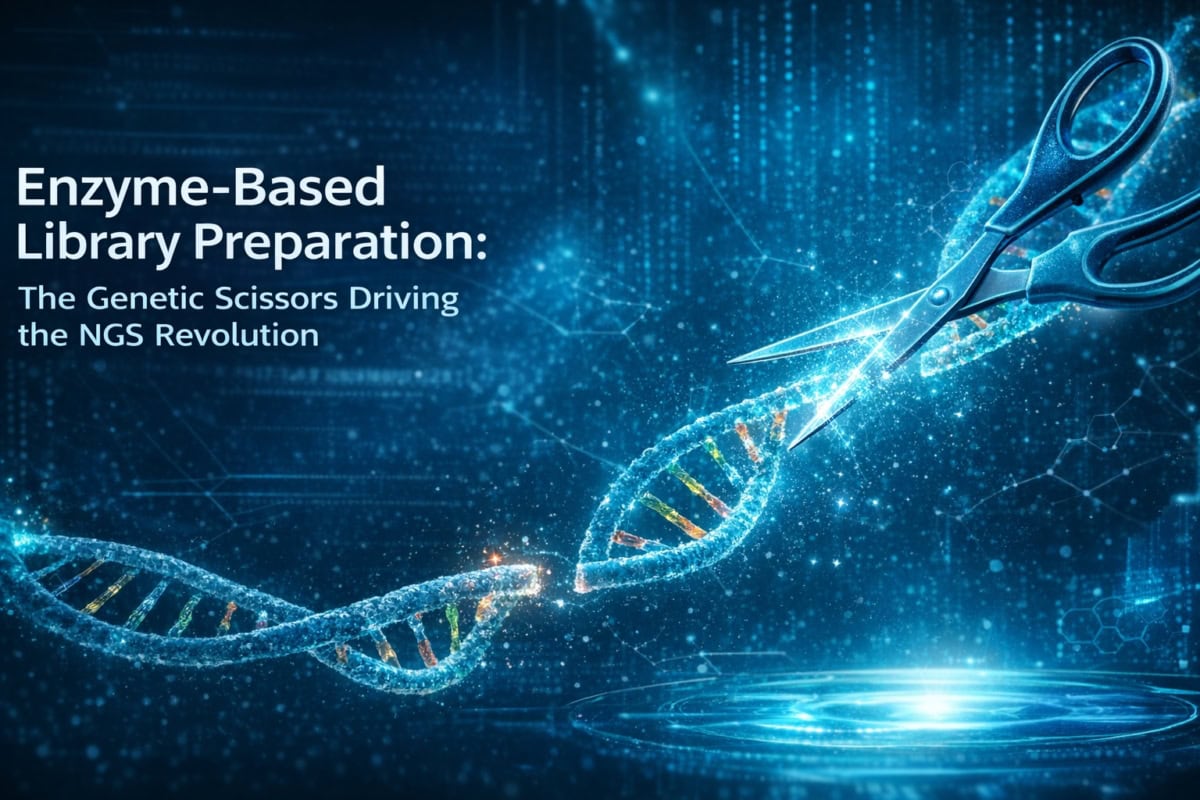
Enzymatic fragmentation functions like a set of molecular scissors. Instead of mechanically breaking DNA, specific enzymes generate fragments suitable for downstream sequencing library construction.
This approach offers several important workflow advantages:
- Simplified protocol design with fewer manual steps
- Reduced equipment dependence because no specialized sonicator is required
- Better automation compatibility for high-throughput processing
- Lower reagent and sample consumption through more compact workflows
- Higher flexibility for different sample inputs and applications
Core Steps in Enzyme-Based Library Preparation
A typical enzyme-based NGS library preparation workflow may include the following steps:
1. DNA or RNA Input Preparation
The workflow begins with purified genomic DNA, cfDNA, amplicons, or RNA-derived cDNA, depending on the sequencing application.
2. Enzymatic Fragmentation
DNA is cut into fragments of suitable size using fragmentation enzymes rather than mechanical force.
3. End Repair and dA-Tailing
Fragment ends are repaired and prepared for adapter ligation. In many workflows, these steps are combined into an efficient module-based reaction.
4. Adapter Ligation
Sequencing adapters are ligated onto DNA fragments to prepare them for platform-specific sequencing.
5. Library Amplification
High-fidelity polymerases are used to amplify the library with strong yield, specificity, and uniformity.
6. Cleanup and Size Selection
Magnetic bead-based cleanup removes unwanted by-products and helps optimize library quality.
Why Enzyme-Based Library Preparation Matters in Modern NGS
As sequencing demand continues to grow, laboratories increasingly need workflows that are faster, easier to automate, and more compatible with complex sample types. Enzyme-based library preparation addresses these needs directly.
It is especially valuable for:
- Targeted sequencing
- Amplicon sequencing
- Microbial sequencing
- Clinical and translational research
- Low-input DNA applications
- High-throughput automated sequencing labs
Advantages of Enzyme-Based Library Preparation
Simplified Workflow
Integrated enzyme modules can reduce the number of manual operations and improve workflow consistency.
High Efficiency
Well-optimized enzymes and premixed reagents can support robust fragmentation, end repair, ligation, and amplification performance.
Compatibility with Automation
Enzymatic workflows are more naturally suited to liquid-handling platforms, helping labs scale sequencing throughput.
Better Suitability for Low-Input Samples
Reducing unnecessary transfer and handling steps helps preserve valuable input material.
Scalability for Different Applications
From targeted pathogen panels to DNA/RNA library preparation workflows, enzyme-based systems provide flexibility across multiple NGS applications.
Choosing the Right Enzymes for NGS Library Preparation
Successful enzyme-based library preparation depends on selecting the right combination of enzymes and supporting reagents for each step. Important considerations include:
- Fragmentation efficiency and reproducibility
- High-fidelity amplification performance
- Strong yield and coverage uniformity
- Compatibility with different sequencing platforms
- Reliable cleanup and size selection performance
For this reason, many laboratories prefer to use workflow-matched module reagents and library prep kits rather than piecing together multiple components from different sources.
The Future of NGS Library Construction
The direction of NGS library preparation is clear: more automation, fewer manual steps, stronger consistency, and broader compatibility with challenging sample types. Enzyme-based workflows are now a core part of that transition.
As sequencing continues to expand in clinical testing, molecular diagnostics, microbiology, oncology, and translational research, enzyme-based library preparation will remain a critical enabling technology for reliable and scalable genomic analysis.
Conclusion
Enzyme-based library preparation has become one of the key workflow innovations driving the NGS revolution. By replacing physical fragmentation with optimized enzymatic reactions, laboratories can simplify library construction, reduce equipment dependence, improve automation readiness, and support high-quality sequencing results.
For labs seeking efficient, scalable, and high-performance NGS workflows, enzyme-based library preparation is no longer just an alternative. It is increasingly becoming the preferred strategy.
FAQ
What is enzyme-based library preparation?
Enzyme-based library preparation is an NGS workflow that uses enzymes to fragment DNA and support downstream library construction steps such as end repair, dA-tailing, amplification, and cleanup.
Why is enzymatic fragmentation important in NGS?
Enzymatic fragmentation reduces dependence on physical shearing equipment, simplifies the workflow, and improves compatibility with automated library preparation systems.
Is enzyme-based library preparation suitable for automation?
Yes. One of its biggest advantages is that it is easier to integrate into automated liquid-handling workflows than traditional sonication-based methods.
What enzymes are commonly used in NGS library preparation?
Common enzymes include high-fidelity DNA polymerases, DNA ligases, end repair enzymes, kinases, fragmentation enzymes, and amplification enzymes used in library construction and cleanup workflows.
What are the benefits of a complete NGS library prep solution?
A complete solution can improve workflow compatibility, reduce optimization burden, and deliver more consistent sequencing performance across fragmentation, end repair, amplification, and cleanup steps.
Biori Recommended Products for Enzyme-Based NGS Library Preparation
The following products are suitable for enzyme-based NGS library preparation, including DNA fragmentation, end repair, ligation, amplification, cleanup, and DNA/RNA library construction workflows. Product names and catalog numbers are organized based on your NGS product sheet and NGS library construction catalog.
| Category | Product Name | Catalog No. | Suggested Use |
|---|---|---|---|
| High-Fidelity DNA Polymerase | AmpHifi HS DNA Polymerase I | BR3P101 | Routine high-fidelity amplification, cloning verification, first-generation sequencing, long-fragment amplification |
| High-Fidelity DNA Polymerase | AmpHifi HS DNA Polymerase III | BR3P103 | Long-fragment amplification, multiplex amplification, universal library amplification, high-yield and high-uniformity workflows |
| DNA End Repair / Ligation | T4 DNA Ligase | BR3P301 | Adapter ligation and sticky-end DNA ligation |
| DNA End Repair | T4 DNA Polymerase | BR3P302 | Blunt-ending, fill-in reactions, efficient end polishing |
| DNA End Modification | T4 Polynucleotide Kinase | BR3P303 | 5′ phosphorylation and DNA end preparation |
| Whole Genome Amplification | phi29 DNA Polymerase | BR3P104 | Isothermal whole genome amplification and strand-displacement applications |
| Strand-Displacement Polymerase | Vent(exo-) DNA Polymerase | BR3P107 | Broad ionic-strength compatibility and special amplification workflows |
| Multiplex Amplification | 2× Multiplex PCR Master Mix | BR3M101 | Pathogen panel amplification, targeted sequencing, microbial NGS workflows |
| Multiplex Amplification | 2× Multiplex PCR Master Mix V2 | BR3M106 | Improved multiplex DNA amplification with upgraded uniformity and amplification efficiency |
| High-Fidelity Multiplex Mix | AmpHiFi Mul-PCR Mix | BR3M104 | High-fidelity multiplex amplification for complex DNA panels |
| Library Amplification | AmpSeq Library Amplification Mix | BR3M105 | Efficient second-round library amplification with strong fidelity and yield |
| Library Preparation Kit | AmpSeq Library Prep Kit | BR3M103 | Integrated NGS library construction workflow |
| First-Strand cDNA Synthesis | Script Max 1st Strand cDNA Synthesis Kit | BR3N701 | Efficient reverse transcription for RNA-related NGS library workflows |
| End Repair / dA-Tailing | Rapid End Repair/dA-Tailing Module | BR3N601 | End repair and A-tailing for DNA library construction |
| DNA Fragmentation | Universal DNA Fragmentation Module | BR3N602 | Enzyme-based DNA fragmentation for library preparation |
| Cleanup / Size Selection | Biori NGS DNA Clean Beads | BR3N401 | Library cleanup, DNA recovery, and size selection |
Recommended Workflow Matching
- DNA fragmentation workflow: Universal DNA Fragmentation Module + Rapid End Repair/dA-Tailing Module + T4 DNA Ligase
- Library amplification workflow: AmpSeq Library Amplification Mix or AmpHifi HS DNA Polymerase III
- Complete DNA library construction: AmpSeq Library Prep Kit + Biori NGS DNA Clean Beads
- RNA-related library workflow: Script Max 1st Strand cDNA Synthesis Kit + downstream DNA library prep reagents
- Targeted / multiplex sequencing: 2× Multiplex PCR Master Mix, 2× Multiplex PCR Master Mix V2, or AmpHiFi Mul-PCR Mix
If you are looking for a complete enzyme-based NGS library preparation solution, Biori can support workflows covering fragmentation, end repair, amplification, cleanup, and library construction, with product lines designed for NGS applications and targeted sequencing development.
Related NGS guide: NGS sample preparation for molecular diagnostics.