

Published by Zhuhai Biori Biotechnology Co., Ltd.
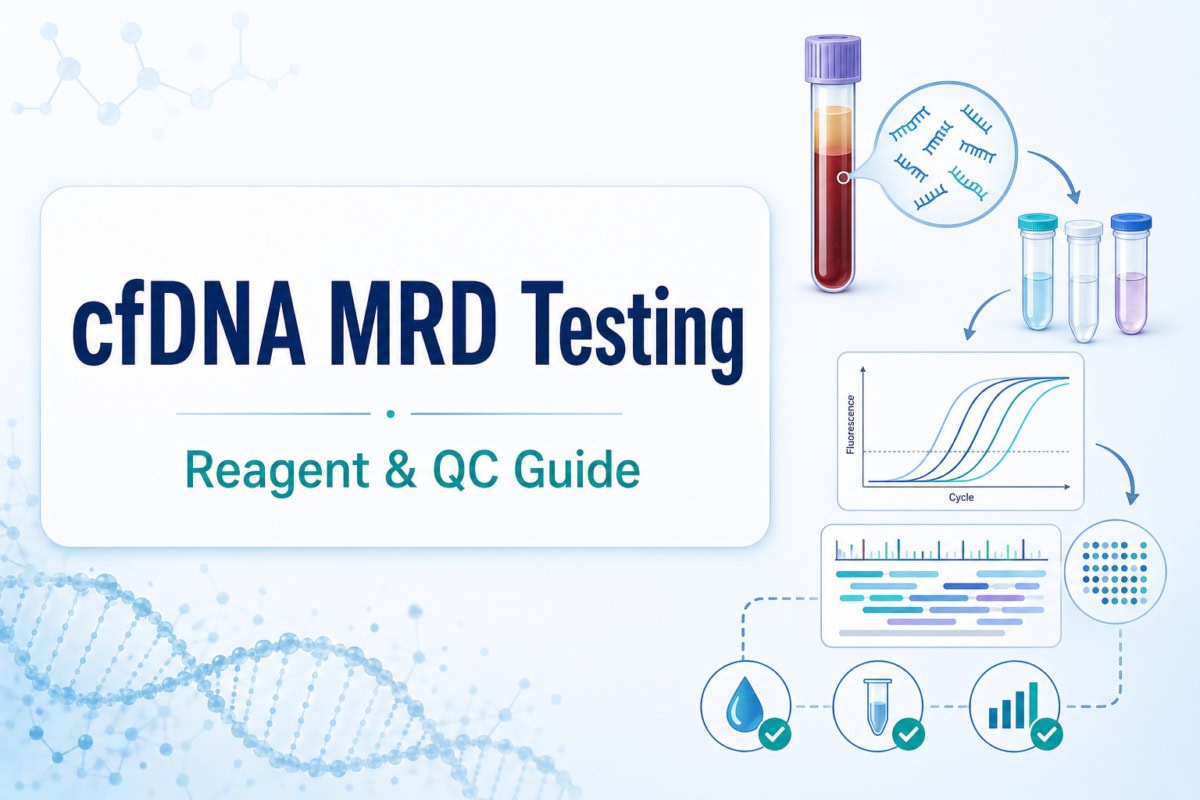
Recent precision-oncology news is putting cfDNA MRD testing back in the spotlight. CareDx announced an agreement to acquire Naveris, a company focused on blood-based molecular residual disease surveillance for viral-mediated cancers, while industry coverage described the transaction as an expansion into precision oncology testing. For molecular diagnostics developers, this trend reinforces a practical question: how should reagent strategy, sample preparation, and assay QC be designed when low-abundance circulating tumor signals must be detected consistently?
This article translates the news into a practical reagent and workflow checklist for diagnostic developers, IVD raw material buyers, and OEM teams working on liquid biopsy, MRD, viral DNA surveillance, or related nucleic-acid assays.
Why cfDNA MRD testing is drawing more industry attention
MRD testing is valuable because it aims to detect molecular signals that may remain after treatment, before they are visible through conventional clinical assessment. In liquid biopsy workflows, those signals may be present at very low abundance and can be influenced by sample handling, extraction efficiency, inhibitors, amplification chemistry, library preparation, and data interpretation.
The CareDx–Naveris news is not just a corporate transaction story. It reflects broader demand for clinically actionable molecular surveillance, especially where a defined DNA signal can be tracked over time. As more companies invest in commercial MRD platforms, reagent robustness and manufacturing consistency become increasingly important.
Key reagent considerations for cfDNA MRD testing workflows
Because cfDNA is fragmented, low-input, and sensitive to pre-analytical variation, reagent choices should be evaluated as a system rather than as isolated components.
1. Nucleic acid extraction and inhibitor control
Sample preparation is often the first source of variability. Developers should evaluate extraction chemistry for recovery of short cfDNA fragments, compatibility with plasma inputs, carryover of inhibitors, and lot-to-lot stability. For OEM or kit-development projects, this step should also be assessed under realistic transport, storage, and user-handling conditions.
2. PCR and qPCR chemistry for low-copy detection
Where assays use PCR or qPCR confirmation, enzymes and master mixes should be assessed for sensitivity, specificity, inhibitor tolerance, multiplex compatibility, and reproducibility near the limit of detection. Hot-start polymerases, optimized buffers, probe compatibility, and lyophilization-ready formulations can help improve workflow consistency for diagnostic kits.
3. NGS library preparation for fragmented templates
For sequencing-based MRD workflows, library prep enzymes need to perform reliably with fragmented and low-input DNA. End repair, A-tailing, ligation, amplification, and cleanup conditions should be evaluated together, because small shifts in efficiency can affect unique molecule recovery and downstream analytical sensitivity.
cfDNA MRD testing assay QC: what teams should validate early
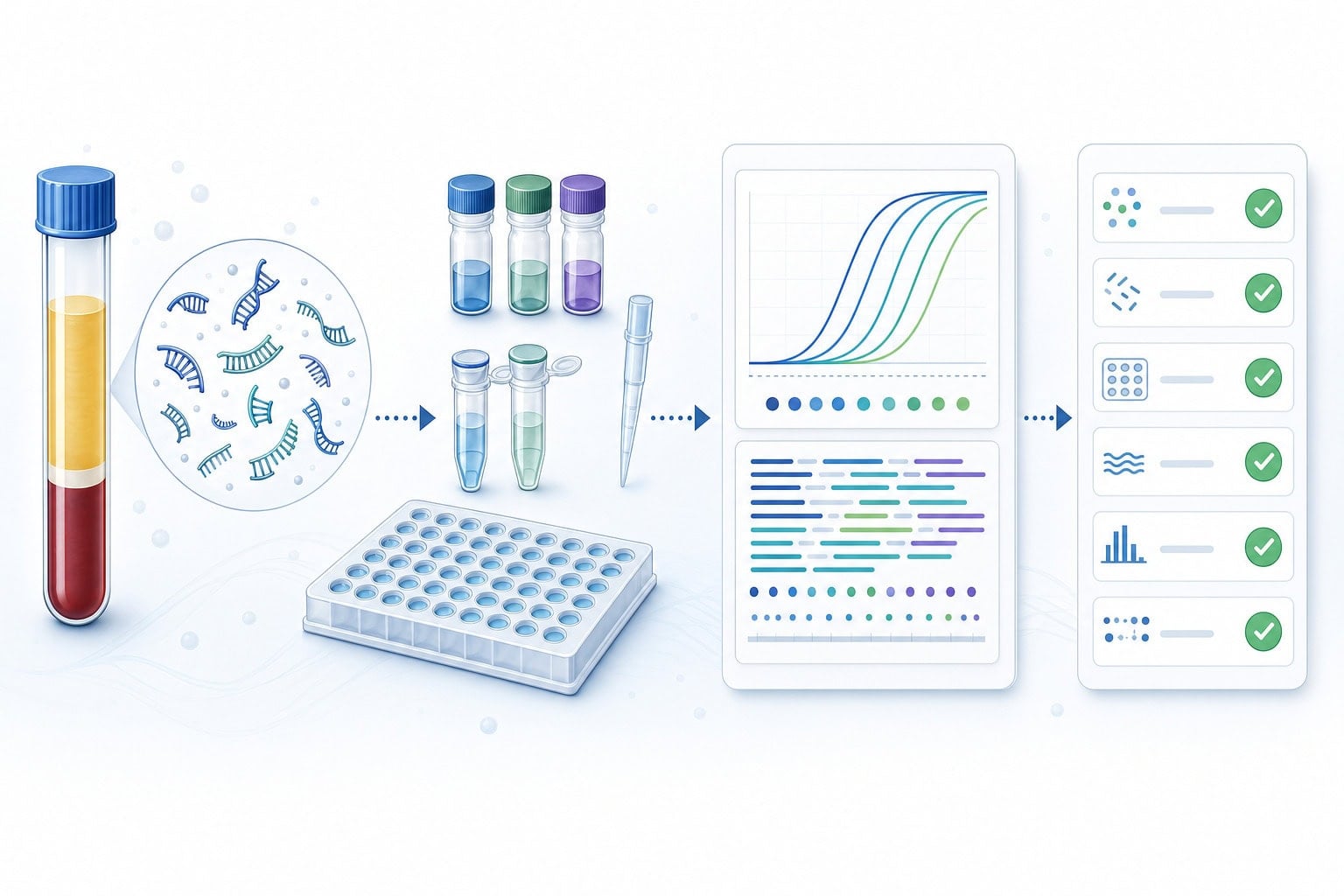
A strong cfDNA MRD testing program requires quality controls that match the risk profile of the assay. Developers should consider the following QC layers early in assay design:
- Input QC: plasma quality, hemolysis risk, cfDNA quantity, fragment profile, and extraction controls.
- Process controls: internal amplification controls, spike-ins, positive/negative controls, and contamination monitoring.
- Analytical sensitivity: limit of blank, limit of detection, linearity, repeatability, and reproducibility across lots.
- Multiplex performance: primer/probe balance, cross-reactivity, signal competition, and robustness across target ranges.
- Manufacturing QC: enzyme activity, purity, residual nuclease activity, stability, and release testing for OEM reagent lots.
Liquid biopsy MRD workflows need supplier and OEM alignment
As MRD assays move from research workflows toward routine clinical and commercial use, reagent suppliers must support more than catalog availability. Diagnostic developers often need:
| Workflow need | Supplier consideration |
|---|---|
| Low-input nucleic acid detection | High-performance enzymes and optimized buffers for sensitive amplification or library prep |
| Kit stability | Lyophilized or glycerol-free formulation options for transport and storage flexibility |
| Assay scale-up | Lot-to-lot consistency, documentation, and QC release support |
| Customized panels | OEM formulation, filling, packaging, and technical co-development |
| Regulated markets | Quality-system alignment such as ISO 13485, ISO 9001, and GMP-oriented manufacturing practices |
- Explore Biori IVD raw materials and molecular diagnostics reagent solutions
- Learn about Biori OEM and custom manufacturing services
- View Biori NGS library prep and sequencing reagent solutions
How Biori supports molecular diagnostics reagent development
Biori supports overseas customers developing molecular diagnostics and life-science assays with enzymes, PCR/qPCR reagents, NGS-related raw materials, OEM customization, and lyophilized or glycerol-free formulation options. For cfDNA and liquid biopsy workflows, Biori can help teams evaluate reagent performance, kit stability, and manufacturing consistency from early assay development through scale-up.
For adjacent biomanufacturing and mRNA programs, Biori also provides a complete portfolio of GMP-grade IVT raw materials for mRNA manufacturing, including key enzymes and workflow reagents, with OEM and customization support. This allows teams working across diagnostics, vaccines, and biopharma QC to coordinate reagent sourcing and quality expectations with one technical partner.
- View Biori GMP-grade IVT enzyme and mRNA workflow raw material solutions
- Explore Biori HCD/HCP product selection for biopharma QC
FAQ: cfDNA MRD testing reagents and assay development
What makes cfDNA MRD testing technically challenging?
The target signal can be fragmented, low-abundance, and affected by pre-analytical handling. Extraction efficiency, inhibitor carryover, PCR chemistry, library prep yield, and contamination control all influence assay performance.
Are PCR reagents still important if an MRD assay uses NGS?
Yes. Many workflows use PCR for library amplification, target enrichment, confirmation, control reactions, or QC checkpoints. Polymerase performance and buffer design can affect sensitivity and reproducibility.
Why consider lyophilized or glycerol-free reagents for diagnostic kits?
Lyophilized and glycerol-free formats can improve transport flexibility, room-temperature handling options, and kit integration. They are especially useful when developers need simplified workflows or consistent performance across distributed testing sites.
How can OEM support help molecular diagnostics developers?
OEM support can combine enzyme selection, buffer optimization, formulation, filling, packaging, documentation, and batch QC, helping developers move from proof-of-concept assays toward manufacturable diagnostic products.
References
- CareDx announces agreement to acquire Naveris
- HIT Consultant coverage of CareDx–Naveris precision oncology expansion
Discuss cfDNA MRD testing reagent needs with Biori
If your team is developing liquid biopsy, MRD, viral DNA surveillance, PCR/qPCR, or NGS-based molecular diagnostic assays, contact Biori to discuss raw materials, custom enzyme solutions, OEM reagent development, QC support, and lyophilized or glycerol-free formulations for international markets.