

Published by Zhuhai Biori Biotechnology Co., Ltd.
Why does that vial of nucleic acid detection reagent have to sit in a −20 °C freezer? Because it is fragile: enzymes are heat-sensitive, repeated freeze–thaw cycles inactivate them, and long-distance shipping without a cold chain can degrade the product. But the moment your reagent needs to reach hospitals in other cities, be listed overseas, or move through ambient-temperature logistics, the cold chain becomes a burden you cannot shake. Lyophilization (freeze-drying, in which ice sublimates directly under vacuum) offers a way out: turn the liquid into a dry powder that can be stored and shipped at room temperature, then reconstitute it with water before use. In this article, we walk through how BIORI takes an existing liquid PCR formulation — from reformulating the mix to pilot scale-up and commercial production — applicable to a wide range of nucleic acid reagents (qPCR, RT-qPCR, isothermal amplification, and more).
In short, lyophilization of existing liquid PCR formulations starts with the formulation: glycerol and other components that interfere with freeze-drying are replaced, and a protectant system is matched to the assay [1]. The freeze-drying cycle is then developed and verified in the final container, and the process is scaled up with surrogate and real material until performance and stability are reproduced before it is locked for commercial production. Lyophilized samples with an optimized cycle are typically available within 4–8 weeks [2].
Key Takeaways
- Most liquid master mixes cannot be freeze-dried as they are: glycerol and other freeze-drying-incompatible components must first be replaced with a lyophilization-friendly system [1].
- A lyophilization cycle runs in three stages: freezing (about −40 °C), primary drying (about 100 mTorr) and secondary drying, and residual moisture is then checked by Karl Fischer titration [1].
- Scale-up starts with roughly 90% surrogate + 10% real material and increases the share of real material until performance and stability are reproduced; only then is the process locked.
- In BIORI internal data, two lyophilized four-plex assays (FM2181-4, DNA; FM5144, RNA) stored for 18 months at room temperature kept the target channels within ΔCt ≤ 1 of the same-batch liquid control.
- There is no minimum order quantity. Routine production batches take 3–7 days of freeze-dryer program run time — this covers only the equipment cycle, not the total lead time from inquiry to delivery, and a bead batch can reach 300,000 beads [2].
qPCR Lyophilization Development: Making the Liquid Formulation Freeze-Dry-Ready
For a reagent to be lyophilizable, the formulation itself must first qualify: it cannot contain glycerol or other components that depress the freezing point and interfere with freezing and drying [1]; the buffer system must withstand freezing and drying (avoid volatile salts and excessively high ionic strength), with pH inside a stability window; and it needs built-in protection — sugars (trehalose, sucrose) shield enzymes and nucleic acids against ice crystals and drying stress, aptamers act as a “temperature switch” that locks enzyme activity, and residual moisture in the finished product must be low enough that performance is retained after reconstitution. The first step in converting a liquid to a lyophilized format is therefore a formulation “check-up” and component swap: replace glycerol and other unfriendly ingredients with a lyophilization-friendly system.
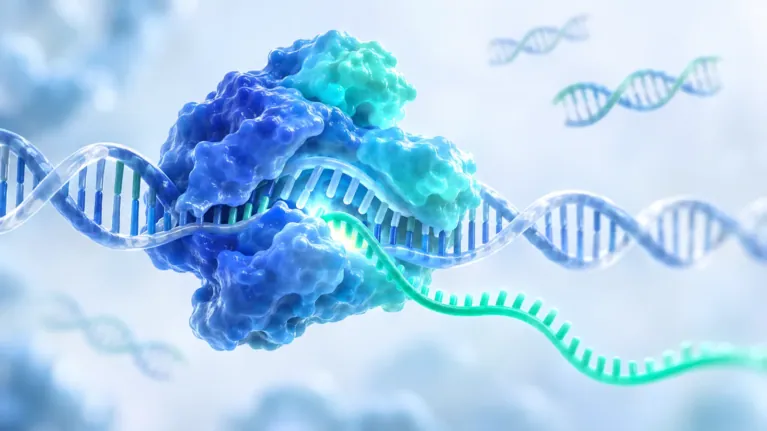
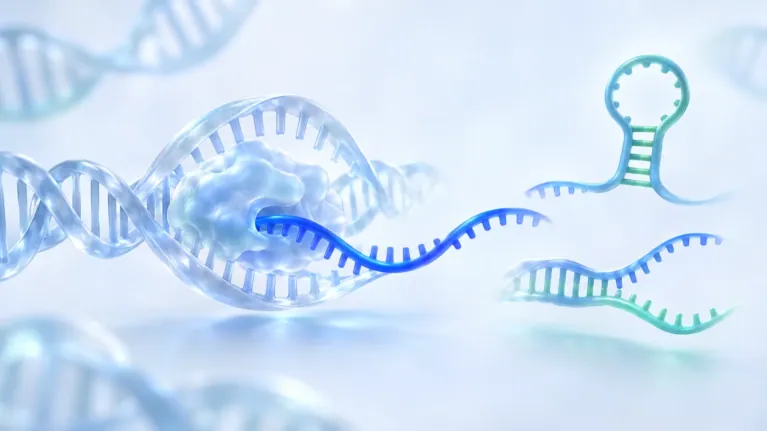
We also introduce a “temperature switch” — a nucleic acid molecule called an aptamer. Like a lock, it holds the activity of key enzymes (e.g., reverse transcriptase, DNA polymerase) firmly in check at ordinary temperatures and releases it only at a specific temperature [1]. This means aliquoting and lyophilization at room temperature will not let the enzymes start working prematurely; activity stays locked — applicable to qPCR, RT-qPCR, and more.
Protectants do most of the work in lyophilization. The most common are sugars such as trehalose and sucrose. Sugars wrap around enzymes and nucleic acids during freezing and drying, shielding them from ice-crystal damage and desiccation stress [3][4]; combined with polymers, bulking agents and an appropriate buffer system, they form a close-fitting protective shell (for more protectant options, see the AcuGenix™ Lyophilization Protectant-9 product page).
The final hurdle is residual moisture: secondary drying brings residual water down to a very low level, which is then measured by Karl Fischer titration [1] against product-specific, agreed release limits to ensure performance is preserved after reconstitution.
How to Lyophilize a qPCR Master Mix: Freezing, Primary and Secondary Drying
A lyophilization cycle has three stages. First, freezing: the sample is frozen to about −40 °C [1] (a typical setpoint range of roughly −30 to −50 °C, determined by the formulation and equipment) to form ice. Then primary drying: at a low pressure of about 100 mTorr [1] (≈0.13 mbar; typical range 50–200 mTorr, adjusted to the formulation and equipment), the ice sublimates directly into water vapor and is pumped away — this is the longest stage, and we use a pressure-rise test to confirm that no ice remains. Finally, secondary drying: a modest temperature increase drives off the bound water still attached to the matrix.
Packaging Lyophilized PCR Reagents: Vacuum-Sealed Aluminum Foil Pouches
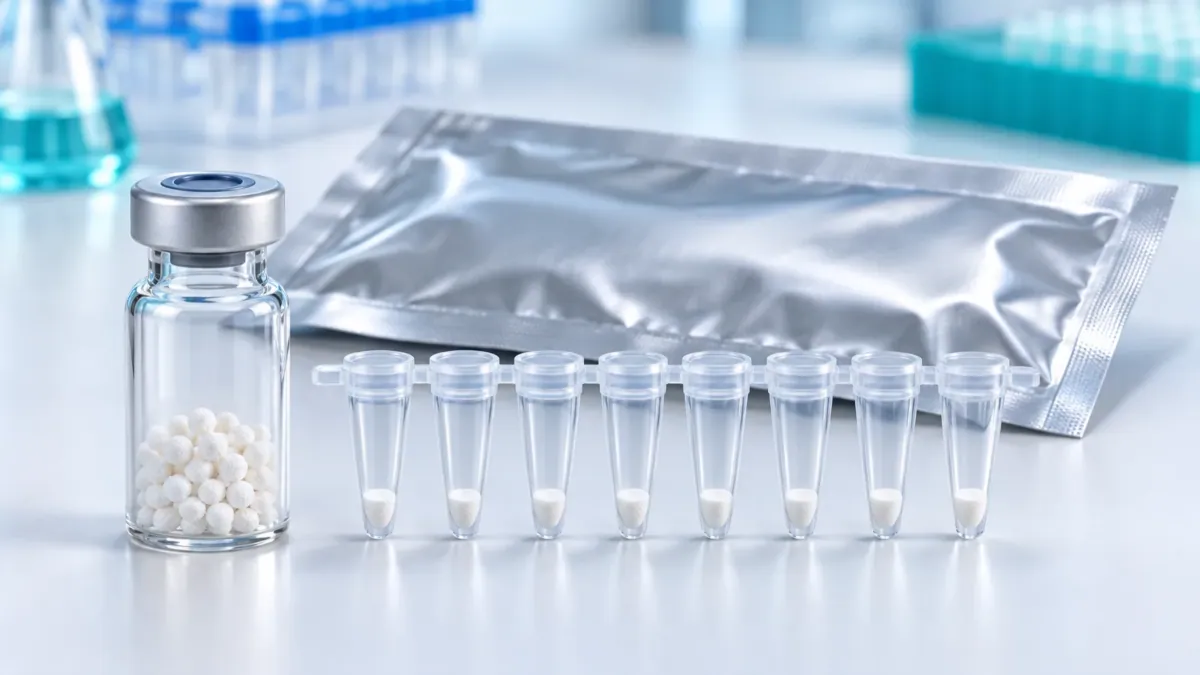
Even lyophilized powder is sensitive to moisture and oxygen, so packaging is the last barrier worth getting right. Before the lyophilized samples are removed from the chamber, the ambient humidity must be kept below 10%; they are then sealed according to format — whether in a glass vial with a stopper or in plastic carriers such as 8-strip tubes or EP tubes, we normally supply matched aluminum foil pouches and vacuum-seal them with a vacuum packaging machine.
Aluminum foil pouches offer excellent barriers to water vapor and oxygen; removing the air inside adds another moisture- and oxygen-proof lock around the powder. Even for glass vials that already seal well, this extra vacuum foil pouch further reduces the risk of moisture uptake and oxidation during long-distance shipping and long-term storage.
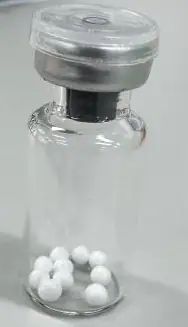
Available formats: lyophilized beads (standard 25 μL beads, 3.0–3.4 mm; custom 10–40 μL), in-situ lyophilization in 8-strip tubes, in 96-well plates, in vials, in EP tubes, and cartridges / custom consumables [2].
Lyophilization Scale-Up From Pilot to Production
Producing one good lyophilized cake at bench scale is easy; the hard part is batch-to-batch consistency and scale-up without surprises (de-risking). For scale-up we first run and optimize the lyophilization program with roughly 90% surrogate material + 10% real material and validate it, then progressively increase the proportion of real material until performance and stability are reproduced. Only then do we lock the process and move to commercial production.
Lyophilization capacity by workshop and format (T = tests):
| Workshop | Lyophilization format | Batch capacity | Weekly capacity |
|---|---|---|---|
| Standard lyophilization workshop | In-situ, 8-strip tubes | 5,200 T | 21,000 T |
| Standard lyophilization workshop | Lyophilized beads | 60,000 T | 120,000 T |
| GMP lyophilization workshop | In-situ, 8-strip tubes | 22,000 T | 44,000 T |
| GMP lyophilization workshop | Lyophilized beads | 300,000 T | 600,000 T |
There is no minimum order quantity (MOQ), and routine production batches have a 3–7 day production turnaround [2].
Custom development follows these 6 steps:
| Step | Customer provides | What we do | Deliverables | Duration (approx.) |
|---|---|---|---|---|
| Requirements review | Application scenario, technical specifications, dosage form / format / stability requirements | In-depth discussion of the customer’s application and technical targets; define the lyophilized dosage form, specifications and stability requirements | Requirements specification / project plan / quotation | 3–5 days |
| Reagent matching and optimization | Complete liquid formulation (components, concentrations, pH) | Match and optimize reagents to customer needs; screen a suitable lyophilization protectant system to preserve the structural integrity of active components during dehydration | Lyophilization-friendly formulation / protectant scheme | 14–21 days |
| Lyophilization process development | Final container information | Develop the lyophilization process based on the formulation by tuning key parameters — freezing, primary (sublimation) drying and secondary (desorption) drying — and build the lyophilization curve as a solid foundation for subsequent performance verification | Lyophilization curve + bench-scale samples | 28 days |
| Lyophilized sample performance verification | Performance, moisture, appearance and stability targets (acceptance criteria) | Comprehensive performance evaluation of lyophilized samples, including moisture content, amplification efficiency, sensitivity and stability | QC and stability report | 14–21 days |
| Lyophilization scale-up verification | Pilot batch size and site | Repeated scale-up runs with surrogate + real material to confirm an industrial lyophilization process; production-scale runs with real material, plus performance and stability verification, reconfirm process reproducibility | Commercial process and release specifications | 21–28 days |
| Batch production | Order and production site | Batch production with batch-to-batch consistency control | Commercial lyophilized product | 14–21 days |
Performance Verification: Does Lyophilization Really Leave Performance Unchanged?
The lyophilization process applies to all types of nucleic acid detection reagents. We let the data speak: all amplification curves below come from real BIORI projects (BIORI internal data).
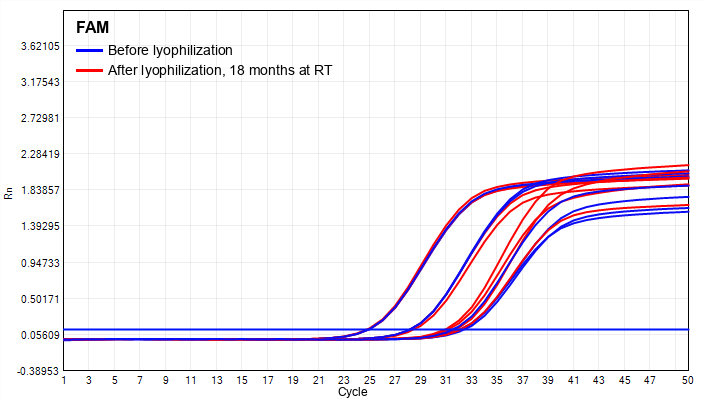
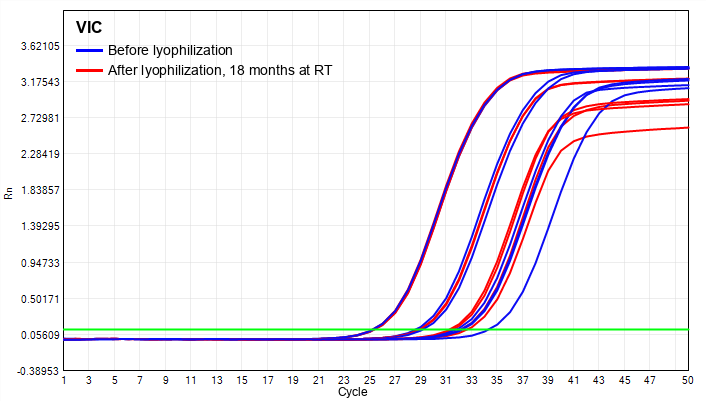
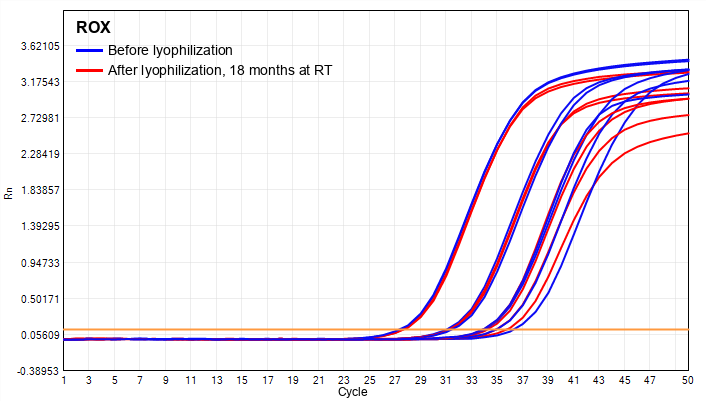
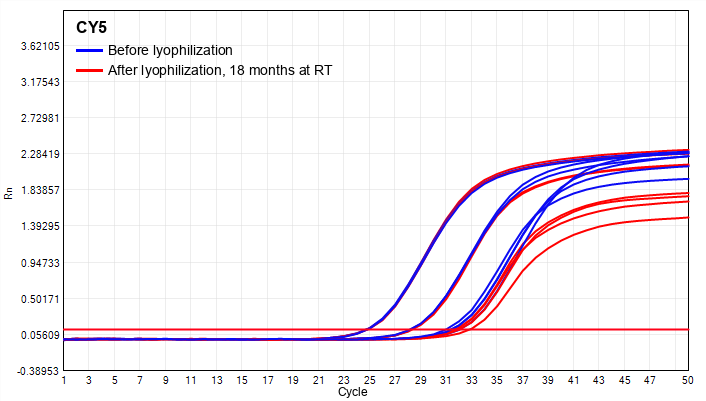
1. Amplification performance of lyophilized reagents: after 18 months of storage at room temperature, BIORI’s lyophilized reagents (DNA assay) still show stable amplification performance, with ΔCt ≤ 1 and ΔRn ≤ 15% versus the liquid control from the same batch.
◇ Experimental conditions:
| Cat. No. | FM2181-4 | Assay | Four-plex human genomic DNA assay |
| Template | Purified human genomic DNA template | Template concentration | 2.5, 25, 250 pg/μL |
| Cycling program | 50 °C 2 min; 95 °C 5 min; 50 cycles (95 °C 10 s, 55 °C 40 s) | ||
Note: the control was freshly prepared liquid reagent from the same batch as the lyophilized reagent. After unloading, the lyophilized reagent was vacuum-packed in aluminum foil pouches and stored at room temperature for 18 months.
◇ Sample images:
◇ Amplification curves:
18 months at room temperature ▼
◇ Ct and Rn statistics:
| Group | Template concentration (pg/μL) | FAM channel | VIC channel | ROX channel | CY5 channel | ||||
|---|---|---|---|---|---|---|---|---|---|
| Ct value | Rn value | Ct value | Rn value | Ct value | Rn value | Ct value | Rn value | ||
| Before lyophilization | 2.5 | 32.04 | 1.72 | 32.63 | 3.06 | 34.78 | 3.21 | 31.45 | 2.10 |
| 25 | 28.16 | 2.07 | 28.88 | 3.35 | 31.24 | 3.34 | 28.19 | 2.29 | |
| 250 | 24.93 | 2.00 | 25.30 | 3.37 | 27.40 | 3.45 | 24.77 | 2.31 | |
| After lyophilization, 18 months at room temperature | 2.5 | 31.48 | 1.95 | 31.88 | 2.86 | 34.69 | 2.82 | 32.06 | 1.80 |
| 25 | 28.29 | 1.95 | 28.91 | 3.22 | 31.27 | 3.07 | 28.27 | 2.16 | |
| 250 | 24.84 | 2.01 | 25.30 | 3.35 | 27.63 | 3.31 | 24.80 | 2.32 | |
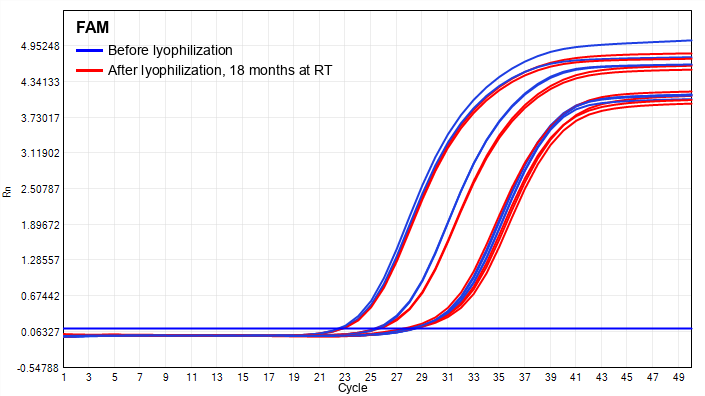
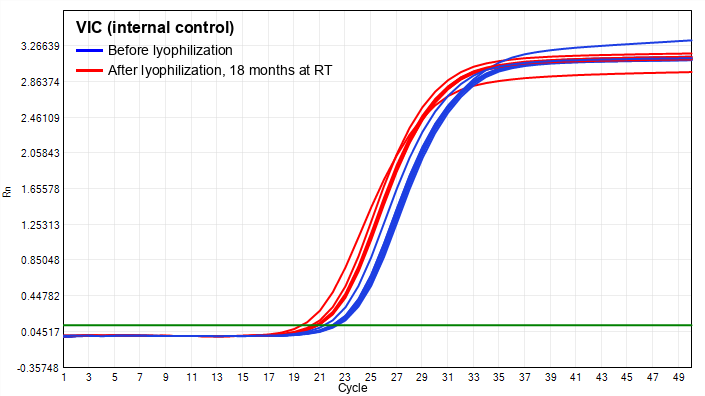
2. Amplification performance of lyophilized reagents: after 18 months of storage at room temperature, BIORI’s lyophilized reagents (RNA assay) still show stable amplification performance, with ΔCt ≤ 1 and ΔRn ≤ 10% versus the liquid control from the same batch (the VIC channel is an internal control and is analyzed qualitatively only).
◇ Experimental conditions:
| Cat. No. | FM5144 | Assay | Four-plex respiratory pathogen assay |
| Template | Purified respiratory specimen template | Template concentration | 235, 23.5, 2.35 copies/μL |
| Cycling program | 50 °C 15 min; 95 °C 1 min; 50 cycles (95 °C 15 s, 56 °C 45 s) | ||
Note: the control was freshly prepared liquid reagent from the same batch as the lyophilized reagent. After unloading, the lyophilized reagent was vacuum-packed in aluminum foil pouches and stored at room temperature for 18 months.
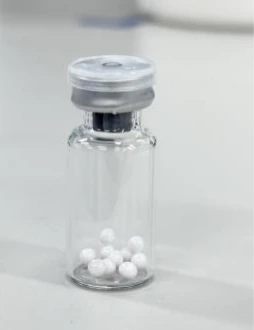
◇ Sample images:
◇ Amplification curves:
18 months at room temperature ▼
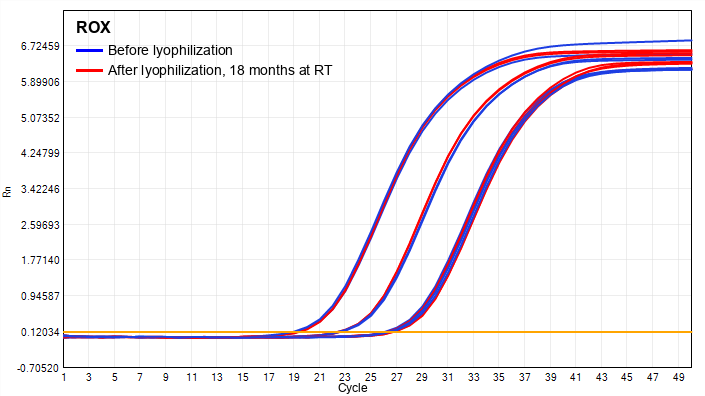
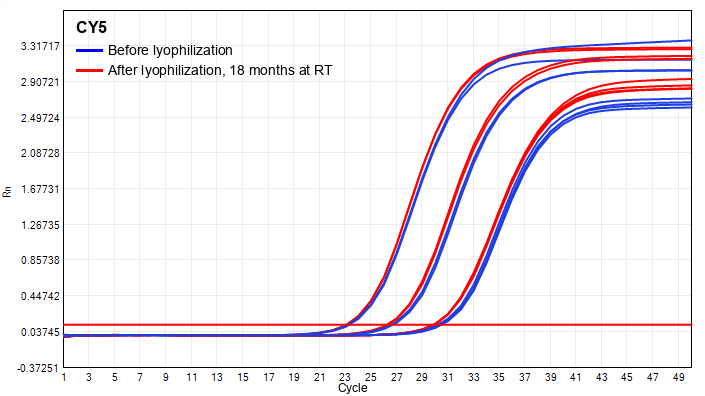
◇ Ct and Rn statistics:
| Group | Template concentration (copies/μL) | FAM channel | VIC channel | ROX channel | CY5 channel | ||||
|---|---|---|---|---|---|---|---|---|---|
| Ct value | Rn value | Ct value | Rn value | Ct value | Rn value | Ct value | Rn value | ||
| Before lyophilization | 2.35 | 28.26 | 4.10 | 22.02 | 3.15 | 26.27 | 6.20 | 30.35 | 2.67 |
| 23.5 | 25.35 | 4.64 | 22.46 | 6.44 | 26.60 | 3.04 | |||
| 235 | 22.56 | 4.91 | 19.06 | 6.70 | 23.22 | 3.27 | |||
| After lyophilization, 18 months at room temperature | 2.35 | 27.98 | 4.07 | 20.57 | 3.12 | 26.48 | 6.31 | 29.89 | 2.87 |
| 23.5 | 25.47 | 4.59 | 22.45 | 6.54 | 26.25 | 3.19 | |||
| 235 | 22.66 | 4.79 | 19.28 | 6.62 | 23.09 | 3.29 | |||
What You Receive at the End of the Workflow
Run the whole workflow and what you receive is a lyophilized powder that can be stored and shipped at room temperature — just reconstitute it and load it straight onto the instrument. If your project is stuck on “can this liquid actually be lyophilized, how long will it take, and what exactly gets delivered”, we invite you to request a free feasibility assessment: this formulation-to-production roadmap is the framework we use to evaluate feasibility.
Frequently Asked Questions (FAQ)
What do I need to provide for a nucleic acid reagent lyophilization feasibility study?
To assess feasibility, we need your microbial residue testing requirements and acceptance criteria, instructions for use of the primers/probes and template, the amplification protocol and the instruments used, assay/detection acceptance criteria, your desired lyophilization format, the lyophilization consumables and aliquoting/dispensing method, packaging specification requirements including aluminum foil pouch specifications, and the target lyophilization volume. The more complete the information, the faster the assessment.
How long does a PCR / DNA lyophilization development project take?
Optimized lyophilized samples are typically available within 4–8 weeks; if pilot scale-up and verification are included, the timeline depends on complexity.
Does a successful pilot batch guarantee production-scale performance?
Not automatically. Scale-up verification is required — repeated runs with surrogate and real material until performance and stability are reproduced and the process is locked; only then is commercial production reliable.
Can a glycerol-containing PCR master mix be lyophilized?
Yes, but glycerol and other components that interfere with lyophilization must first be replaced with a lyophilization-compatible system, followed by matching a suitable lyoprotectant before lyophilization.
Why Choose BIORI
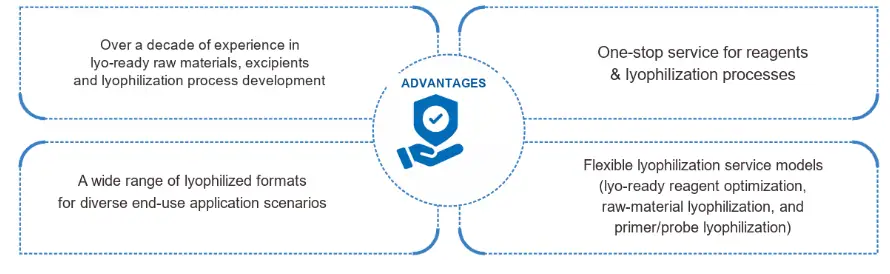
More than a decade of experience in lyo-ready raw materials, lyophilization excipients and lyophilization process development, combined with one-stop reagent + lyophilization process services, a wide range of lyophilized formats and flexible collaboration models, allows BIORI to make the “liquid formulation → room-temperature powder” route work in practice.
References
- Lee MA, Chiu SG, Lee DR, Nichols NM. Key considerations for optimal lyophilized reagent development (white paper, v2.0). New England Biolabs; 2022.
- BIORI. Lyophilization Service for Molecular Diagnostics.
- Wang W. Lyophilization and development of solid protein pharmaceuticals. Int J Pharm. 2000;203(1–2):1–60. doi:10.1016/S0378-5173(00)00423-3
- Jain NK, Roy I. Effect of trehalose on protein structure. Protein Sci. 2009;18(1):24–36. doi:10.1002/pro.3
Disclaimer: BIORI lyo-ready reagents and lyophilization services are for further manufacturing use only.