

Published by Zhuhai Biori Biotechnology Co., Ltd.
mRNA functions in vivo as a single-stranded molecule carrying the information for protein expression. Currently, the bulk mRNA drug substance in mRNA vaccines and therapeutics is typically produced via in vitro transcription (IVT) using a double-stranded DNA template. In this process, double-stranded RNA (dsRNA) represents the most critical process-related impurity. dsRNA is a critical concern for mRNA vaccines and therapeutics because it directly threatens both product safety and efficacy. As a major byproduct of IVT, dsRNA can be recognized by pattern recognition receptors (PRRs) such as MDA5 and RIG-I, activating the innate immune system and triggering inflammatory responses [1], while also inhibiting mRNA translation efficiency and compromising drug efficacy. Consequently, it is a critical quality attribute (CQA) explicitly required to be controlled by regulatory agencies.
Key takeaways
- Modified nucleotides cannot replace physical removal; PKR pathway recognition of dsRNA is unaffected by modifications: While m1Ψ can reduce some immunogenicity, it cannot block PKR’s recognition of the dsRNA duplex structure or the resulting translational blockade. The use of modified nucleotides should not serve as a rationale for relaxing purification standards. dsRNA residues should be controlled as an independent CQA, and functional readouts such as PKR phosphorylation/eIF2α inhibition should be introduced early in process development to quantitatively assess the actual impact of residual dsRNA on translation efficiency [2].
- Upstream enzyme engineering is the preferred lever; downstream purification should only serve as a “safety net”: Because the physicochemical properties of dsRNA and mRNA are highly similar, complete separation via downstream purification is extremely difficult. T7 RNAP mutants (e.g., M183E + I210V, which achieves >99% elimination, and M17, etc.) represent the most effective upstream intervention currently available. First, identify the dominant pathway, then select the matching mutant (e.g., G47W for DNA end-initiation, M17 for RNA-dependent extension). The role of downstream purification should be downgraded from “primary removal” to “polishing and batch-to-batch consistency assurance” [3].
- No unified regulatory limits exist; sponsors must “prove their own case”: EMA requires dsRNA control and the use of reference standards but does not set a unified numerical threshold. Control strategies must be proactively justified by the sponsor based on product-specific risks. At the IND/CTA stage, a three-part evidence chain consisting of “method validation + representative batch data + functional attribution” should be established. Internal control standards should be based on actual process capabilities, with buffer space reserved for stricter future regulatory requirements [4].
- A “passing” total amount does not equal controllable risk; short dsRNA fragments are a testing blind spot: Conventional J2 antibodies cannot detect fragments <40 bp, yet short fragments of >15 bp are sufficient to activate receptors such as OAS. A “passing” test result may mask true risks of immune activation. Testing should be upgraded from a “total amount determination” to a three-dimensional evidence system of “total amount + length distribution characterization (e.g., immuno-northern blot) + functional attribution (e.g., innate immune reporter cell activation profile)” [5][6].
The principal source of dsRNA in IVT is T7 RNA polymerase (T7 RNAP) itself, which generates it through three distinct pathways.
1. Three origins of dsRNA during IVT and the corresponding process controls
1.1 Cryptic promoters antisense transcription
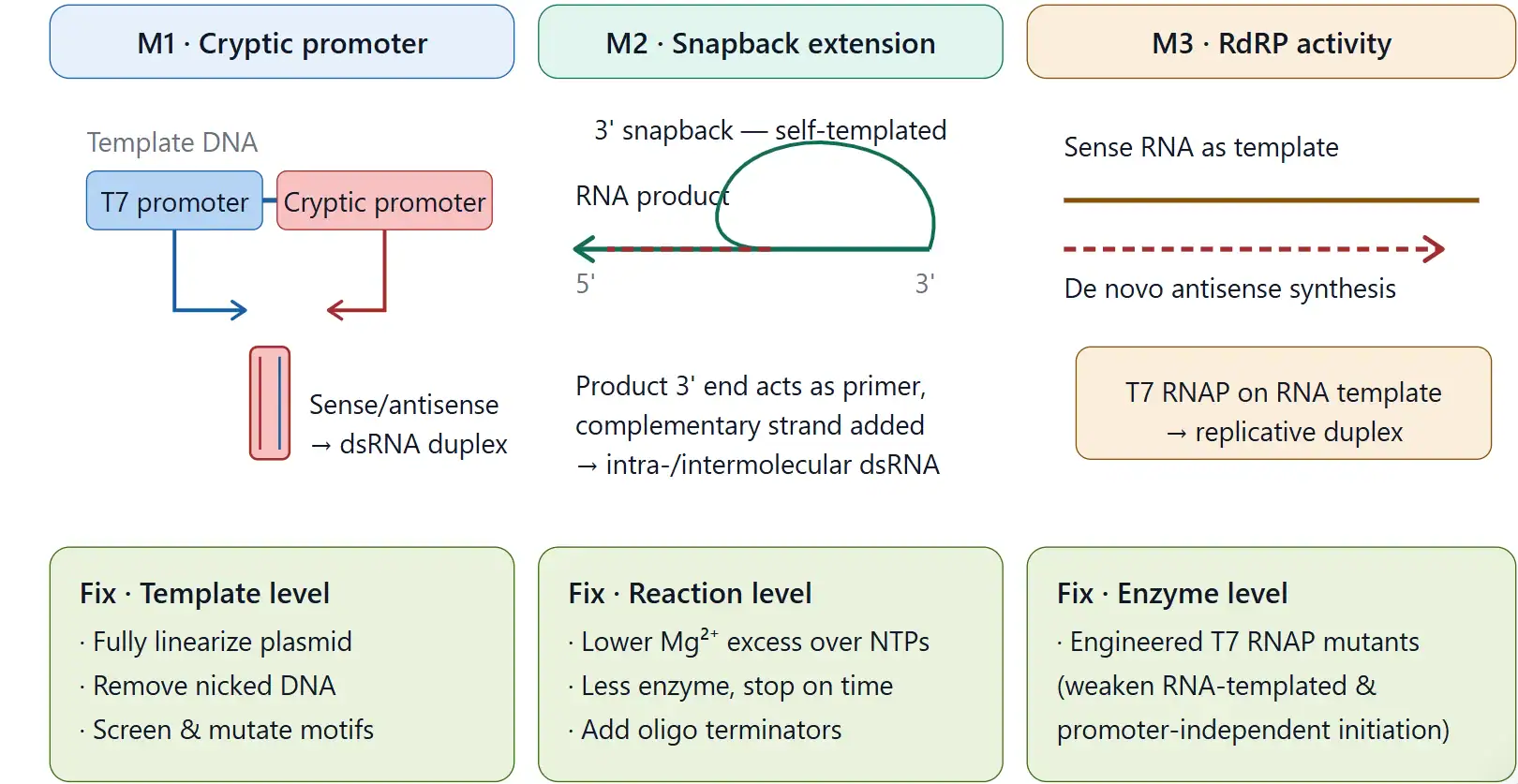
T7 RNAP directly initiates transcription at the free ends of linear DNA lacking a T7 promoter, generating an antisense strand complementary to the sense RNA that anneals to form full-length dsRNA. The core motif of the T7 promoter requires only partial sequence similarity to initiate transcription at low efficiency, especially for CTP-rich segments (such as φ2.5-like/class II promoters)[7]. When linearization is incomplete, or when nicked or residual supercoiled plasmid remains, T7 RNAP may initiate at non-target sites and generate antisense RNA that hybridizes with the sense transcript to form long dsRNA duplexes.
Process control: Fully linearize the template DNA with a restriction enzyme and confirm complete linearization as a single band by agarose gel electrophoresis; establish chromatographic purification steps for both plasmid DNA and the linearized template to remove nicked species; apply bioinformatic screening for cryptic T7 promoter-like motifs within the target sequence and optimize the sequence accordingly.
1.2 Self-templated 3′ snapback extension of the RNA product
After run-off transcription, the free 3′ end of the RNA product may fold back on itself and act as both primer and template, directing T7 RNAP to extend a complementary strand and generate hairpin-like dsRNA extensions; the same reaction can occur intermolecularly when the 3′ ends of two RNA molecules prime each other. Excess Mg²⁺, elevated enzyme concentration, and prolonged reaction times all exacerbate this process[8].
Process control: Optimize the IVT formulation for each individual sequence — Mg²⁺ concentration and counter-ion species, NTP molar ratios, reaction time, and enzyme loading — to define conditions that suppress 3′ snapback extension at its source.
1.3 RNA-dependent RNA polymerase (RdRP) activity of T7 RNAP
T7 RNAP can extend using DNA as a template, and it can also synthesize a complementary strand using RNA as a template — using the sense product RNA as a template to synthesize an antisense transcript and forming a double-stranded complex. This activity is sensitive to template structure and is sequence-dependent (C-rich sequences are more susceptible).
Process control: RdRP activity is the most difficult of the three mechanisms to eliminate through process engineering alone; polymerase engineering is the most effective approach. Recently reported active-site T7 RNAP mutants (which attenuate RNA template binding and de novo initiation activity) exhibit a 10-fold increase in catalytic efficiency and an approximately 10-fold reduction in dsRNA by-product yield at 37°C, while essentially retaining DNA-templated transcription activity.[9]
| Source | Mechanism | Contributing factors | Control strategy |
|---|---|---|---|
| Cryptic promoters on the template DNA drive antisense transcription | A core T7 promoter motif that is only partially matched is sufficient to support inefficient initiation; T7 RNAP initiates at non-target sites and transcribes antisense RNA, which then hybridizes with the sense strand to form long dsRNA. | T7 promoter-like / CTP-rich segments (e.g., φ2.5-like/class II); incomplete plasmid linearization; nicked DNA; residual supercoiled plasmid | Template: fully linearize the template with a restriction enzyme Purification: chromatographic purification of the plasmid and of the linearized template Sequence: optimize the sequence |
| 3′ fold-back extension (snapback) of the product RNA | After run-off transcription, the free 3′ end of the RNA product folds back and, acting as both primer and template, is extended by T7 RNAP to synthesize a complementary sequence, generating hairpin-like dsRNA extensions; this can also occur between two RNA molecules, whose 3′ ends prime each other. | Excess Mg²⁺; excessive enzyme concentration; prolonged reaction time | Optimize Mg²⁺ concentration, counter-ion species, NTP molar ratio, reaction time and enzyme loading |
| RNA-dependent RNA polymerase (RdRP) activity of T7 RNAP | T7 RNAP can not only extend on a DNA template but also initiate de novo synthesis of a complementary strand on an RNA template, copying the sense product RNA into antisense RNA and forming a double-stranded complex. | Sensitive to template structure; sequence-dependent, with C-rich sequences more prone to occur | Engineering of T7 RNAP mutants |
2. Downstream control strategies
Chromatographic removal exploits the differences in binding affinity between dsRNA and mRNA using cellulose-based media, ion-pair reversed-phase HPLC (IP-RP HPLC), or hydrophobic interaction chromatography (HIC).
Release testing: Quantify dsRNA by J2 antibody dot blot/ELISA[5], complemented by immunoblotting.
Priority guidance: (1) template quality, (2) reaction conditions, (3) engineered polymerase. Typically, the combination of these three approaches can reduce dsRNA to some extent, with chromatographic purification serving as an additional process safeguard.
3. BIORI Biotech’s integrated solutions for dsRNA control
3.1 T7 RNA Polymerase 3.0 (Cat. No. BP-E11) — engineered to minimize dsRNA at the source
T7 RNA Polymerase 3.0 (Cat. No. BP-E11; hereafter T7 RNAP 3.0), developed in-house by BIORI Biotech, is produced by recombinant expression in E. coli from a mutated gene encoding T7 RNA polymerase. It is a DNA-dependent 5’→3′ RNA polymerase that specifically recognizes the T7 promoter sequence. Compared with wild-type others, T7 RNAP 3.0 efficiently transcribes templates of varying lengths and characteristics while substantially reducing dsRNA by-products.
3.1.1 Performance validation I: strong transcriptional driving force, low magnesium dependence
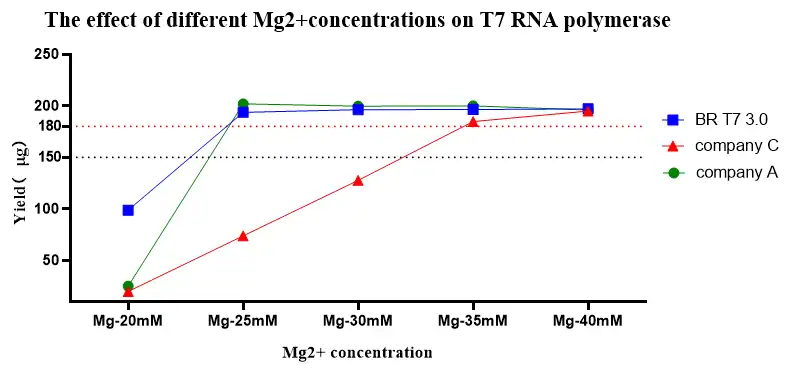
At reduced Mg²⁺ concentrations (Mg²⁺=20mM), T7 RNAP 3.0 retains robust transcriptional output, demonstrating markedly lower magnesium dependence than the competitor products (Figure 2).
3.1.2 Performance validation II: broad template compatibility
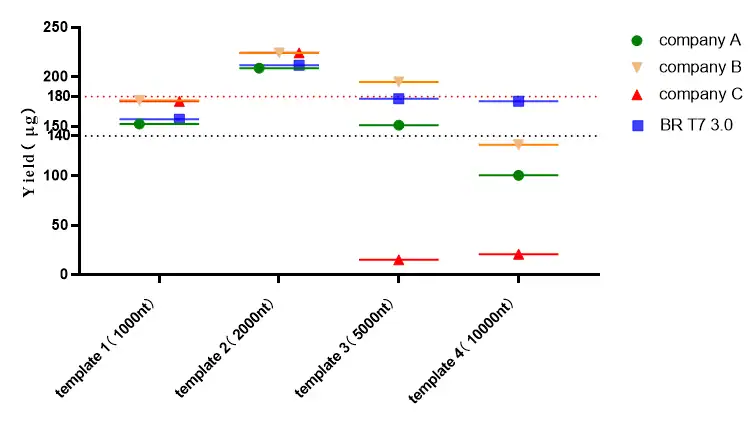
Across linearized templates of different types and lengths (1,000–10,000 nt). Under identical IVT reaction conditions, T7 RNAP 3.0 consistently delivered high product yields (Figure 3).
3.1.3 Performance validation III: high yield, low dsRNA content
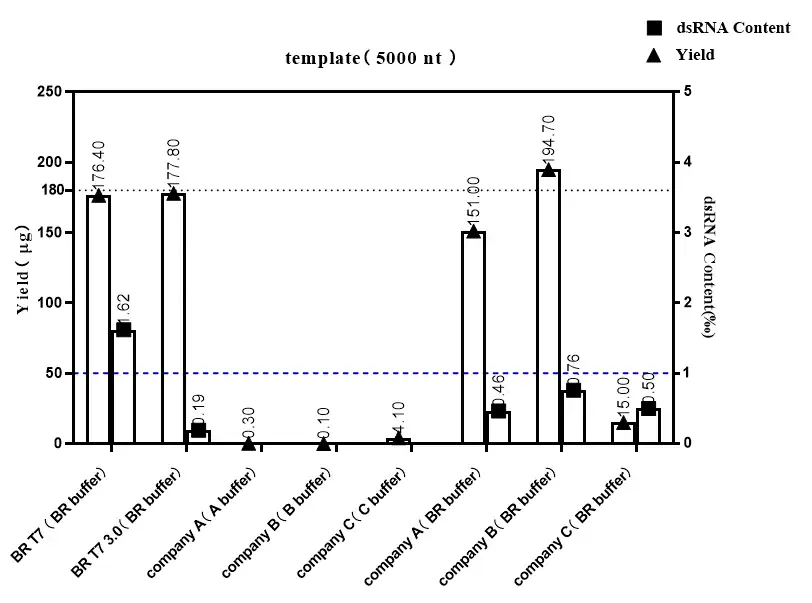
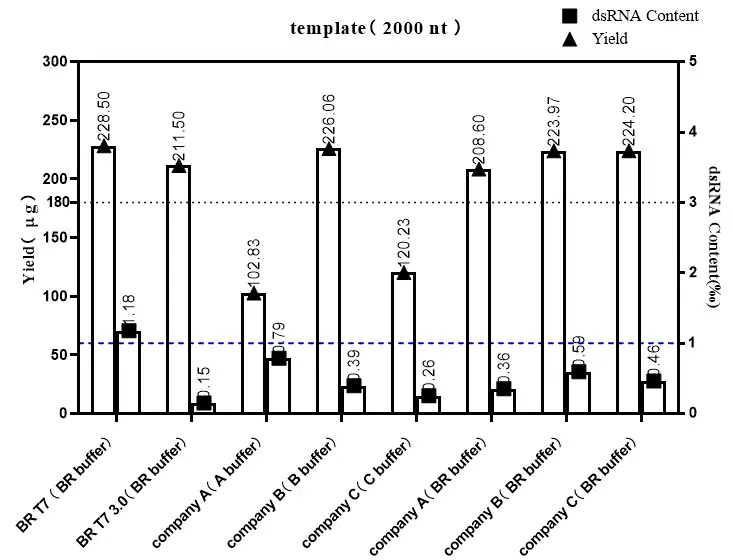
On both 2,000-nt and 5,000-nt linearized templates, T7 RNAP 3.0 achieved efficient transcription with substantially lower dsRNA content: a 7.9- to 8.5-fold reduction (1.18‰ to 0.15‰ on 2,000 nt; 1.62‰ to 0.19‰ on 5,000 nt) relative to wild-type T7 RNA polymerase (BP-E01), and a clear advantage in dsRNA control over T7 mutants from other suppliers (Figures 4 and 5).
3.2 dsRNA Residue Quantification ELISA Kit (2.0) — precise monitoring of dsRNA throughout the manufacturing process
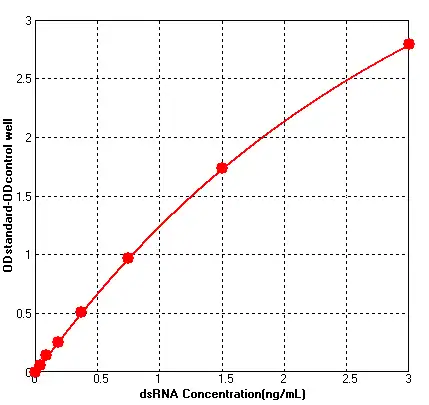
The dsRNA Residue Quantification ELISA Kit (2.0), developed independently by BIORI Biotech, employs a double-antibody sandwich ELISA for the quantification of dsRNA in IVT reaction mixtures and mRNA drug substance. The calibration range is 0.046875–3 ng/mL, with a detection limit of 0.046875 ng/mL.
3.2.1 Calibration curve
The standard curve comprises seven concentration points, run according to the kit instructions; absorbance values at each concentration are averaged and fitted with a four-parameter logistic (4PL) model. The calibration range of the kit is 0.046875–3 ng/mL, with R² ≥ 0.99 (Figure 6).
3.2.2 Spike recovery
Recovery was assessed using kit-compatible samples spiked with dsRNA standards at high, medium, and low concentration levels, with at least six replicates per level. Recoveries at the three levels were 86.09%, 86.86%, and 95.25%, respectively; relative deviations of the measured concentrations were all ≤15%, and recoveries met the acceptance criterion of 80–120%. All results passed (Table 2).
| Parameter | Sample 1 | Sample 2 | Sample 3 |
|---|---|---|---|
| Theoretical dsRNA concentration of sample (ng/mL) | 0.2209 | 0.2209 | 0.2209 |
| Concentration of spiked standard (ng/mL) | 1.5 | 0.375 | 0.09375 |
| Measured concentration after spiking (ng/mL) — mean | 1.5122 | 0.5466 | 0.3102 |
| Relative deviation | 12.1% | 8.3% | 1.3% |
| Recovery | 86.09% | 86.86% | 95.25% |
| Acceptance criteria | Relative deviation ≤15%; recovery 80–120% | Relative deviation ≤15%; recovery 80–120% | Relative deviation ≤15%; recovery 80–120% |
| Result | Pass | Pass | Pass |
4. Conclusion: From raw materials to QC — BIORI Biotech supports you all the way
BIORI Biotech has been deeply engaged in the mRNA field for years, with a systematically established portfolio of mRNA raw materials and QC products. On the raw-material side, the portfolio spans restriction endonucleases, transcription enzymes, and other reagents: over 100 restriction endonucleases have been developed and manufactured in-house, with GMP-grade supply available for the 20 endonucleases most commonly used in pharmaceutical processes. The complete transcription enzyme portfolio is manufactured under GMP conditions. Core enzyme reagents — including T7 RNA polymerase (DMF filing number: 038850), and RNaseR (DMF filing number: 038849) — have completed Drug Master File (DMF) filings, providing direct support for customers’ regulatory submissions. On the QC side, BIORI Biotech pioneered the standardization of analytical workflows into ready-to-use kits, such as the capping-efficiency sample-preparation kit and the poly(A) tail distribution sample-preparation kit, complemented by the dsRNA residue quantification kit, RNA integrity kit, RNA Ladder, and residual nucleic acid/protein detection products — supporting customer programs from development through manufacturing to regulatory filing.
FAQ
What are the sources of dsRNA in in vitro transcription (IVT)?
Three main sources: First, promoter-independent antisense transcription from promoter-less DNA termini (the dominant source of full-length dsRNA[2]); second, RNA-dependent 3′ end addition (snapback/RdRP extension, typically initiated by terminal transferase activity); third, the RNA-dependent RNA polymerase (RdRP) activity of T7 RNAP (generating antisense RNA using the sense product RNA as a template). Their relative contributions depend on template design and IVT conditions.
Does the end of a linearized DNA template affect dsRNA formation?
Yes, the ends of a linearized DNA template significantly affect dsRNA formation. This is primarily because T7 RNA polymerase (T7 RNAP) can erroneously initiate transcription at DNA ends in a “promoter-independent” manner, and the structural features of the ends directly determine the likelihood of such errors.
Do SP6 and other phage RNA polymerases also make dsRNA?
SP6 and T7 belong to the same family of single-subunit viral RNA polymerases, retaining similar RNA-dependent RNA polymerase activity and promoter-independent transcription ability[10]. Therefore, the dsRNA problem also exists.
References
- Liu X, Hu C, He Q, et al. Research progress on immune mechanism and control strategy of dsRNA impurities in mRNA vaccine[J]. Expert Review of Vaccines, 2025, 24(1).
- Szymanek W, Pastucha A, Bausch A R, et al. Effective recognition of double-stranded RNA does not require activation of cellular inflammation[J]. Science Advances, 2025, 11(15):eads6498-eads6498.
- He W, Xi J, Wu X P, et al. Minimizing dsRNA impurity generation through structure–function-guided directed evolution of T7 RNA polymerase[J]. International Journal of Biological Macromolecules, 2026, 360:151789-151789.
- Vroby. EMA – Development of a guideline on the quality aspects of mRNA vaccines – Scientific guideline[J]. Industrias Culturais (Universidade de Coimbra), 2025.
- Bounader C, Juma K M, Bothra A, et al. Structural basis of double-stranded RNA recognition by the J2 monoclonal antibody[J]. Nature Communications, 2025, 17(1):1-16.
- Clark N E, Schraut M R, Winters R A, et al. An immuno‐northern technique to measure the size of dsRNA byproducts in in vitro transcribed RNA[J]. ELECTROPHORESIS, 2024, 45(17-18):1546-1554.
- Bingbing Y, Yifan C, Yan Y, et al. DNA-terminus-dependent transcription by T7 RNA polymerase and its C-helix mutants[J]. Nucleic Acids Research, 2024(14):14.
- Lenk R, Kleindienst W, Szabó, Gábor Tamás, et al. Understanding the impact of in vitro transcription byproducts and contaminants[J]. Frontiers in Molecular Biosciences, 2024.
- Qin W, Nie T, Hei M, et al. Directed Evolution of T7 RNA Polymerase Minimizes dsRNA By-product and Enables High-Fidelity mRNA Synthesis for Demanding Therapeutic Applications[J]. Research, 2026, 9:1172-1172.
- Xia H, Yu B, Jiang Y, et al. Psychrophilic phage VSW-3 RNA polymerase reduces both terminal and full-length dsRNA byproducts in in vitro transcription[J]. [2026-11-24].