

Published by Zhuhai Biori Biotechnology Co., Ltd.
The dsRNA content in the transcription products was precisely quantified using ELISA (BP-18), verifying the regulatory capacity of BIORI independently developed T7 RNA polymerase 3.0 GMP-grade (low dsRNA) in controlling dsRNA during transcription: the dsRNA level was 7–8 times lower. The level of dsRNA must be strictly regulated, because its abnormal accumulation can aberrantly activate the innate immune system, triggering autoimmune inflammation, cytotoxicity, and even cell death. Cells maintain dsRNA at a “tolerable” level through multiple mechanisms: this ensures both antiviral defense capacity and prevents “off-target damage” to the host’s own cells.
Key takeaways
- Why it is essential to control dsRNA (four key reasons): dsRNA is the most reactogenic impurity—it activates TLR3 / RIG-I / MDA5 after delivery via LNPs, triggering the production of IFN, IL-6, and TNF-α (causing fever, chills, etc.); it also activates PKR, which phosphorylates eIF2α and shuts down global translation within tens of seconds. Additionally, OAS/RNase L degrades the RNA, leading to a plateau phase in which “increasing the dose does not increase expression; instead, only toxicity increases.” In scenarios involving protein replacement or tolerance induction, dsRNA promotes the development of antidrug antibodies. The level of dsRNA itself is also a key quality attribute (CQA) indicating whether the manufacturing process is under control.
- There are six major mechanisms by which dsRNA is generated, among which 3′-end folding and self-primer extension are the most dominant: the others include antisense transcription, rolling-circle transcription, self-complementary structures in transcripts, premature termination followed by short-segment hybridization, and intermolecular annealing during purification or storage. The dominant pathways involve incomplete dissociation of the polymerase after run-off transcription, and 3′-end folding followed by continued primer extension.
- Key data: BIORI T7 RNA polymerase 3.0, GMP-grade, is a mutant with low dsRNA levels: compared with the wild-type, its dsRNA level is reduced by a factor of 7–8. ELISA was used to perform precise quantitative validation of transcription products of two lengths—2000 nt and 5000 nt—and dsRNA levels were controlled at <1 ng/µg (approximately 1‰). There are no globally uniform mandatory thresholds for regulatory requirements, but a range for internal control has become widely accepted: the commonly used internal control level is ≤10 ng/µg (10‰); leading processes can achieve <1 ng/µg (1‰). For vaccines and alternative therapies, thresholds are set based on respective risk levels.
- Six Key Points for Enzyme Replacement (Practical Checklist): First, define the objective: the goal is to address immunogenicity or downstream purification burden, not to provide a universal substitute. For low yields, GC-rich/long templates, circRNA, or high-temperature IVT, thermostable T7 should be prioritized. Convert units based on U, not volume: 1 U produces 1 nmol of PPi in 1 h at 37 °C. Common concentrations are 50 U/µL; follow the current COA. Perform a gradient of 0.5×/1×/1.5×/2× and evaluate the overall yield, integrity, dsRNA level, and capping efficiency. Modify only one variable at a time: keep the temperature at 37 °C, use the accompanying 10× buffer, leave all other components unchanged, add the enzyme last while the reaction is on ice, and measure the reaction at 1/2/4 h; do not change everything at once. Also check the template end: ensure complete linearization, remove uncleaved circular plasmids, avoid 3′ overhangs (choose enzymes that produce blunt ends or 5′ overhangs), ensure no RNase contamination, and verify that the promoter is compatible with the cap analog. Co-transcriptional capping may be retained but must be revalidated (capping efficiency, cap analog/GTP ratio, starting sequence, total yield, integrity, and translation efficiency). Do not simplify the purification step right from the beginning: enzymes are intended to “reduce impurities at the source” rather than “remove existing impurities.” Only after obtaining bridging data and confirming that multiple CQAs remain stable should you consider simplifying the HPLC/cellulose purification steps. Several clarifications regarding common misconceptions (FAQs): “reducing at the source” ≠ “purification is unnecessary”; unlike the thermally stable T7 system (which modifies the propensity for side reactions versus improving high-temperature stability), these two approaches represent different process routes rather than being mutually exclusive. The degree of reduction in dsRNA depends on the template and the process; each new template should undergo dsRNA and immunogenicity validation.
Why dsRNA Content Must Be Controlled in Nucleic Acid Therapeutics
-
Safety and reactogenicity: dsRNA is a reactogenic impurity. LNPs deliver RNA efficiently into endosomes — precisely where TLR3 resides — while RIG-I and MDA5 patrol the cytosol. Residual dsRNA activates these receptors and triggers type I interferon, IL-6 and TNF-α, which manifest clinically as fever, chills, myalgia, fatigue and injection-site erythema. Such reactions cannot be solved by reducing the dose, because lowering the dose also lowers efficacy; they can be addressed by increasing purity. This was the core of the 2011 work by Karikó, Weissman and colleagues: after HPLC purification removed dsRNA, inflammatory cytokines were markedly reduced and protein expression increased substantially.[1]
-
Efficacy: dsRNA directly suppresses translation of the mRNA itself. This is the most easily overlooked point. Once activated by dsRNA, PKR shuts down global translation through eIF2α phosphorylation, and the therapeutic mRNA is downregulated along with it; RNase L produced via the OAS pathway directly degrades RNA. The result is the classic plateau of the dose–expression curve: increasing the dose no longer increases protein output, it only increases toxicity.
-
Immunogenicity: dsRNA affects immune tolerance to the encoded protein. For vaccines, a moderate adjuvant effect is beneficial. For protein replacement therapy (e.g., coagulation factors, enzyme replacement) and tolerance-induction settings, however, innate immune activation by dsRNA promotes DC maturation and thereby strengthens adaptive immunity against the therapeutic protein, generating anti-drug antibodies and leading to loss of efficacy. The “optimal dsRNA level” is therefore not the same for vaccines and for replacement therapies.
-
Quality attributes and process consistency: dsRNA content is an indicator of whether the process is under control. A rise in dsRNA usually means incomplete template linearization, residual plasmid, “turnaround” synthesis by T7 polymerase, or an overloaded purification column. At the same time, mRNA containing dsRNA aggregates more readily and is more susceptible to nucleases, so both stability and shelf life deteriorate. dsRNA is therefore classified as a critical quality attribute (CQA) that must be tested at batch release with validated methods.
Six Major Mechanisms of dsRNA Generation in IVT
The mechanisms by which dsRNA is generated during in vitro transcription primarily involve the following six aspects, as shown in the table below.
| Mechanism | Molecular details | Diagnostic signature | Mitigation |
|---|---|---|---|
| 3′ fold-back self-primed extension | After run-off, 1–3 nt are added to the 3′ end in a template-independent manner; the terminus folds back and anneals, is used as a primer, and the polymerase extends a segment complementary to its own 5′ region; the extension product can in turn serve as a new primer, perpetuating the cycle | A 3′ extension band 1–3 nt longer than the main product; strongly J2-positive; persists even with blunt-ended templates | Eliminate 3′ overhangs; raise the reaction temperature[2]; low-dsRNA polymerase mutants[3] |
| Antisense transcription | Dual-promoter vectors, uncut plasmid, or nicked sites initiate from the opposite direction, producing full-length antisense RNA that is complementary along the entire sense strand | dsRNA co-migrates with the main peak at equal length; symmetric double peaks in AEX; drops sharply when a PCR template is used instead | Single-promoter design; thorough linearization; full-length template sequencing |
| Rolling-circle transcription | Supercoiled or circular templates are transcribed for multiple consecutive rounds, generating concatemeric RNA whose repeat units can self-complement | High-molecular-weight smear; depends on the proportion of supercoiled template | Template QC (capillary electrophoresis); exonuclease pretreatment |
| Self-complementary structure within the transcript | Inverted repeats in UTRs, IRES-like folding, and poly(A) complementarity with upstream sequence form long intramolecular stems (more than 40 bp is recognized by antibodies) | A fast-migrating band persists on denaturing gels; signal reduction after RNase III treatment is limited | UTR screening by minimum free energy; disruption of long perfect stems |
| Premature termination and annealing of short fragments | 2–12 nt oligonucleotides are released during initiation; insufficient NTP or template secondary structure causes pausing and dissociation, and truncated products anneal to one another | Elevated small-RNA peak; strongly correlated with NTP concentration and reaction time | optimization of Mg²⁺ and pH; shorter reaction time |
| Intermolecular annealing during purification and storage | Sense and antisense species pair under low-salt, low-temperature and high-concentration conditions, aggravated by freeze–thaw cycles | dsRNA increases with storage time; related to buffer ionic strength | Increase ionic strength; avoid repeated freeze–thaw; add denaturants |
One major pathway is 3′ fold-back and self-templated extension. In normal run-off transcription, the polymerase should dissociate upon reaching the 5′ end of the template, releasing a single-stranded RNA with a free 3′ end. In practice, however, the polymerase often fails to dissociate cleanly: the 3′ end of the transcript folds back, either within the enzyme or after release, and anneals to complementary sequences on the template or on another product, forming a local duplex. The polymerase then uses this 3′ end as a primer and continues to extend.[4,5]
Introduction to BIORI T7 RNA Polymerase 3.0 GMP-grade Product
BIORI mutated and engineered the enzymatic sites of T7 RNA polymerase 3.0, resulting in reduced dependence on Mg²⁺ concentration and a decrease in the production of dsRNA during transcription.
T7 RNA Polymerase 3.0 GMP-grade (BR T7 3.0, Cat. No.: GMP-BP-E11), independently developed by BIORI, is a polymerase mutant with low-dsRNA characteristics. In practical applications, T7 RNA Polymerase 3.0 GMP grade yields a lower double-stranded RNA content; compared with the dsRNA generated by wild-type T7 RNA polymerase (BR T7, Cat. No.: GMP-BP-E01), the dsRNA level produced by this enzyme is reduced by 7–8 fold (Two templates of different lengths were used: 2,000 nt and 5,000 nt; the enzyme concentration was 5 U/µL, NTP concentration was 10 mM, the reaction temperature was 37 °C, and the reaction time was 2 h. The data were measured before purification).
ELISA (BP-18) was used to accurately quantify the dsRNA content in the transcription products, thereby verifying the ability of T7 RNA Polymerase 3.0 GMP grade (low dsRNA) to regulate dsRNA during transcription.
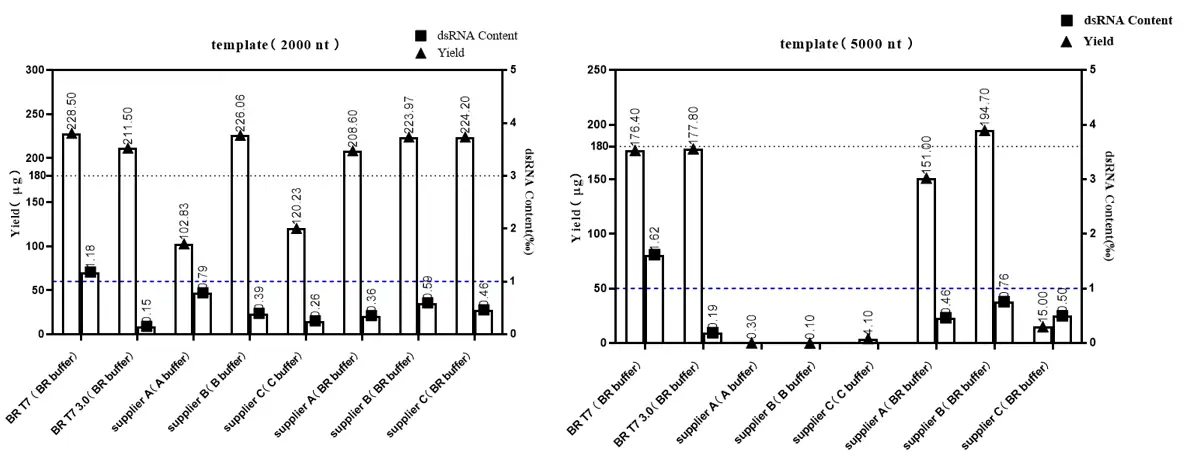
At present there is no globally harmonized hard limit at the regulatory level, but a consensus range has emerged across the industry: reported as ng/µg (ng dsRNA per µg RNA) or as % (w/w), common in-house specifications are ≤10 ng/µg (10‰), and leading processes can reach the <1 ng/µg level (1‰). Vaccines and replacement therapies set their limits separately according to risk. T7 RNA Polymerase 3.0 GMP-grade, independently developed by BIORI, reduces dsRNA generation.
Key Points for Enzyme Switching
The following is a practical checklist for switching from wild-type T7 to low-dsRNA T7.
1. First confirm the objective of the switch
Low-dsRNA T7 mainly addresses immunogenicity and downstream purification burden; it is not a universal substitute for all IVT problems.
Suitable scenarios: in vivo or primary-cell applications; mRNA vaccines, gene editing, protein replacement, and related settings; elevated residual dsRNA, IFN-α/β, IL-6, RIG-I/MDA5 or PKR activation; excessive burden from downstream HPLC/cellulose purification.
Scenarios where switching may not be the first choice: the main problem is low yield; GC-rich, long, or strongly structured templates cause poor transcription; circRNA or high-temperature IVT work flows (in these cases, a thermostable T7 should be considered).
2. Convert enzyme amount by units, not by volume
The activity unit definition for low-dsRNA T7 is: 1 U = the amount of enzyme that produces 1 nmol PPi in 1 h at 37°C under the standard reaction system. The common current specification is 50 U/µL, but this may differ among vendors or older pages; the current COA and label should be considered authoritative.
When switching between vendors, do not convert directly by volume. We recommend the following:
- An enzyme amount gradient of 0.5×, 1×, 1.5× and 2×;
- Keep template, buffer, NTPs, temperature and time fixed;
- Make the overall judgment based on yield, integrity, dsRNA and capping efficiency.
3. Reaction conditions: change only one variable at a time
One of the selling points of low-dsRNA T7 is that it reduces dsRNA under standard 37°C conditions without changing existing IVT process parameters. For the first enzyme switch, we recommend:
- Keep the temperature at 37°C initially;
- Use the matched 10× buffer and avoid mixing buffers from different vendors;
- Keep Mg²⁺, NTPs, DTT, spermidine, pyrophosphatase, RNase inhibitor, etc., in the original system;
- Add the enzyme last, work on ice, and minimize repeated freeze–thaw cycles;
- Do not change temperature, buffer, enzyme amount and reaction time simultaneously at the outset;
- Test reaction times of 1 h, 2 h and 4 h. Do not simply extend the reaction time; overly long reactions may increase truncated products, 3′ additions or by-products.
4. Check the template at the same time
Low-dsRNA enzymes reduce enzyme-derived side reactions, but the template itself still contributes to dsRNA. Before switching, confirm the following:
- The plasmid is completely linearized;
- The linearized template is purified to remove uncut circular plasmid;
- Avoid 3′ overhangs; prefer restriction enzymes that generate blunt ends or 5′ overhangs;
- The template is free of RNase and nuclease contamination;
- The promoter sequence is correct and the initiation sequence downstream of the T7 promoter matches the cap analog.
If template quality is poor, high dsRNA levels or abnormal long transcripts may still occur even after switching to low-dsRNA T7.
5. Co-transcriptional capping can be retained, but must be revalidated
Low-dsRNA T7 is generally compatible with co-transcriptional capping. However, when switching enzymes, the following six quality attributes should still be measured: capping efficiency; cap analog/GTP ratio; whether the initiation sequence matches, e.g., Cap AG/Cap GAG systems; total RNA yield; RNA integrity; and cellular translation efficiency.
6. Do not eliminate purification at the first step
Low-dsRNA T7 reduces formation at the source; it does not remove impurities that have already formed. For the first switch, keep the original purification workflow and consider simplification only after bridging data are available.[1,6]
Six major classes of critical quality attributes should be tested:
- dsRNA: J2 ELISA, dot blot, HPLC, or cellulose-binding assay;
- RNA integrity: agarose gel, Bioanalyzer/Fragment Analyzer;
- Capping rate: LC-MS, enzymatic assay, or gel-shift assay;
- Immunogenicity: IFN-α/β, IL-6, RIG-I/MDA5/TLR3 reporter systems;
- Translation: reporter gene expression or target protein expression;
- Residuals: DNA, protein, endotoxin, nucleotides and salts.
Only after multiple indicators consistently meet specifications should reduction of HPLC/cellulose steps be considered.
FAQ
Do low-dsRNA T7 RNA polymerases still need a dsRNA removal step?
Yes, in most workflows. The low-dsRNA enzyme “reduces dsRNA generation at the source” rather than “removing dsRNA that has already formed.” The low-dsRNA T7 enzyme can still significantly reduce dsRNA, but one should not assume that “removal/purification is completely unnecessary.”
Is a low-dsRNA T7 RNA polymerase compatible with co-transcriptional capping?
It is generally compatible, but the capping efficiency must be determined experimentally based on the specific template and cap analog used.
How does a low-dsRNA T7 mutant differ from a thermostable T7 polymerase?
The optimization objectives and mechanisms for the dsRNA T7 mutant and the thermostable T7 polymerase differ. The low-dsRNA variant primarily addresses the tendency for side reactions: it is designed to “reduce dsRNA generation” at the enzymatic level. The thermostable variant, by contrast, is primarily optimized for stability and activity at high temperatures: “hotter IVT” makes it more difficult for structures or hairpins to form[2], while the enzyme itself can withstand high temperatures. The two approaches are not mutually exclusive; rather, they represent different process pathways.
Is the fold reduction in dsRNA the same on every template?
No, the fold reduction depends on the template. The extent of reduction in dsRNA/hairpin formation varies depending on the template. The low-dsRNA T7 enzyme can reduce dsRNA on templates of various lengths and sequences, but the degree of reduction depends on the template and the process conditions. Each new template should undergo dsRNA and immunogenicity validation.
References
- Karikó K, Muramatsu H, Ludwig J, Weissman D. Generating the optimal mRNA for therapy: HPLC purification eliminates immune activation and improves translation of nucleoside-modified, protein-encoding mRNA. Nucleic Acids Res. 2011;39(21):e142. doi:10.1093/nar/gkr695
- Wu MZ, Asahara H, Tzertzinis G, Roy B. Synthesis of low immunogenicity RNA with high-temperature in vitro transcription. RNA. 2020;26(3):345–360. doi:10.1261/rna.073858.119
- Dousis A, Ravichandran K, Hobert EM, Moore MJ, Rabideau AE. An engineered T7 RNA polymerase that produces mRNA free of immunostimulatory byproducts. Nat Biotechnol. 2023;41:560–568. doi:10.1038/s41587-022-01525-6
- Mu X, Greenwald E, Ahmad S, Hur S. An origin of the immunogenicity of in vitro transcribed RNA. Nucleic Acids Res. 2018;46(10):5239–5249. doi:10.1093/nar/gky177
- Gholamalipour Y, Karunanayake Mudiyanselage A, Martin CT. 3′ end additions by T7 RNA polymerase are RNA self-templated, distributive and diverse in character—RNA-Seq analyses. Nucleic Acids Res. 2018;46(18):9253–9263. doi:10.1093/nar/gky796
- Baiersdörfer M, Boros G, Muramatsu H, Mahiny A, Vlatkovic I, Sahin U, Karikó K. A facile method for the removal of dsRNA contaminant from in vitro-transcribed mRNA. Mol Ther Nucleic Acids. 2019;15:26–35. doi:10.1016/j.omtn.2019.02.018