
Klenow Fragment (3’→5’ exo-)
Exonuclease-Deficient Mutant for 3’-End-Preserving DNA Synthesis | Ideal for NGS Library Prep & Probe Labeling

Product overview
Klenow Fragment (3’→5’ exo-), also known as exonuclease-deficient Klenow Fragment, is a recombinant mutant of the E. coli DNA Polymerase I large fragment. Engineered via site-directed mutagenesis, it abolishes the intrinsic 3’→5’ exonuclease (proofreading) activity of the wild-type enzyme while fully retaining 5’→3’ DNA polymerase activity and the native lack of 5’→3’ exonuclease activity. It exhibits no detectable 3’→5’ exonucleolytic degradation of primer or template 3’ termini, with no significant strand displacement activity, making it the preferred choice for workflows requiring intact 3’ ends. Each batch is rigorously quality-controlled to confirm the absence of contaminating DNase, RNase, and non-specific nuclease activities.
Features and applications
- Precision Engineered Activity Profile: Targeted mutagenesis eliminates unwanted 3’→5’ proofreading activity while preserving high-efficiency 5’→3’ polymerization, with no 5’→3’ exonuclease activity to interfere with downstream applications.
- 3’-End Integrity Protection: Prevents non-specific degradation of primer or template 3’ termini, ensuring reliable results for applications sensitive to 3’ end modification.
- Ultra-High Purity & Batch Consistency: Stringent QC validation confirms no detectable nuclease contamination, delivering reproducible performance across all production lots.
- Broad Workflow Compatibility: Functions efficiently under mild reaction conditions, compatible with standard molecular biology buffers and protocols with minimal optimization required.
- NGS Library Preparation: End repair for DNA fragment libraries, second-strand cDNA synthesis for RNA-seq workflows
- Nucleic Acid Probing: Random-primed or gene-specific probe labeling (radioactive, fluorescent, or biotin tags)
- Molecular Cloning: Primer extension assays, site-directed mutagenesis, Sanger sequencing (dideoxy chain termination)
- Genomic Research: Fill-in reactions for 5’overhangs, generation of blunt-ended DNA fragments
- Diagnostic R&D: Development of amplification-based or hybridization-based assay components
Components
| Component | Specification/Notes |
|---|---|
| 10×KF Buffer | 10× |
| Klenow Fragment, Exo- | 1 U/ μL |
Performance data
Blunting of DNA 5′-Overhangs
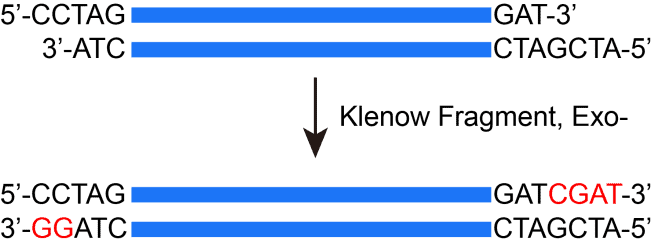
Compatible Applications: NGS library construction, vector ligation
Ideal for NGS library construction and vector ligation workflows. The exonuclease-deficient Klenow Fragment (Klenow exo-) exhibits no detectable 3′→5′ exonucleolytic degradation of primers or template 3′ termini. It efficiently fills in 5′-overhangs, converting sticky-end DNA fragments into blunt-ended products.
Note: Blunt ends are the standard compatible substrate for NGS adapter ligation. This step maximizes ligation efficiency and minimizes adapter dimer formation, a critical prerequisite for high-quality library preparation. The enzyme lacks 3′→5′ exonuclease proofreading activity, preventing degradation of primer or template 3′ termini to avoid ligation failure.
Second-Strand cDNA Synthesis
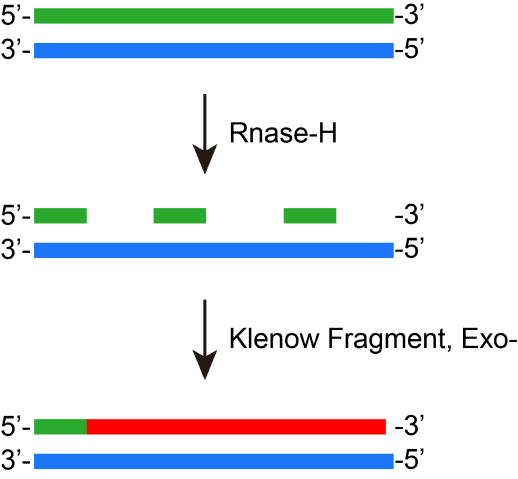
Compatible Applications: NGS RNA library preparation workflows
This workflow is widely adopted for second-strand cDNA synthesis in NGS RNA library preparation: following first-strand cDNA synthesis by reverse transcriptase, RNase H degrades the RNA component of RNA-DNA hybrids and cleaves full-length mRNA into short oligonucleotide fragments. These fragments remain annealed to the first-strand cDNA and serve as primers for second-strand cDNA synthesis catalyzed by the exonuclease-deficient Klenow Fragment (Klenow exo-).
Note: The enzyme retains full 5′→3′ polymerase activity while lacking 3′→5′ exonuclease activity, so it does not degrade the short RNA primers generated by RNase H cleavage. This enables efficient second-strand cDNA synthesis and ensures the integrity and uniformity of RNA-seq libraries.
Shipping and storage
| Condition | Recommendation |
|---|---|
| Storage | Store at -20±5°C. Avoid repeated freeze-thaw cycles. |
| Shipping | Refer to product label and shipping documentation. |
Downloads


Need this product lyophilized, in bulk, or in a custom format?
The feasibility assessment is free of charge. Send the assay brief and target format.