
T4 DNA Ligase
High-Efficiency ATP-Dependent Ligation for Cloning, NGS & Molecular Biology Workflows

Product overview
T4 DNA Ligase is an ATP-dependent ligase optimized for high-efficiency catalysis of phosphodiester bond formation between the 5′-phosphate terminus of one nucleotide and the 3′-hydroxyl terminus of an adjacent nucleotide in double-stranded DNA (dsDNA), effectively sealing nicks in duplex molecules. It supports repair of single-stranded nicks in double-stranded RNA, DNA/RNA hybrids, and chimeric nucleic acids, but does not catalyze ligation of fully single-stranded polynucleotides. With blunt-end ligation efficiency significantly exceeding that of E. coli DNA ligase, it also supports cohesive-end ligation, DNA/RNA hybrid nick sealing, and gap repair in hybrid duplexes. Rigorous quality control confirms the absence of detectable contaminating exonuclease or nick-translation activities, making it a reliable choice for sensitive molecular workflows.
Features and applications
- Broad-Spectrum Ligation Activity: Efficiently seals nicks in dsDNA, dsRNA, DNA/RNA hybrids, and chimeric nucleic acids; explicitly does not ligate fully single-stranded polynucleotides, avoiding off-target artifacts.
- Superior Blunt-End Performance: Blunt-termini ligation efficiency is significantly higher than that of wild-type E. coli DNA ligase, solving a common pain point for challenging cloning and NGS library construction workflows.
- Ultra-High Purity: Batch-to-batch validation confirms no detectable exonuclease or nick-translation activities, preventing unwanted nucleic acid degradation and ensuring reproducible results.
- Workflow Compatibility: Functions optimally with standard ligation buffers and reaction conditions, requiring minimal protocol optimization for most applications.
- NGS Library Preparation: Adapter ligation for amplicon, shotgun, and target enrichment libraries; gap repair in hybrid nucleic acid duplexes
- Genetic Cloning: Blunt-end and cohesive-end ligation for vector insertion, gene assembly, and site-directed mutagenesis
- Molecular Biology Assays: Ligation-mediated PCR (LM-PCR), linker ligation for ChIP-seq or ATAC-seq, RNA secondary structure probing
- RNA-Focused Workflows: Repair of nicks in dsRNA or DNA/RNA hybrids for RNA-seq, Ribo-seq, or in vitro translation assays
- Diagnostic R&D: Development of hybridization-based or ligation-dependent molecular detection assays
Components
| Component | Specification/Notes |
|---|---|
| 5×Ligase Buffer | 5x |
| T4 DNA Ligase | 600 U/ μL |
Performance data
High Ligation Efficiency and Specificity
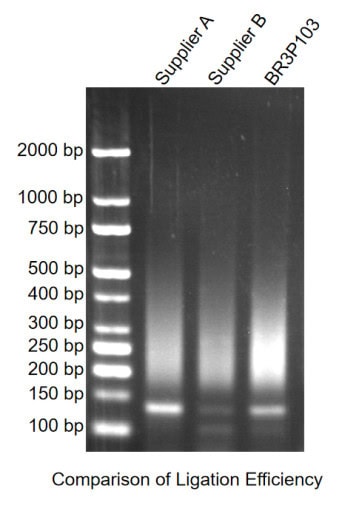
Note: BR3P301 is the catalog number for T4 DNA Ligase. Adapter dimers are a common byproduct of NGS library preparation that reduce usable sequencing data yield; minimal adapter dimer formation improves overall library quality.
Superior Ligation Performance at Low Input
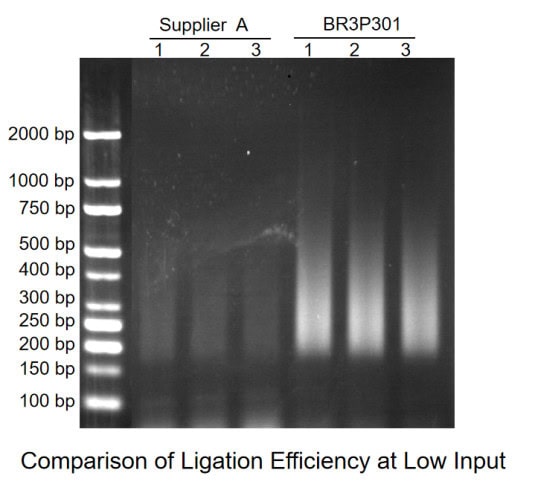
Note: Low-input workflows include single-cell sequencing, cell-free DNA (cfDNA) sequencing, and FFPE-derived library construction where template availability is limited. This performance ensures reliable library construction from precious, limited samples.
Inter-batch Consistency of Ligation
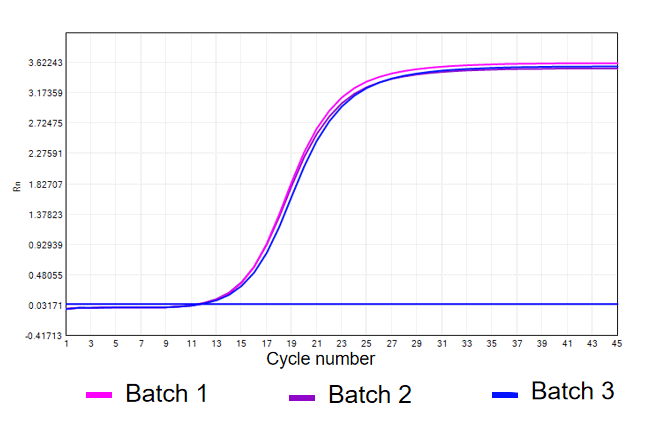
Note: Lot-to-lot consistency is a critical quality metric for clinical and high-throughput NGS workflows, ensuring comparable results across multiple experiments, studies, and production batches.
Shipping and storage
| Condition | Recommendation |
|---|---|
| Storage | Store at -20±5°C. |
| Shipping | Refer to product label and shipping documentation. |
Downloads


Need this product lyophilized, in bulk, or in a custom format?
The feasibility assessment is free of charge. Send the assay brief and target format.