
T4 DNA Polymerase
Template-Dependent Polymerase with Robust Proofreading Activity for Precision Nucleic Acid Manipulation

Product overview
T4 DNA Polymerase is a template-dependent DNA polymerase that catalyzes 5′→3′ DNA synthesis from primed single-stranded DNA templates in the presence of a primer-template complex. Engineered via recombinant expression of the cloned T4 DNA polymerase gene in E. coli, it delivers a well-defined activity profile optimized for high-precision molecular workflows. The enzyme exhibits robust 3′→5′ exonuclease (proofreading) activity—significantly higher than that of E. coli DNA Polymerase I—while completely lacking 5′→3′ exonuclease activity, preventing unwanted degradation of primers or template termini. Each batch is rigorously quality-controlled to confirm the absence of contaminating DNase, RNase, and non-specific nuclease activities.
Features and applications
- Precision Activity Profile: Retains full 3′→5′ proofreading activity for accurate end modification, with no 5′→3′ exonuclease activity to interfere with downstream applications.
- Superior Proofreading Capacity: 3′→5′ exonuclease activity significantly exceeds that of wild-type E. coli DNA Polymerase I, enabling more efficient removal of misincorporated nucleotides and aberrant termini.
- Template-Dependent Synthesis: Strictly dependent on primer-template complexes for 5′→3′ polymerization, minimizing off-target extension artifacts.
- Consistent Recombinant Quality: Produced via a validated recombinant expression system, ensuring excellent batch-to-batch consistency and high purity for reproducible results.
- NGS Library Preparation: End repair of fragmented DNA to convert cohesive ends to blunt ends, a critical step for adapter ligation in amplicon, shotgun, and target enrichment libraries
- Nucleic Acid Probe Labeling: Primer extension for radioactive, fluorescent, or biotin-labeled probe generation, enabled by the absence of 5′→3′ exonuclease activity that would degrade labeled primers
- Molecular Cloning: Preparation of blunt-ended DNA fragments for ligation-independent cloning or vector insertion
- High-Fidelity Primer Extension: Site-directed mutagenesis, Sanger sequencing, and other workflows requiring precise end modification
- Diagnostic R&D: Development of hybridization-based or amplification-based molecular detection assays
Components
| Component | Specification/Notes |
|---|---|
| 10×Blue Buffer | 10× |
| T4 DNA Polymerase | 3 U/μL |
Performance data
Blunting of DNA 5'- or 3'- overhangs
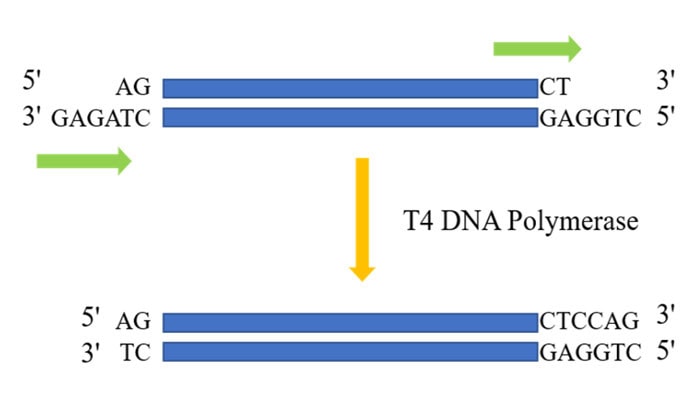
Suitable for NGS library construction and vector ligation.
T4 DNA Polymerase efficiently trims 3′-overhangs and fills 5′-overhangs of sticky-end DNA fragments, converting them into blunt-ended products. This reaction is mediated by the enzyme’s robust intrinsic 3′→5′ exonuclease proofreading activity and 5′→3′ polymerase activity; notably, the complete absence of 5′→3′ exonuclease activity eliminates the risk of non-specific template degradation, fully preserving nucleic acid terminus integrity.
Note: Blunt ends are the standard compatible substrate for NGS adapter ligation. This capability maximizes ligation efficiency, minimizes adapter dimer formation, and reduces ligation bias—a critical prerequisite for high-quality library preparation. T4 DNA Polymerase exhibits significantly stronger 3′→5′ proofreading activity than the Klenow Fragment, enabling more precise end modification for workflows requiring strict terminus integrity.
3′-End Labeling via Replacement Synthesis
Compatible Applications: Nucleic acid probe labeling, primer extension assays
Double-stranded DNA fragments are incubated with T4 DNA Polymerase in the presence of dNTPs: the enzyme’s 3′→5′ exonuclease activity degrades DNA from the 3′ termini, followed by addition of all four dNTPs to activate its 5′→3′ polymerase activity and extend the 3′ ends of the template. This coordinated exonuclease-polymerase action enables site-specific 3′-end labeling with radioactive, fluorescent, or biotin tags without requiring pre-existing 3′ terminus modifications.
Note: Replacement synthesis is a gold-standard method for probe preparation, avoiding the 3′ end heterogeneity associated with terminal transferase labeling to ensure probe uniformity and detection specificity. It is ideally suited for FISH, Southern blot, and Northern blot workflows.
Superior Polymerization Efficiency
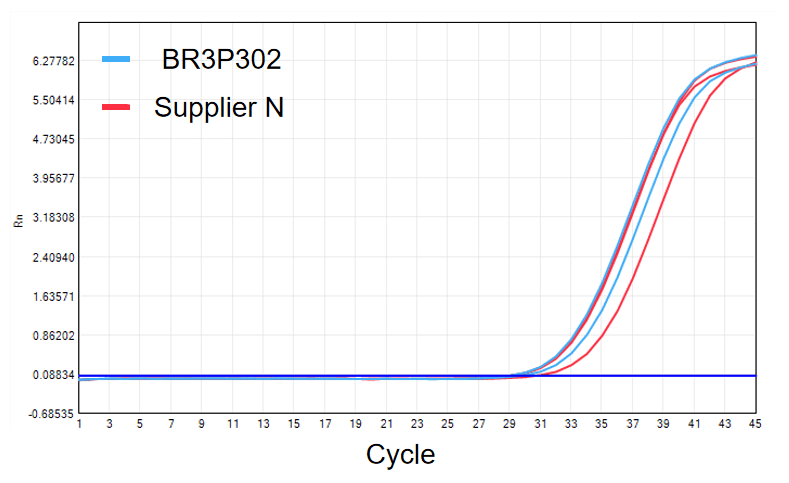
Note: BR3P302 is the catalog number for this product. Lower Ct values correspond to higher yields of repaired template, reflecting enhanced enzymatic efficiency. The 0.73 Ct reduction observed here corresponds to ~1.65-fold higher product enrichment, confirming BR3P302 retains superior catalytic activity even on challenging gap substrates. This performance is particularly valuable for end repair of damaged samples such as FFPE-derived DNA or cell-free DNA (cfDNA).
Shipping and storage
| Condition | Recommendation |
|---|---|
| Storage | Store at -20±5°C. |
| Shipping | Refer to product label and shipping documentation. |
Downloads


Need this product lyophilized, in bulk, or in a custom format?
The feasibility assessment is free of charge. Send the assay brief and target format.