
T4 Polynucleotide Kinase (T4 PNK)
Versatile End-Modification Enzyme for NGS, Probe Labeling & Molecular Cloning

Product overview
T4 Polynucleotide Kinase (T4 PNK) is a versatile polynucleotide 5′-hydroxyl kinase that catalyzes precise end modifications of DNA, RNA, and nucleotide substrates. It is an essential reagent for workflows requiring controlled nucleic acid terminal functionalization, including NGS library preparation, probe labeling, and ligation-dependent molecular biology applications.
Features and applications
- Triple End-Modification Activity: Delivers three functionally distinct, workflow-relevant activities:
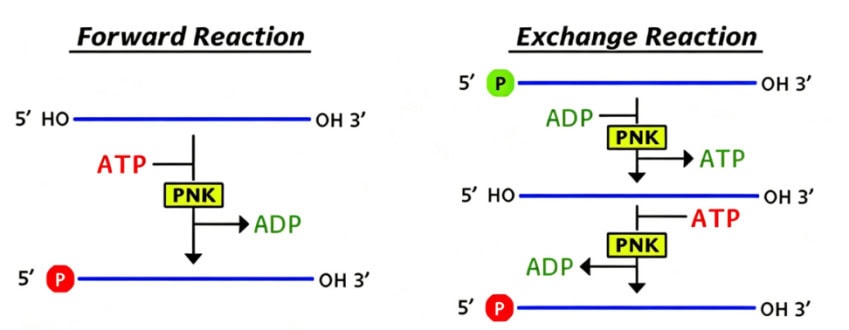
- Forward 5′-hydroxyl kinase activity: Transfers the γ-phosphate group from ATP to the 5′-OH terminus of double-stranded DNA (dsDNA), single-stranded DNA (ssDNA), RNA, and nucleoside 3′-monophosphates.
- 5′-Phosphatase/exchange activity: In the presence of ADP, removes 5′-terminal phosphates and catalyzes phosphate exchange between 5′-phosphorylated oligo-/polynucleotides and ATP.
- 3′-Phosphatase activity: Hydrolytically removes 3′-phosphate groups from DNA, RNA, and deoxynucleoside 3′-monophosphate termini, repairing damaged nucleic acid ends that are incompatible with ligation.
- Broad Substrate Compatibility: Functions efficiently with dsDNA, ssDNA, RNA, and nucleotide monophosphates, supporting diverse experimental designs.
- High Reaction Efficiency: Achieves rapid, complete end modification under standard reaction conditions, minimizing protocol optimization time.
- Ultra-High Purity: Rigorously batch-tested to confirm the absence of detectable DNase, RNase, and non-specific nuclease contamination, ensuring reproducible results for sensitive applications.
- NGS Library Preparation: 5′-phosphorylation of DNA fragments and adapters to enable efficient ligation; 3′-phosphate removal to repair damaged ends from FFPE, cfDNA, or chemically treated samples, reducing ligation failures and improving library yield.
- Nucleic Acid Probe Labeling: 5′-end labeling with radioactive, fluorescent, or biotin tags via forward kinase activity; site-specific probe modification via phosphate exchange reactions.
- Molecular Cloning: Preparation of phosphorylated linkers, vector arms, and RNA termini for ligation-dependent workflows.
- Diagnostic R&D: Development of hybridization-based or ligation-dependent molecular detection assays requiring precise nucleic acid end modification.
Components
| Component | Specification/Notes |
|---|---|
| T4 Polynucleotide Kinase | 10 U/μL |
| 10×T4 PNK Buffer | 10× |
Performance data
Equivalent 3′ Dephosphorylation Activity to Supplier N
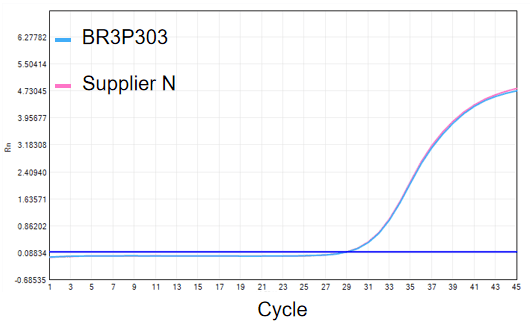
Note: BR3P303 is the catalog number for this product. 3′ end repair is a prerequisite for library construction from damaged samples, as it restores ligation compatibility of termini compromised by nucleic acid degradation, preventing low library yields.
Shipping and storage
| Condition | Recommendation |
|---|---|
| Storage | Store at -20±5°C. |
| Shipping | Refer to product label and shipping documentation. |
Downloads


Need this product lyophilized, in bulk, or in a custom format?
The feasibility assessment is free of charge. Send the assay brief and target format.