
AcuGenix™ Universal DNA Fragmentation Module
All-in-One Pre-Ligation Module for Streamlined NGS Library Construction

Product overview
The AcuGenix™ Universal DNA Fragmentation Module is a core pre-processing solution engineered to simplify and accelerate NGS library preparation. It integrates three critical pre-ligation steps—controlled DNA fragmentation, end repair, and 3′-deoxyadenosine (dA) tailing—into a single-tube reaction, eliminating the need for intermediate purification and significantly reducing hands-on time.
Features and applications
- Integrated Single-Tube Workflow: Performs three enzymatic steps in one tube, removing three rounds of purification to minimize sample loss for precious low-input samples (e.g., cfDNA, FFPE DNA) and reducing total hands-on time to under 45 minutes.
- Precise & Adjustable Fragmentation: Enables accurate tuning of fragment size via input DNA mass and reaction duration. Generates a uniform 200–500 bp fragment distribution by default, perfectly suited for Illumina and MGI sequencing platforms, with adjustable parameters for custom size selection.
- Efficient End Repair & dA-Tailing: The integrated system converts ragged and overhung termini into blunt-ended, 5′-phosphorylated substrates. Subsequent dA-tailing by a 3′→5′ exonuclease-deficient Klenow fragment (Klenow exo-) adds a single dA residue to prevent adapter self-ligation and ensure directional cloning with dT-overhang adapters.
- Broad Compatibility & High Sensitivity: Validated for inputs ranging from 1 pg to 1 μg, including genomic DNA, cell-free DNA (cfDNA), FFPE-derived DNA, and PCR products. Exhibits excellent lot-to-lot consistency in fragment distribution and ligation efficiency.
- Ultra-High Purity: Rigorously tested to be free of detectable nuclease activity and residual host genomic DNA, ensuring data integrity and reproducibility.
- Whole-Genome Sequencing (WGS)
- Whole-Exon Sequencing (WES)
- Cell-Free DNA Sequencing (cfDNA-seq)
- Targeted Sequencing Library Preparation
Components
| Component | Specification/Notes |
|---|---|
| 10×FEA Buffer | 10× |
| 10×FEA Enzyme | / |
Performance data
Multi-Species Compatibility
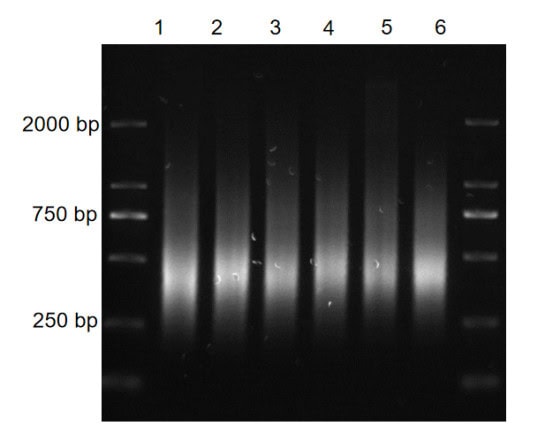
Six sheared DNA backgrounds were processed with BR3N602: E. coli (Lane 1), T. thermophilus (Lane 2), phi29 product (Lane 3), λDNA (Lane 4), 10-kb HF amplicon (Lane 5), and 293T gDNA (Lane 6). Following end repair and purification, all lanes displayed comparable band intensity and uniform recovery, indicating no template-dependent variation. These results confirm that BR3N602 provides stable, background-independent end modification for heterogeneous and complex genomic samples.
Note: BR3N602 is the catalog number for the AcuGenix™ Universal DNA Fragmentation Module. Multi-species compatibility is a critical metric for evaluating library prep reagent versatility.
Robust Clinical mNGS Performance
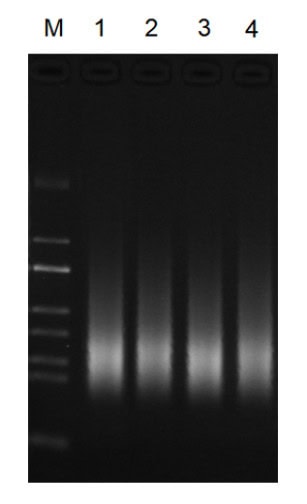
50 ng of DNA from swab (Lane 1), sputum (Lane 2), bronchoalveolar lavage (BAL, Lane 3), and blood (Lane 4) was fragmented (14 min) and converted to libraries using BR3N602. Electrophoresis showed matched size profiles across all inputs, demonstrating consistent library construction from complex clinical specimens.
Note: Uniform fragment distribution is essential for mNGS data quality, directly impacting pathogen detection limits and quantification accuracy.
EDTA Tolerance
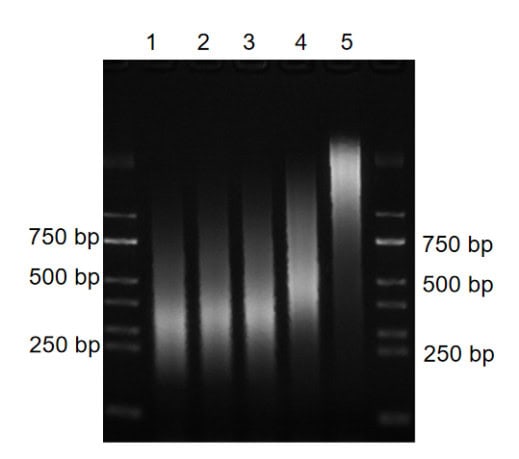
Reactions were supplemented with 0–0.8 mM EDTA (Lane 1: 0 mM; 2: 0.1 mM; 3: 0.2 mM; 4: 0.4 mM; 5: 0.8 mM). BR3N602 maintained matched library size distributions up to 0.2 mM EDTA, corresponding to 10 μL of TE-eluted DNA in a 50 μL reaction, demonstrating excellent buffer compatibility.
Note: EDTA tolerance prevents enzyme inhibition from residual storage buffers, improving library construction success rates.
Frag Enhancer Mitigates Organic Contaminant Inhibition
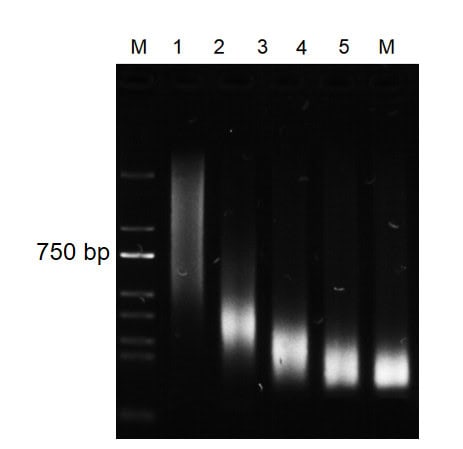
Note: Clinical samples (e.g., FFPE, sputum) often contain extraction inhibitors; Frag Enhancer significantly improves library construction robustness for such samples.
Time-dependent Size Control
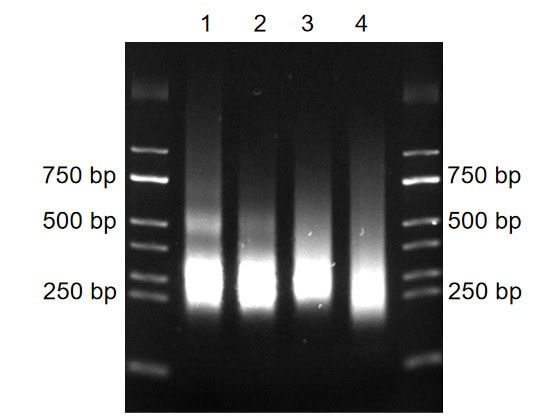
293T gDNA (0.1, 1, 10, 1000 ng, Lanes 1–4) was fragmented for 7 min within the BR3D201 single-step workflow. Electrophoresis showed matched dominant fragment sizes across all inputs, confirming fragment length is dictated by incubation time rather than DNA input. This allows predictable insert tuning for any starting mass.
Note: Time-dependent size control is a key advantage of enzymatic fragmentation, simplifying protocol optimization across diverse input masses.
Shipping and storage
| Condition | Recommendation |
|---|---|
| Storage | Store at -20±5°C. |
| Shipping | Refer to product label and shipping documentation. |
Downloads

Need this product lyophilized, in bulk, or in a custom format?
The feasibility assessment is free of charge. Send the assay brief and target format.