
AcuGenix™ Universal DNA Library Prep Kit
Dual-Platform Compatible, Single-Tube Workflow for Rapid, Low-Input NGS Library Construction

Product overview
The AcuGenix™ Universal DNA Library Prep Kit is a dual-indexed library preparation solution compatible with all Illumina and MGI high-throughput sequencing platforms. It integrates three critical pre-ligation processing steps—controlled DNA fragmentation, end repair, and 3′-deoxyadenosine (dA) tailing—into a single-tube reaction, eliminating the need for intermediate purification between steps. Users can proceed directly to adapter ligation and library enrichment post-reaction, streamlining the workflow to under 1 hour of hands-on time while minimizing nucleic acid loss for precious low-input samples.
Features and applications
- True Dual-Platform Compatibility: Validated for direct cluster generation and sequencing on all Illumina and MGI instruments, with no buffer re-optimization required for most applications—eliminating the need for platform-specific library preparation workflows.
- Streamlined Single-Tube Workflow: Consolidates three enzymatic steps into one closed-tube reaction, removing three rounds of intermediate purification to reduce sample loss for low-input specimens (e.g., FFPE DNA, cfDNA) and minimize aerosol contamination risks from open-tube handling.
- Broad Input & Sample Compatibility: Supports a wide input range of 100 pg–1 μg total DNA and is compatible with diverse sample types including animal/plant genomic DNA, microbial genomic DNA, FFPE-derived DNA, cell-free DNA (cfDNA), and chromatin immunoprecipitation DNA (ChIP-DNA).
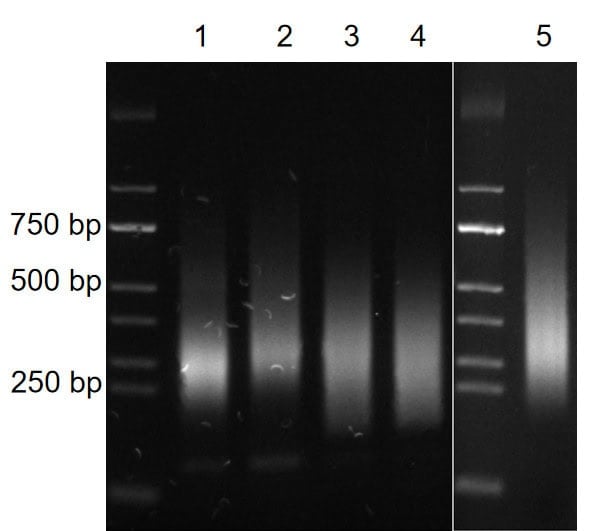
- Tunable Insert Size: Insert fragment length can be precisely adjusted by varying fragmentation reaction time. The default 150–350 bp uniform size distribution is optimized for paired-end sequencing on both platforms, ensuring balanced coverage for downstream analysis.
- Ultra-High Purity & Batch Consistency: Each batch is rigorously validated to be free of detectable RNase, DNase, and extraneous nucleic acid contamination, with consistent fragment size distribution across all production lots to guarantee reproducible sequencing performance.
- Whole-genome sequencing (WGS) and whole-exome sequencing (WES)
- Cell-free DNA sequencing (cfDNA-seq) for oncology and liquid biopsy research
- FFPE-derived DNA sequencing for retrospective clinical studies
- Chromatin immunoprecipitation sequencing (ChIP-seq) for epigenomic profiling
- Microbial genome sequencing and metagenomic library preparation
Components
| Component | Specification/Notes |
|---|---|
| 10×FEA Buffer | 10× |
| 10×FEA Enzyme | 10× |
| Ligation Buffer | 5× |
| DNA Ligase | / |
| AmpSeq Amplification Mix | 2× |
Performance data
Multi-Species Compatibility
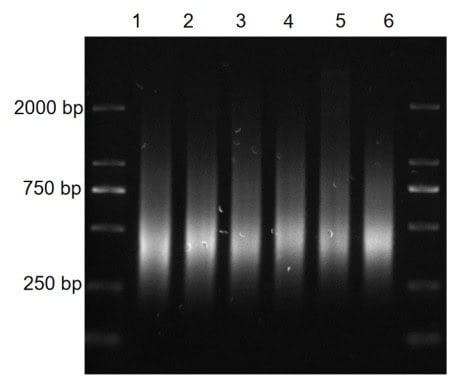
Note: BR3D201 is the catalog number for this kit. Multi-species compatibility is a critical metric for evaluating library prep reagent versatility, supporting workflows with microbial, animal/plant, and clinical sample types.
EDTA Tolerance
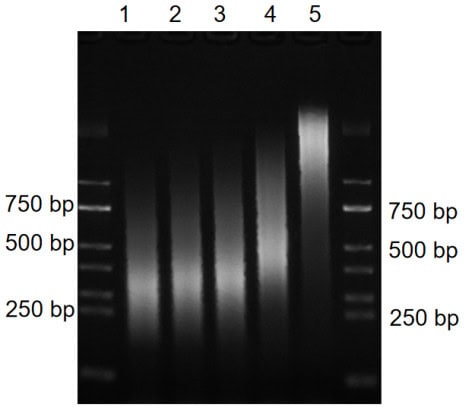
Note: EDTA tolerance prevents enzyme inhibition from residual storage/elution buffers, improving library construction success rates for low-input samples.
Enhancer Mitigates Organic Contaminant Inhibition
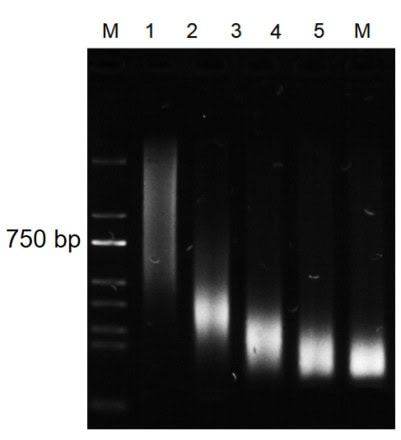
Note: Clinical samples (e.g., FFPE, sputum) and environmental samples often contain extraction inhibitors; Frag Enhancer significantly improves library construction robustness for these challenging sample types.
Reduced Amplification Cycles with Single-Step Workflow
| DNA Input | Amplification Cycles (Total library yield: 1000 ng) |
|---|---|
| 1000 ng | 1-3 |
| 500 ng | 3-5 |
| 100 ng | 5-7 |
| 10 ng | 9-11 |
| 1 ng | 11-13 |
| 100 pg | 13-15 |
Note: Reduced cycle counts minimize amplification bias and duplicate read fractions, improving the usable data yield of sequencing runs.
Time-Dependent Size Control
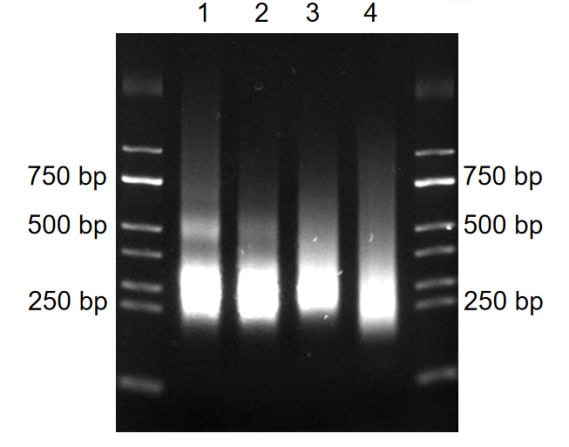
Note: Time-dependent size control is a key advantage of enzymatic fragmentation, simplifying protocol optimization across diverse input amounts.
Library & Capture Parity with Supplier V
Note: BR3N601 is the catalog number for the AcuGenix™ Hybridization Capture Kit. Parity validation confirms BR3D201 can directly replace Supplier V for pan-cancer panel library preparation without workflow re-optimization.
Matched Library Profiles with Superior Pan-cancer Variant Detection
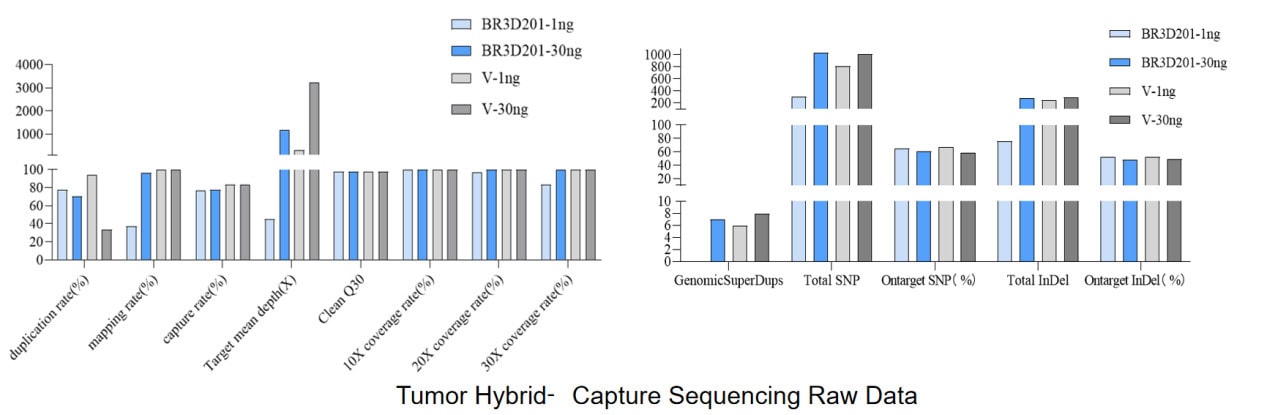
Note: Low off-target rates and high variant detection sensitivity are critical performance metrics for oncology panels. BR3D201 delivers more reliable variant calling results for cancer research workflows. For Research Use Only.
Shipping and storage
| Condition | Recommendation |
|---|---|
| Storage | Store at -20±5°C. Avoid repeated freeze-thaw cycles. |
| Shipping | Refer to product label and shipping documentation. |
Downloads
Documents
BR3D201 AcuGenix™ Universal DNA Library Prep Kit Instruction Manual (PDF)BR3D201 AcuGenix™ Universal DNA Library Prep Kit COA (PDF)BR3D201 10×FEA Buffer MSDS (PDF)BR3D201 10×FEA Enzyme MSDS (PDF)BR3D201 AmpSeq Amplification Mix MSDS (PDF)BR3D201 DNA Ligase MSDS (PDF)BR3D201 Ligation Buffer MSDS (PDF)


Need this product lyophilized, in bulk, or in a custom format?
The feasibility assessment is free of charge. Send the assay brief and target format.