
Pre-treatment Kit for mRNA Capping Rate Detection, BP-05
Prepares mRNA samples for capping-rate analysis.

Product overview
The capping efficiency is a critical quality attribute (CQA) for mRNA vaccine therapeutics and constitutes essential validation data required for the regulatory submission of mRNA-based products. Currently, the determination of capping efficiency is primarily conducted via liquid chromatography-mass spectrometry (LC-MS). There is a difference on the order of hundreds in molecular weight between mRNA with a cap structure and uncapped mRNA. Compared to the molecular weight of intact mRNA, which is on the order of hundreds of thousands, it is challenging to precisely analyze the difference between capped and uncapped samples. Therefore, analyzing capping efficiency first requires processing the long mRNA fragments into smaller segments, thereby transforming the task of finding a difference on the order of hundreds within hundreds of thousands into finding a difference on the order of hundreds within thousands. The Pre-treatment Kit for mRNA Capping Rate Detection developed by BIORI can accurately and efficiently process mRNA samples. The processed samples can be directly used for LC-MS analysis, facilitating rapid assessment of sample capping efficiency. This kit is suitable for the pre-treatment of mRNA samples with different capping methods and various cap structures.
Features and applications
- Processes long mRNA into small fragments so that capped and uncapped species can be distinguished by LC-MS.
- The processed samples can be directly used for LC-MS analysis, facilitating rapid assessment of sample capping efficiency.
- Suitable for the pre-treatment of mRNA samples with different capping methods and various cap structures.
- Probe-guided digestion at 37°C for 2 hours followed by magnetic bead recovery; target-specific probes are designed by the user and are not supplied in the kit.
- For sample preparation prior to the detection of capping efficiency of capped mRNA.
Components
| Components | Volume | Storage | |
|---|---|---|---|
| Box 1 | M Reagent | 40 μL | -20±5°C |
| 10×M Buffer | 200 μL | ||
| Buffer 1 | 1 mL | ||
| Box 2 | Magnetic Beads | 1 mL | 2-8°C |
| Loading Buffer | 200 μL | ||
| Buffer 2 | 18 mL | ||
| Buffer 3 | 1 mL×2 | ||
| EB Buffer | 1 mL |
Performance data
1 Urea-PAGE verification
Description: After enzymatic digestion and recovery, preliminary verification was performed by Urea-PAGE.
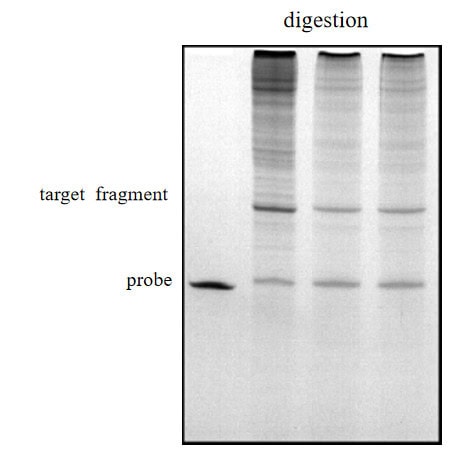
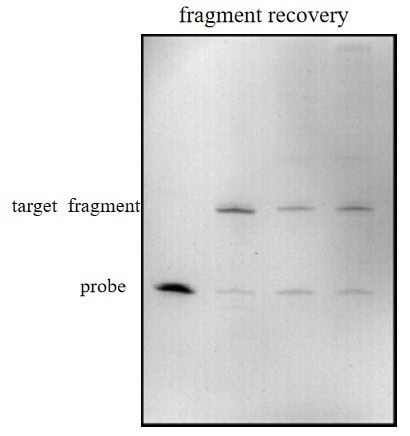
Conclusion: After purification and recovery, the fragments were analyzed by Urea-PAGE, and it was clearly observed that all fragments other than the target band and the probe band had been thoroughly removed. The presence of the probe in the sample did not interfere with the subsequent LC-MS (liquid chromatography-mass spectrometry) analysis; on the contrary, the probe band of known molecular weight could serve as a size marker for the subsequent measurements.
2 LC-MS instrumental readout graph
Description: Representative instrument readouts obtained after sample pretreatment for capping efficiency detection.
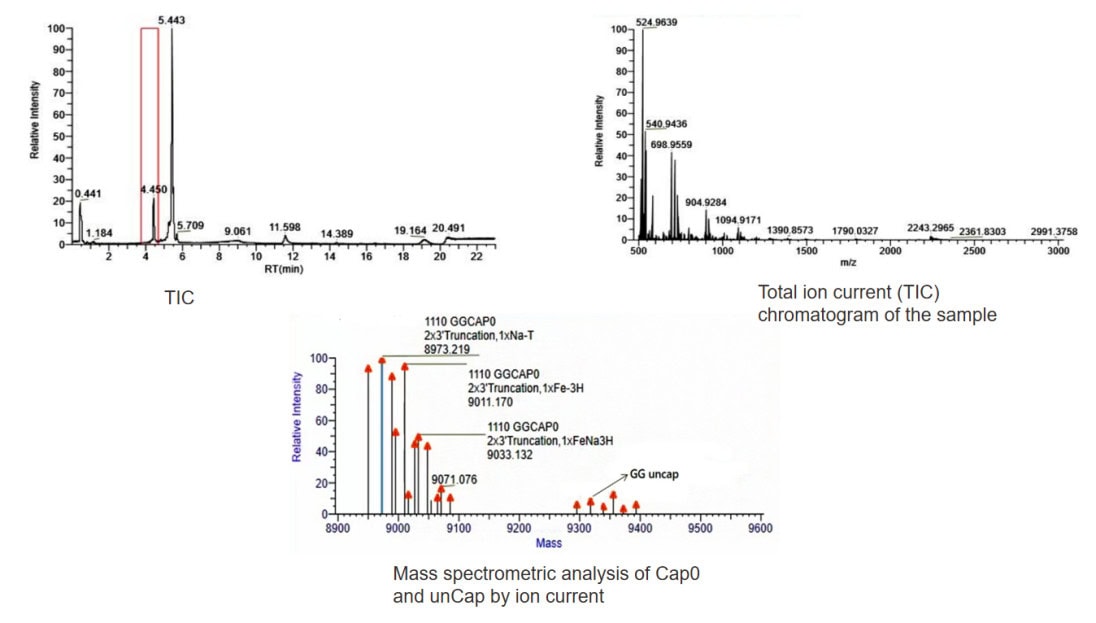
Conclusion: The instrumental readout graphs obtained from samples processed with the capping efficiency detection pretreatment kit exhibited high response signals and predominantly single peaks.
3 Accuracy test
Description: Two RNA strands differing by a single nucleotide were synthesized as standards for uncapped and capped RNA, respectively.
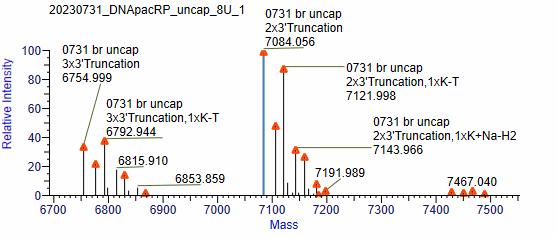
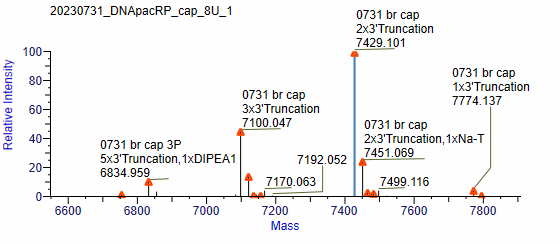
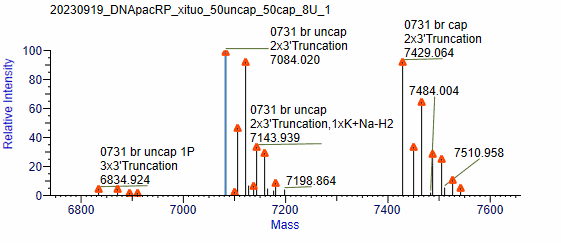

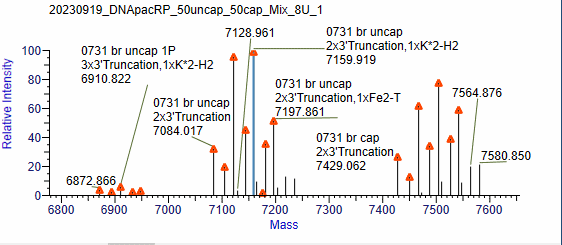

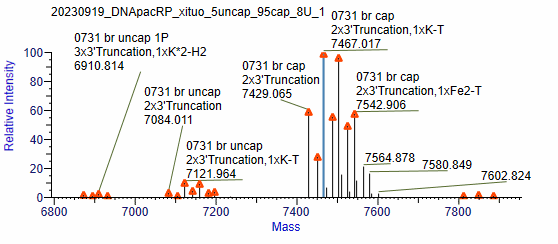
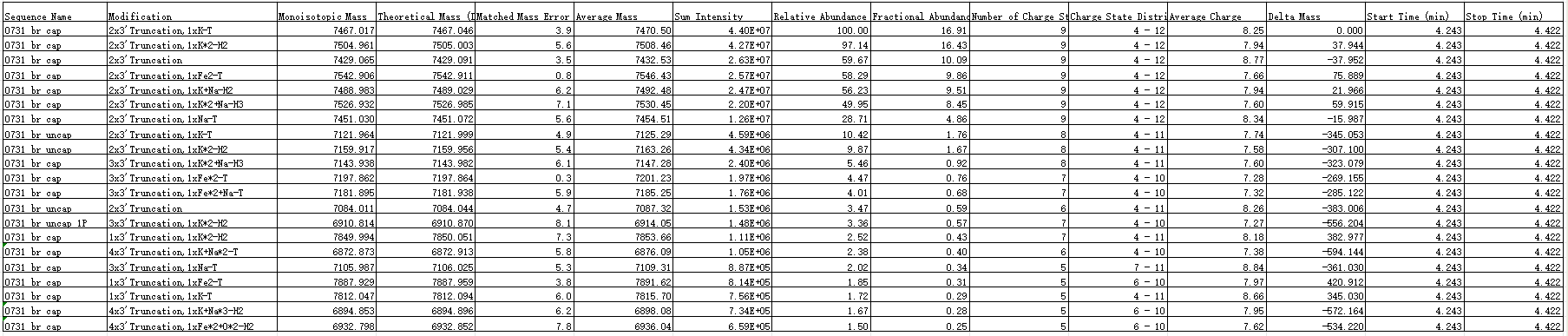
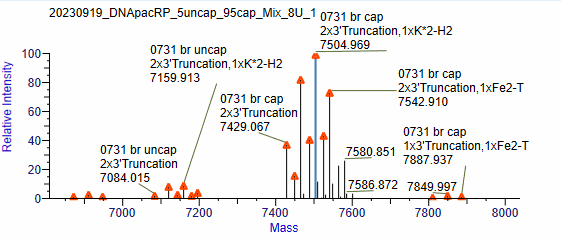

Conclusion: After pretreatment with Biori's capping efficiency detection pretreatment kit, the samples were subjected to instrumental analysis and data processing. The results showed that for samples spiked with various ratios of capped to uncapped RNA, the coefficient of variation (CV) between the measured ratios obtained after kit treatment and the actual input ratios was less than 5%, demonstrating that this kit exhibits excellent accuracy and sensitivity.
4 Operability and reproducibility test
Description: Different operators processed the same sample following the kit manual.
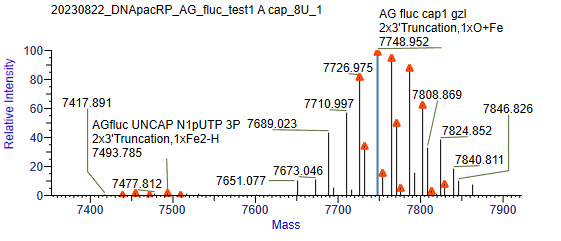
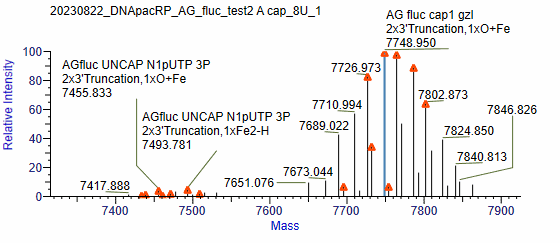
Conclusion: The instrumental analysis results were consistent across operators, demonstrating that the Biori capping efficiency detection pretreatment kit is easy to use and provides good reproducibility.
5 Applicability verification
Description: This kit is suitable for the pretreatment of capped samples prepared by different capping methods. Samples generated either by enzymatic capping or by co-transcriptional capping using different cap analogs, when pretreated with this kit, all yielded effective detection of both uncapped and capped RNA by instrumental analysis.
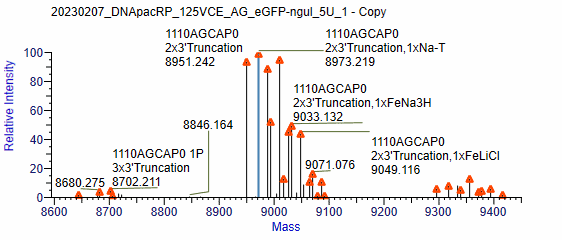
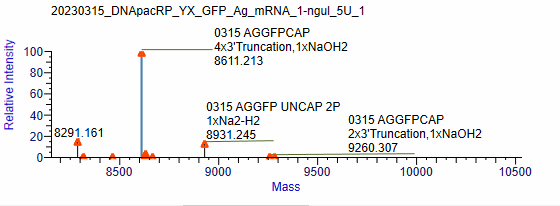
Conclusion: These results demonstrate that the Biori capping efficiency detection pretreatment kit exhibits broad applicability and can accommodate samples prepared by various capping approaches and with different cap analogs.
Shipping and storage
| Condition | Recommendation |
|---|---|
| Storage | Box 1 is stored at -20±5°C and Box 2 at 2-8°C. Do not freeze-thaw the magnetic beads. |
| Shipping | Ship with split cold-chain packaging: frozen components at -20°C on dry ice and refrigerated components at 2-8°C with cold packs. |
| Handling | Avoid repeated freeze-thaw cycles; mix thoroughly after thawing where applicable. |
Downloads


Need this product lyophilized, in bulk, or in a custom format?
The feasibility assessment is free of charge. Send the assay brief and target format.