
dsRNA Residual Quantitative Detection Kit 2.0, BP-18
Quantifies residual dsRNA in IVT mRNA workflows.

Product overview
During the preparation of mRNA by in vitro transcription (IVT) using T7 RNA polymerase, by-products such as double-stranded RNA (dsRNA) are generated. dsRNA can not only trigger the body's innate immune response but may also lead to mRNA degradation. Therefore, the residual amount of dsRNA is a critical quality attribute for mRNA drugs. This kit employs a double-antibody sandwich enzyme-linked immunosorbent assay (ELISA) to detect the dsRNA content in in vitro transcription systems or synthesized mRNA stock solutions. Microplates are coated with capture antibody to form a solid-phase antibody. dsRNA standards and test samples are added to the solid-phase antibody microplate wells, followed by the addition of horseradish peroxidase (HRP)-labeled detection antibody, forming an antibody-antigen-antibody complex. After thorough washing, the TMB substrate is added. The substrate solution is converted to blue under the catalysis of HRP enzyme and finally to yellow under the action of acid. The intensity of the color is positively correlated with the amount of dsRNA in the sample.
Features and applications
- Double-antibody sandwich ELISA; dsRNA standards for unmodified UTP, pUTP-modified, and N1-Me-pUTP-modified RNA are supplied.
- Good reproducibility: intra-assay coefficient of variation < 10%; inter-assay coefficient of variation < 15%.
- Accuracy: 80%-120%.
- Linear range: 0.047-3 ng/mL for unmodified and pUTP-modified dsRNA; 0.093-6 ng/mL for N1-Me-pUTP-modified dsRNA.
- dsRNA quantitation in mRNA vaccine/medicine development.
- Detection of dsRNA content in in vitro transcription systems or synthesized mRNA stock solutions.
Components
| Components | Volume | Storage | |
|---|---|---|---|
| Box 1 | dsRNA Standard (Unmodified UTP, 3μg/mL) | 30 μL×1 Tube | -20±5°C |
| dsRNA Standard (pUTP-modified, 3μg/mL) | 30 μL×1 Tube | ||
| dsRNA Standard (N1-Me-pUTP-modified, 3μg/mL) | 30 μL×1 Tube | ||
| Detection Antibody | 30 μL×1 Tube | ||
| Box 2 | Anti-dsRNA Antibody Precoated ELISA Plate | 12×8 Wells, 96 Wells Total | 2-8°C |
| Concentrated Washing Buffer (20×) | 20 mL×1 Bottle | ||
| Sample Diluent | 30 mL×1 Bottle | ||
| Antibody Diluent | 12 mL×1 Bottle | ||
| Chromogenic Solution | 12 mL×1 Bottle | ||
| Stop Solution | 6 mL×1 Bottle | ||
| Plate Sealer | 4 Sheets | ||
| Instruction Manual | 1 Copy |
Performance data
1 Standard curve
Description: Establishing the standard curve by gradient dilution of dsRNA standard.
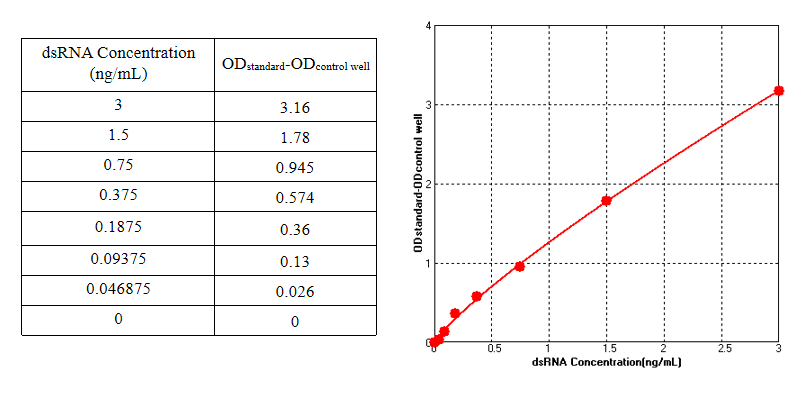
Conclusion: The dsRNA standard were subjected to gradient dilution for absorbance measurement. The data were processed using a four-parameter fitting curve. The results showed that R2 value was greater than 0.99.
2 Recovery rate
Description: Different concentrations of dsRNA standard substances are added to the sample with a known concentration. The accuracy of the kit's recovery is determined based on the difference between the actual measured concentration and the theoretical concentration.
Table 1 Recovery test data.
| Sample | 1 | 2 | 3 |
|---|---|---|---|
| Sample theoretical concentration(ng/mL) | 0.2209 | 0.2209 | 0.2209 |
| Added standard concentration(ng/mL) | 1.5 | 0.375 | 0.09375 |
| Measured spiked sample concentration(ng/mL) | 1.5122 | 0.5466 | 0.3102 |
| CV(%) | 12.8% | 8.3% | 1.3% |
| Spike recovery(%) | 86.09% | 86.86% | 95.31% |
| Acceptance criteria | The relative deviations of the sample assay concentrations were all ≤15%, and the recoveries met the acceptance criteria of 80%–120%. | ||
| Result | Acceptable | Acceptable | Acceptable |
Conclusion: The relative deviations of the sample assay concentrations were all ≤15%, and the recoveries met the acceptance criteria of 80%-120%.
3 Repeatability test
Description: Repeatability was assessed by measuring high, medium, and low level samples in six replicates. The resulting CV for the measured concentrations were within the predefined acceptance limits.
Table 2 Repeatability test data.
| Sample theoretical concentration(ng/mL) | 1.5 | 0.375 | 0.09375 |
|---|---|---|---|
| Mean concentration(ng/mL) | 1.2157 | 0.3042 | 0.07632 |
| CV(%) | 5.52 | 1.73 | 0.36 |
| Acceptance criteria | CV≤10% | ||
| Result | Acceptable | Acceptable | Acceptable |
Conclusion: The repeatability test was tested at three concentrations (high, medium, and low) of the standard sample. Each group was repeated 6 times, and the coefficient of variation in each group was all less than 10%, which met the requirements, indicating that the repeatability of the kit is good.
4 Inter-lot precision test
Description: Precision was evaluated by assaying three batches of the kit in a single session by the same operator. Each batch was tested with high, medium, and low concentration samples in six replicates. In total, 54 determinations were made (18 per concentration level).
Table 3 Inter-lot precision test data.
| Sample theoretical concentration(ng/mL) | 1.5 | 0.375 | 0.09375 |
|---|---|---|---|
| Mean measured conc. of 3 batches(ng/mL) | 1.2842 | 0.3058 | 0.07412 |
| CV(%) | 9.54% | 1.48% | 2.03% |
| Acceptance criteria | CV≤15% | ||
| Result | Acceptable | Acceptable | Acceptable |
Conclusion: The inter-lot precision was evaluated by the same operator in a single analysis of three batches of test kits. Each batch was tested with 6 repeated detections using samples of high, medium and low concentrations respectively. The coefficient of variation was all less than 10%, within the predetermined acceptable range, indicating good inter-lot precision.
5 Human precision
Description: Human precision was assessed by having two operators assay a single batch of the kit in the same session. Each operator tested high, medium, and low concentration samples in six replicates. In total, 36 determinations were obtained (12 per concentration level).
Table 4 Human precision test data.
| Sample theoretical concentration(ng/mL) | 1.5 | 0.375 | 0.09375 |
|---|---|---|---|
| Mean measured conc. of 2 operators(ng/mL) | 1.1357 | 0.2153 | 0.06916 |
| CV(%) | 7.36 | 1.54 | 0.29 |
| Acceptance criteria | CV≤15% | ||
| Result | Acceptable | Acceptable | Acceptable |
Conclusion: Human precision was evaluated by having two operators test a single batch of reagents simultaneously. Each operator conducted 6 repetitions for samples with high, medium, and low concentrations. The obtained precision values were within the predetermined acceptable range.
Shipping and storage
| Condition | Recommendation |
|---|---|
| Storage | 1. Box 1 is stored at -20±5°C and Box 2 at 2-8°C, protected from strong light. 2. After the precoated ELISA plate is unsealed and used, the remaining precoated ELISA plate shall be sealed, stored at 2-8°C and used within the validity period. 3. Box 1 and Box 2 shall be promptly returned to the corresponding storage conditions after use. 4. Reagents in Box 1 shall be subjected to minimal repeated freeze-thaw cycles during use. |
| Shipping | Ship with split cold-chain packaging: frozen components at -20°C on dry ice and refrigerated components at 2-8°C with cold packs. |
| Handling | Protect from light and avoid unnecessary freeze-thaw cycles where applicable. |
Downloads


Need this product lyophilized, in bulk, or in a custom format?
The feasibility assessment is free of charge. Send the assay brief and target format.