



Published by Zhuhai Biori Biotechnology Co., Ltd.
High-fidelity PCR: when should you reach for it, and when is standard Taq enough? Here is the short answer: look at whether the sequence of this PCR product will get “read” or get kept around. Need sequencing, need it to live long-term in a vector, need mutation detection — use high-fidelity PCR with a proofreading polymerase. You just want to know “is it there, and how big is the band” — standard Taq is completely up to it, and it is cheaper and hardier too.
Key takeaways
- Choosing an enzyme comes down to one question: will the sequence of this PCR product be “read” or kept around? If you need sequencing, long-term storage in a vector, or mutation detection, use a high-fidelity enzyme. If all you need is to confirm “is it there, and how big is the band,” standard Taq is fully up to the task — and it’s cheaper and more forgiving.
- The difference lies in proofreading: high-fidelity enzymes carry native 3′→5′ exonuclease activity that recognizes a misincorporated base, cuts it out, and tries again, giving a misincorporation rate around 10⁻⁷. Taq has no such activity, with a misincorporation rate around 10⁻⁵ — a 100- to 1000-fold gap. The trade-offs: high-fidelity products are blunt-ended, extension is slower, and the price is higher.
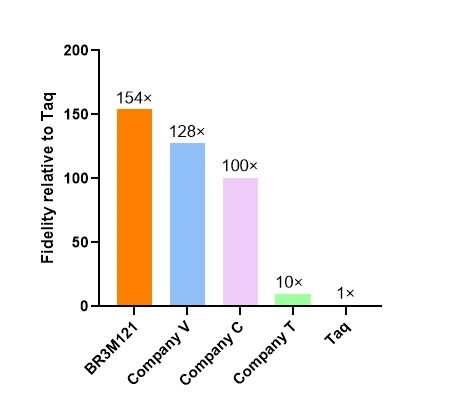
- Fidelity numbers can’t be compared across methods: blue-white screening (low cost but blind to synonymous mutations), Sanger sequencing (precise, detects synonymous mutations, costly at scale — BIORI BR3M121 used exactly this method and measured about 154× the fidelity of standard Taq) and NGS (fast and accurate but requires a specialized platform, with limited read length). Only values measured under the same method, the same cycling parameters and the same definition of error rate can be compared directly; across methods you can compare trends and rankings, not numbers.
- Two practical reminders: high-fidelity products are “filed down” to blunt ends and cannot go straight into TA cloning (you need A-tailing or blunt-end cloning). And even with a high-fidelity enzyme, clones still must be sequenced — the enzyme only lowers the probability of “random mismatches introduced during amplification,” and many other steps in clone construction can corrupt the sequence.
- Blended enzymes are the “efficiency-first” compromise: Taq plus a small amount of a proofreading enzyme borrows Taq’s yield, robustness and 3′-A tailing, reaching only a few-fold fidelity gain over pure Taq. The reason to pick a blend is never “most accurate” — it’s “accurate enough, while still amplifying long fragments, crude templates and direct-amplification targets.”
Where high-fidelity enzymes and Taq come from
The “birthplace” of high-fidelity enzymes is places humans can barely survive — deep-sea hydrothermal vents and submarine volcanic vents. In the early 1990s, researchers turned their attention to superthermophilic archaea living in extremes above 90℃, and found among them family-B DNA polymerases that came with their own “backspace key”: in 1991, Mattila et al[1] reported Vent polymerase, isolated from the thermophilic archaeon Thermococcus litoralis taken from a submarine volcanic vent — the first thermostable DNA polymerase ever reported to carry 3′→5′ proofreading exonuclease activity, with a misincorporation frequency 5–10 times lower than that of thermostable enzymes without proofreading. That same year, Lundberg et al[2] reported the Pfu polymerase isolated from the superthermophilic archaeon Pyrococcus furiosus, an organism sourced from shallow-sea volcanic vents. Its 3′→5′ proofreading activity sharply pushed the amplification error rate down and made it a milestone for high-fidelity PCR. Later, Takagi et al[3] cloned and characterised KOD polymerase from Pyrococcus sp. strain KOD1, combining high fidelity with high processivity.
Worth pointing out: the single most landmark enzyme in the history of PCR, Taq DNA polymerase, does not belong to this family. Taq comes from Thermus aquaticus, a thermophilic bacterium isolated from the volcanic hot springs of Yellowstone National Park in the United States, which lives at 70–75℃. In 1988, Saiki et al first put Taq DNA polymerase to work in an in vitro PCR — which not only moved PCR toward automation but also sharply improved product specificity, because annealing and extension could be run at higher temperatures[4]. In 1989, Lawyer et al fished its full-length gene out of a genomic library — the gene is 2,499 bp with a GC content as high as 68% — then cloned it into Escherichia coli and, after induced expression and purification, obtained Taq DNA polymerase in high purity[5], which opened the door to its wide application across the life sciences.
Standard Taq
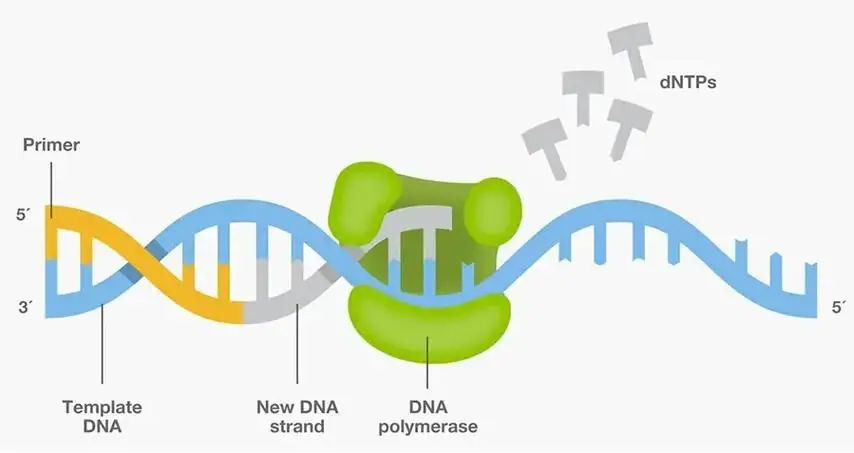
It has 5′→3′ polymerase activity and 5′→3′ exonuclease activity, but no 3′→5′ exonuclease activity. It is mainly used for simple gene fragment amplification, for example 1) qualitative detection of target nucleic acids from bacteria, viruses and the like; 2) studying how a specific gene is expressed in a plant — you amplify that gene fragment by PCR, and standard Taq copies the target DNA fast and in bulk, providing plenty of material for the experiments downstream; 3) genotype identification, where you amplify specific loci and judge the individual’s genotype from product size, sequence features and the like. The misincorporation rate of standard Taq is relatively high, roughly 10-5 errors per base per cycle[2], which means some wrong bases can get introduced while you are amplifying. So for experiments with very strict fidelity requirements, it is not the right fit.
High-fidelity enzymes
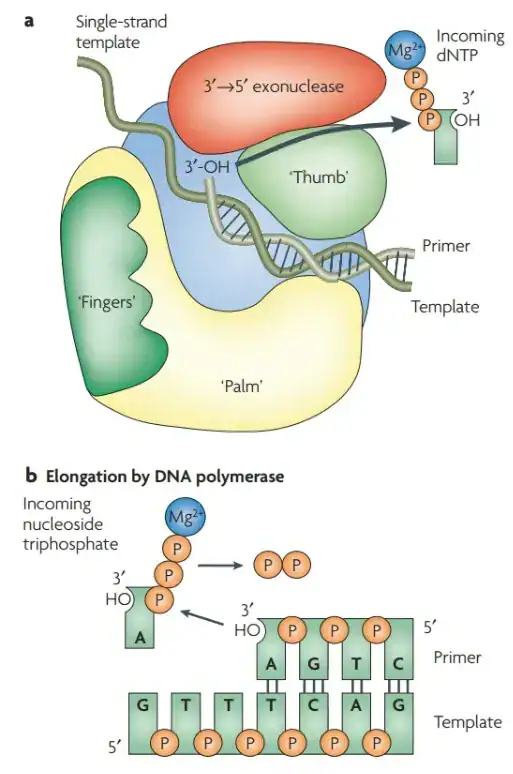
High-fidelity enzymes exist precisely to solve the high misincorporation rate of standard Taq. Their error rate can come down to the 10-7 order, thanks to a 3′→5′ exonuclease activity that corrects misincorporated bases during DNA synthesis — like a strict proofreader, making sure the amplified DNA sequence is highly accurate.
What is the fidelity of a DNA polymerase?
The fidelity of a DNA polymerase is its ability to copy the template sequence faithfully during amplification. A high-fidelity enzyme with 3′→5′ exonuclease activity can recognise a mismatched base once it has been incorporated, cut it out, and put the correct base in instead, sharply reducing the random mutations introduced by amplification.
Take BIORI AcuGenix™ LongR Super-Fidelity Master Mix (BR3M121) as an example: internal testing puts its fidelity at roughly 154 times that of standard Taq, a relatively high level among comparable products. It further lowers the chance of mismatches during amplification and provides more reliable product for applications where sequence accuracy matters — gene cloning, expression vector construction, sequencing template preparation and mutation screening.
How is DNA polymerase fidelity measured?
The common ways to measure DNA polymerase fidelity are blue-white screening, Sanger (first-generation) sequencing and NGS sequencing.
Blue-white screening
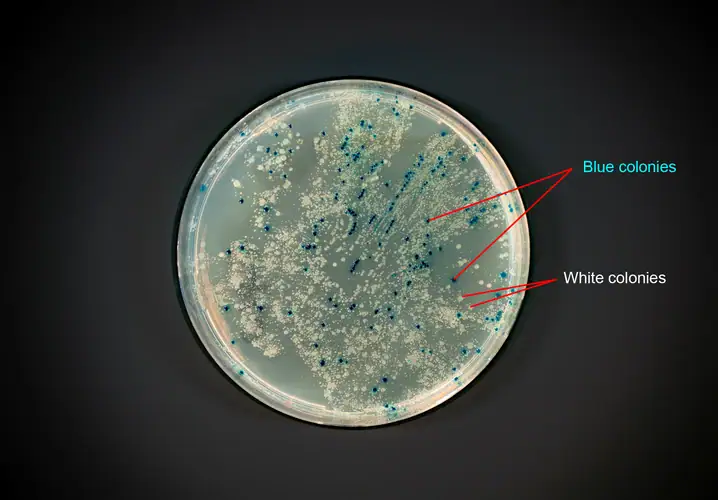
Principle: the polymerase under test amplifies the lacZ gene, and on the strength of lacZ’s α-complementation this restores β-galactosidase gene activity and produces blue colonies, so blue-white screening can be used to assess fidelity. The α-peptide encoded by lacZ (the N-terminus of the enzyme) complements the C-terminus of the β-galactosidase expressed by the β-galactosidase-deficient host strain, reconstituting an active β-galactosidase that can cleave X-gal into a blue substance and form blue colonies; blue-white screening is then used to determine the fidelity of the DNA polymerase.
Steps: amplify the lacZ gene with the DNA polymerase under test, ligate the PCR product into a linear vector to form recombinant plasmids, transform them into host cells and plate for culture, then run blue-white screening, count the blue and white plaques, and calculate the misincorporation rate. The formula is: (1 − misincorporation rate) raised to the power of (number of bases × number of cycles) = number of blue plaques / total number of plaques. If the polymerase’s misincorporation rate causes errors when the lacZ gene is amplified, β-galactosidase activity is lost and the colonies appear white.
This method is low cost and needs no supporting instrumentation, but it cannot detect synonymous mutations.
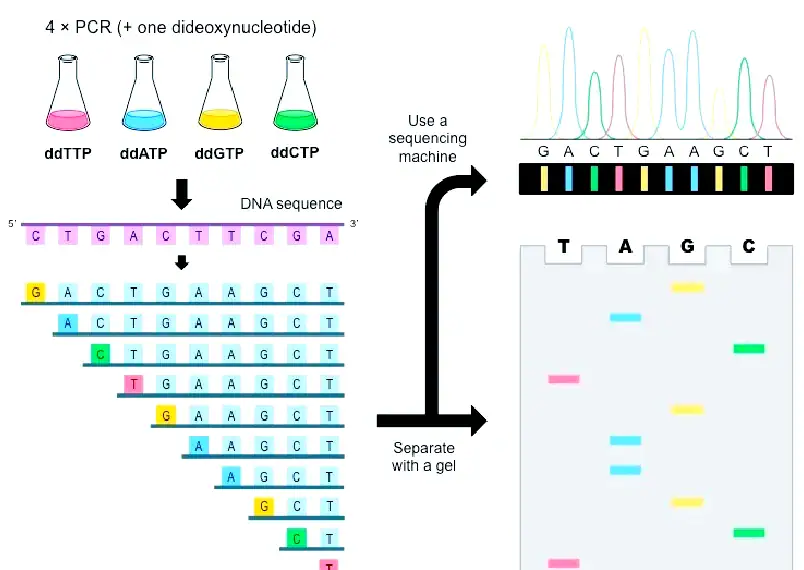
Sanger (first-generation) sequencing
Principle: clone the PCR amplification product of the DNA polymerase under test into a vector, run first-generation sequencing on single colonies, then statistically analyse the mismatched nucleotides found in the reads and calculate fidelity.
Steps: design PCR primers according to the DNA template, amplify with the DNA polymerase under test, clone the PCR product into a vector, transform host cells and plate for culture, then pick single colonies for large-batch first-generation sequencing and take the ratio of mismatched nucleotides to total nucleotides assembled as the misincorporation rate.
This method is highly accurate and can detect synonymous mutations, but running sequencing at scale is costly. BIORI BR3M121 had its fidelity measured on exactly this platform, and the experimental data are genuine and credible.
NGS sequencing
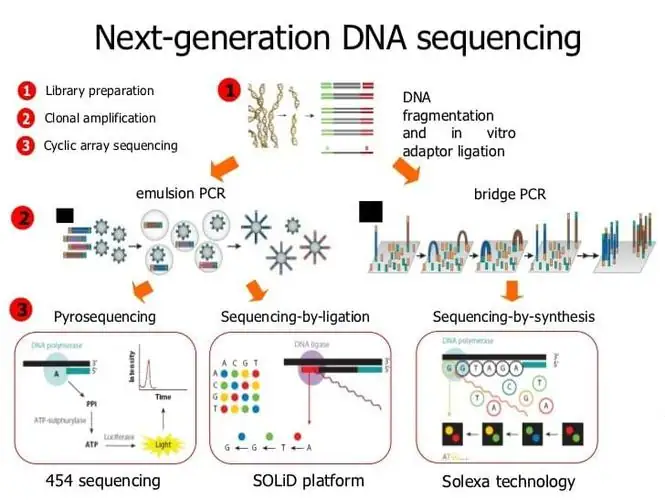
Principle: fragment the PCR amplification product of the DNA polymerase under test to the size required by the NGS platform’s read length, then analyse it on the platform, statistically process the mismatched nucleotides found in the reads and calculate fidelity.
Steps: design PCR primers according to the DNA template, amplify with the DNA polymerase under test, fragment the PCR product and build a library, sequence in both directions on the NGS platform, and keep only the data valid in both orientations. In calling a mutation, a position that reads as mutant in both directions counts as one mutation — that one was introduced by the DNA polymerase’s misincorporation rate. If only one direction reads as mutant while the other reads clean, the mutation was introduced by the sequencing platform and is not an error introduced by DNA polymerase amplification. The misincorporation rate is then the mutations introduced by DNA polymerase amplification divided by the effective amount of DNA sequenced.
This method is accurate and fast and can also detect synonymous mutations, but it requires a more specialised sequencing platform or other instrumentation, and the sequencing read length is limited.
The core differences between high-fidelity enzymes and standard Taq
| Dimension | Standard Taq | High-fidelity enzyme |
|---|---|---|
| Fidelity | Low, with a higher error rate (roughly 10⁻⁵~ 10⁻⁴ per base per cycle) | High, with an extremely low error rate (roughly 10⁻⁷ ~ 10⁻⁶ per base per cycle — 100 to 1000 times lower) |
| Error correction | No 3′→5′ exonuclease activity; cannot recognise or correct mismatched bases | Has 3′→5′ exonuclease activity (“proofreading”), cutting out the mismatched base and then re-extending |
| Source & stability | From Thermus aquaticus; thermostable (stable at 95℃) but with no 3′→5′ exonuclease activity | Mostly from high-fidelity polymerases (thermophiles such as Pfu, Phusion, etc.), or a fusion of Taq with an error-correcting enzyme — thermostable and able to proofread |
| Extension speed | Fast (about 1-2 kb/min); suits rapid amplification of short fragments (<3 kb) | Moderate (about 0.5-1 kb/min); some high-fidelity enzymes (Phusion) reach 1 kb/min and suit mid-to-long fragments (1-20 kb) |
| Product ends | Product carries a 3′ A (template-independent A-tailing), so it ligates directly into a T-vector (TA cloning) | Product is blunt-ended (the 3′→5′ exonuclease trims the extra A); needs an “A-tailing step” or blunt-end vector cloning |
| Typical use | Experiments with low sequence-accuracy requirements (routine gene detection, gel verification, short-fragment amplification) | Experiments with high sequence-accuracy requirements (gene cloning, mutation screening, sequencing, expression vector construction) |
How to choose based on the experiment
| Purpose | Preferred choice | Why |
|---|---|---|
| Routine PCR check (presence/absence) | Standard Taq | No high accuracy needed; Taq is fast and low cost and covers gel verification |
| TA cloning (direct ligation into T-vector) | Standard Taq | The product’s 3′ A pairs with the T-vector’s 3′ T, so no extra processing is needed |
| Low-cost, fast amplification | Standard Taq | High-fidelity enzymes usually cost more than Taq, so using Taq for non-critical work keeps costs down |
| Gene cloning, expression vector construction | High-fidelity enzyme | The insert has to be 100% sequence-correct, so mismatches do not derail protein expression or knock out function |
| Sequencing template prep, mutation screening | High-fidelity enzyme | The read must accurately reflect the original sequence; wrong bases scramble the chromatogram or get mistaken for mutations |
| Long-fragment amplification (>3 kb) | High-fidelity enzyme | Standard Taq on long fragments easily produces mismatches and non-specific bands; high-fidelity enzymes are better on both stability and accuracy |
FAQ
Can a high-fidelity PCR product be used for TA cloning?
Not directly. Almost all high-fidelity enzymes carry 3′→5′ proofreading activity, which “files down” the non-templated base at the end of the product, leaving blunt ends. TA cloning depends on the vector’s 3′‑T overhang pairing with a 3′‑A overhang on the insert. A blunt-ended fragment has no A tail, so it cannot pair and ligate with the T-vector effectively — direct ligation efficiency is very low, and false-positive (empty-vector) clones pile up.
Do clones built with a high-fidelity polymerase still need sequencing?
Yes, they still need sequencing. What a high-fidelity enzyme lowers is the probability of one class of error — “random mismatches introduced during amplification” — not down to zero; and in clone construction, base misincorporation by the polymerase is far from the only step where the sequence can go wrong. So the industry practice has not changed: a high-fidelity enzyme makes sequencing easier to pass, but it cannot replace sequencing.
Can I compare fidelity data measured by different polymerase assays?
You can, but with a hard constraint: only values measured under “the same assay + the same cycling parameters + the same definition of error rate” can be compared directly; across methods you can compare the trend and the ranking, not the numbers. This is stated clearly in the technical documentation from both vendors and the literature: fidelity is usually expressed as the reciprocal of the error rate, and the measured value depends heavily on amplicon length and cycle number — to compare different polymerases accurately, they must have been measured with the same method and the same cycling parameters.
What are blended enzymes (Taq + proofreading enzyme) good for?
Blended enzymes (Taq + proofreading enzyme) are the “efficiency first, accuracy second” compromise: they borrow Taq’s yield, tolerance and 3′‑A tailing ability, then add a small amount of an enzyme with 3′→5′ proofreading activity to pull the error rate down somewhat. Their fidelity is usually only a few times higher than pure Taq — far below a single high-fidelity enzyme, which runs one to two orders of magnitude higher. So the reason to pick a blend is never “the most accurate”; it is “accurate enough, while still getting the product amplified, and getting a lot of it”. Good for long-fragment amplification, crude templates, direct amplification and so on.
References
- Mattila P, Korpela J, Tenkanen T, Pitkänen K. Fidelity of DNA synthesis by the Thermococcus litoralis DNA polymerase–an extremely heat stable enzyme with proofreading activity. Nucleic Acids Res. 1991 Sep 25;19(18):4967-73.
- Lundberg KS, Shoemaker DD, Adams MW, Short JM, Sorge JA, Mathur EJ. High-fidelity amplification using a thermostable DNA polymerase isolated from Pyrococcus furiosus. Gene. 1991 Dec 1;108(1):1-6.
- Takagi M, Nishioka M, Kakihara H, Kitabayashi M, Inoue H, Kawakami B, Oka M, Imanaka T. Characterization of DNA polymerase from Pyrococcus sp. strain KOD1 and its application to PCR. Appl Environ Microbiol. 1997 Nov;63(11):4504-10.
- Saiki RK, Gelfand DH, Stoffel S, et al. Primer-directed enzymatic amplification of DNA with a thermostable DNA polymerase. Science. 1988;239(4839):487-491.
- Lawyer FC, Stoffel S, Saiki RK, Myambo K, Drummond R, Gelfand DH. Isolation, characterization, and expression in Escherichia coli of the DNA polymerase gene from Thermus aquaticus. J Biol Chem. 1989;264(11):6427-6437.
- Loeb L A, Jr R. DNA polymerases and human disease[J]. Nature Reviews Genetics.
About BIORI
Established in 2012 in Zhuhai, China, BIORI (Zhuhai Biori Biotechnology Co., Ltd.) integrates protein engineering, recombinant expression, process development and application development under ISO 9001 and ISO 13485 quality systems, backed by an in-house enzyme library of 1,000+ enzymes. The company supplies enzymes, master mixes and kits across molecular diagnostics, NGS & genomics, life science, and biopharma QC & mRNA, in standard glycerol, glycerol-free, lyo-ready and lyophilized-bead formulations.
PCR Master Mix
| Category | Representative products (Cat. No.) |
|---|---|
| High-fidelity PCR enzyme | AcuGenix™ HandyAmp Fast PCR Master Mix (Dye plus) (BR1A401) |
| AcuGenix™ LongR Super-Fidelity Master Mix (BR3M121) |