

Published by Zhuhai Biori Biotechnology Co., Ltd.
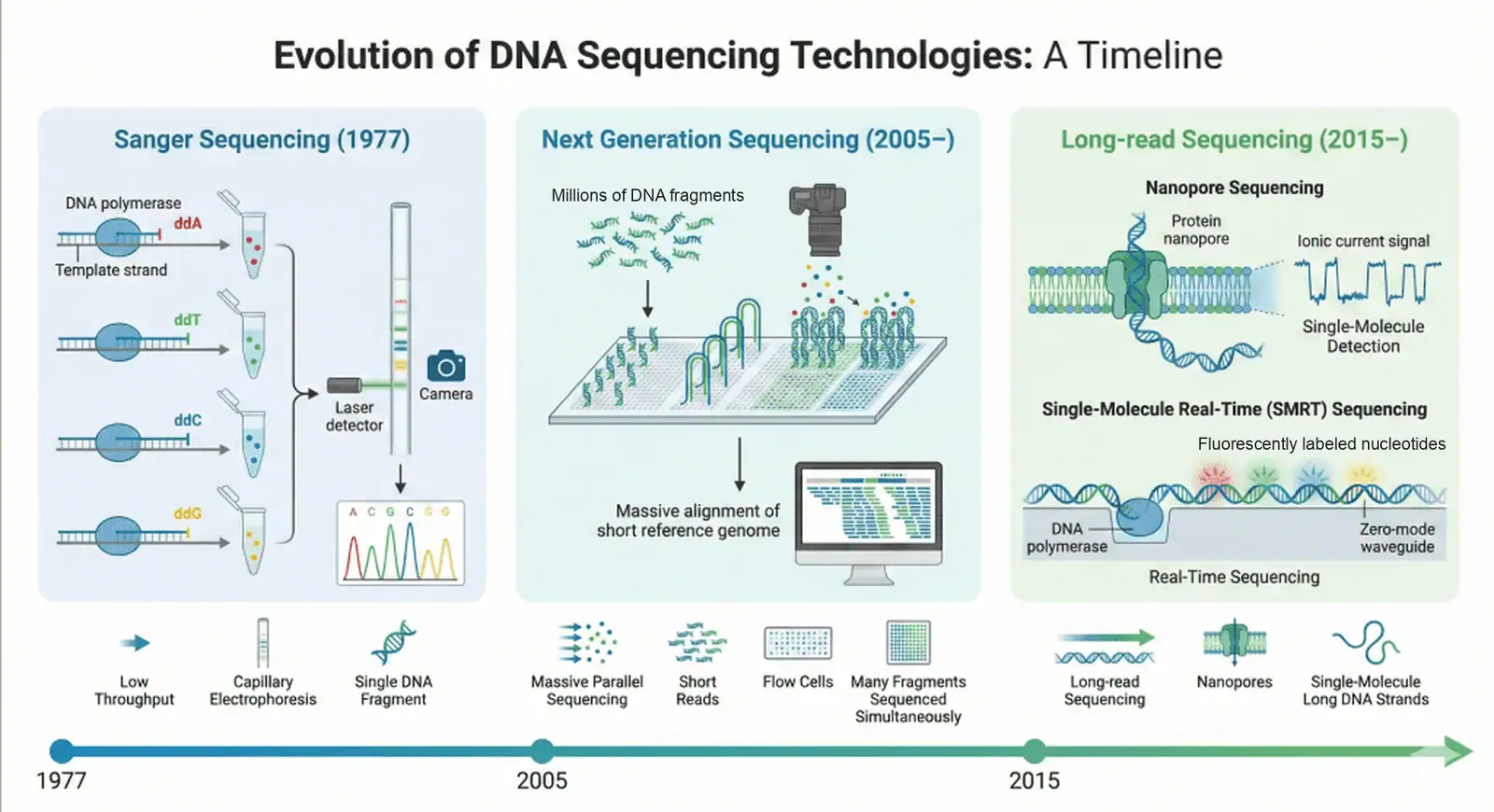
In 1977, Frederick Sanger and his team sequenced the first complete DNA genome, the Phi X 174 bacteriophage, and published the chain-termination method in the same year. Over the following half-century, sequencing technology advanced along three lines — “read accurately, read more, read longer”: the Human Genome Project published its first draft in 2001; massively parallel platforms cut costs by orders of magnitude from 2005; and single-molecule long reads pushed read length from a few hundred bases into the megabase range in the mid-2010s. The three generations are not simple replacements — they are complementary tools that trade off accuracy, throughput, read length and cost. This article compares first-, second- and third-generation sequencing across development path, technical principles and key performance parameters, and provides scenario-driven selection guidance.
1. The Development Path of Sequencing Technology
Gen 1 establishes the accuracy standard (1977-2001). Sanger’s chain-termination method was used for the first complete genome in 1977 and earned him the 1980 Nobel Prize in Chemistry. The first automated fluorescence sequencer (ABI 370A) appeared in 1986, and capillary-electrophoresis instruments (ABI 310/377) went commercial in 1998, raising throughput by roughly an order of magnitude. In 2001 the Human Genome Project — about $2.7 billion and 13 years of effort, built almost entirely on improved Sanger chemistry — published its first draft. This era set the standard of per-base accuracy above 99.99%, at the cost of low throughput and high cost.
Gen 2 makes sequencing cheap and massive (2005-present). In 2005, 454 introduced the GS20 pyrosequencing platform, sequencing hundreds of thousands of molecules in parallel — widely regarded as the start of next-generation sequencing (NGS). Solexa/Illumina’s sequencing-by-synthesis platforms scaled up in 2006-2007, and per-genome cost fell from the multi-million-dollar range to roughly $200 (Illumina NovaSeq X series, consumables at list price). NGS became the workhorse of genomics, clinical testing and industrial applications, establishing the “read more, read cheaply” path.
Gen 3 completes the long-read picture (2011-present). PacBio’s single-molecule real-time (SMRT) sequencing launched in 2011, and Oxford Nanopore Technologies (ONT) nanopore sequencing followed in 2014. Third-generation systems read single native molecules without PCR amplification, extending reads from a few hundred bases to tens of kilobases and beyond. PacBio HiFi high-accuracy long reads went mainstream in 2019; the Telomere-to-Telomere (T2T) Consortium published the first complete human genome, T2T-CHM13, in 2022, closing roughly 8% of the previous reference; and Revio/Vega platforms have driven long-read costs down since 2023. This generation fills the blind spots of repeats, structural variants and base modifications — the “read longer” line.
2. First-Generation Sequencing: Sanger, the Gold Standard for Accuracy
Chemistry. Sanger sequencing (dideoxy chain termination) was developed by Frederick Sanger and is built on the natural process of DNA replication. The reaction combines template DNA, a primer, a DNA polymerase, standard dNTPs and fluorescently labeled ddNTPs; because ddNTPs lack the 3′-OH group required for extension, incorporation terminates the chain, generating fragments of defined lengths. The earliest implementations ran four separate reactions (one per ddNTP) and resolved fragments on slab gels. Modern instruments label all four ddNTPs with distinct fluorophores, run a single reaction and read out the sequence automatically via capillary electrophoresis (e.g., Thermo Fisher’s 3730XL, which runs up to 96 capillaries in parallel).
A contemporary alternative, the Maxam-Gilbert chemical degradation method (developed 1976-1977 by Allan Maxam and Walter Gilbert), selectively modified bases with chemical reagents, cleaved the DNA backbone at the modified sites, and inferred the sequence from fragment sizes on electrophoretic gels. Because it is laborious, relies on hazardous chemicals and is difficult to automate, it has been largely superseded by Sanger chemistry and NGS.
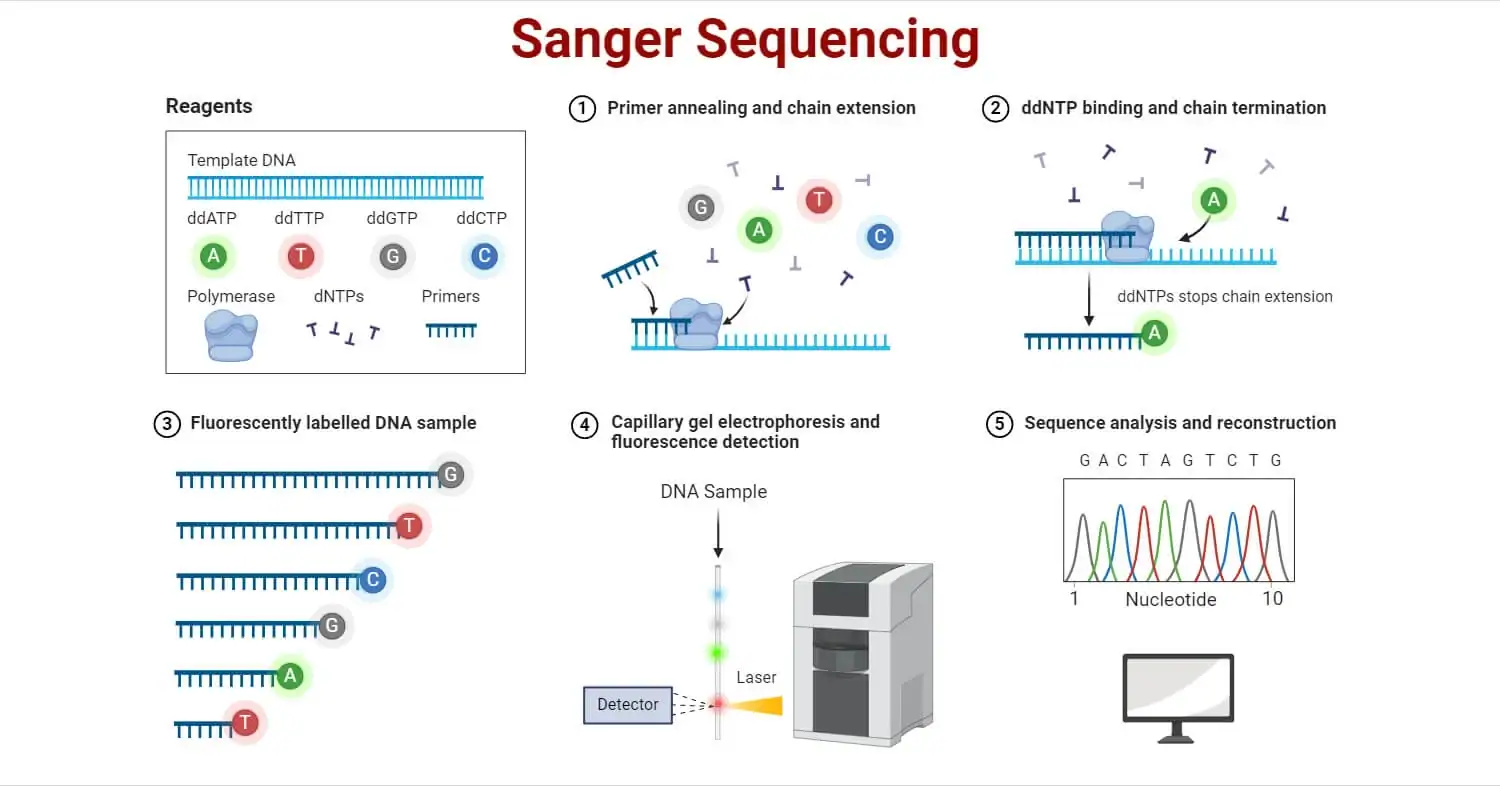
Today Sanger sequencing has a well-defined niche: plasmid and construct confirmation, CRISPR edit verification, and orthogonal confirmation of NGS-detected variants (the error profiles of the two methods are largely uncorrelated, so each validates the other), as well as small-scale assays of known loci.
3. Second-Generation Sequencing (NGS): The High-Throughput Workhorse
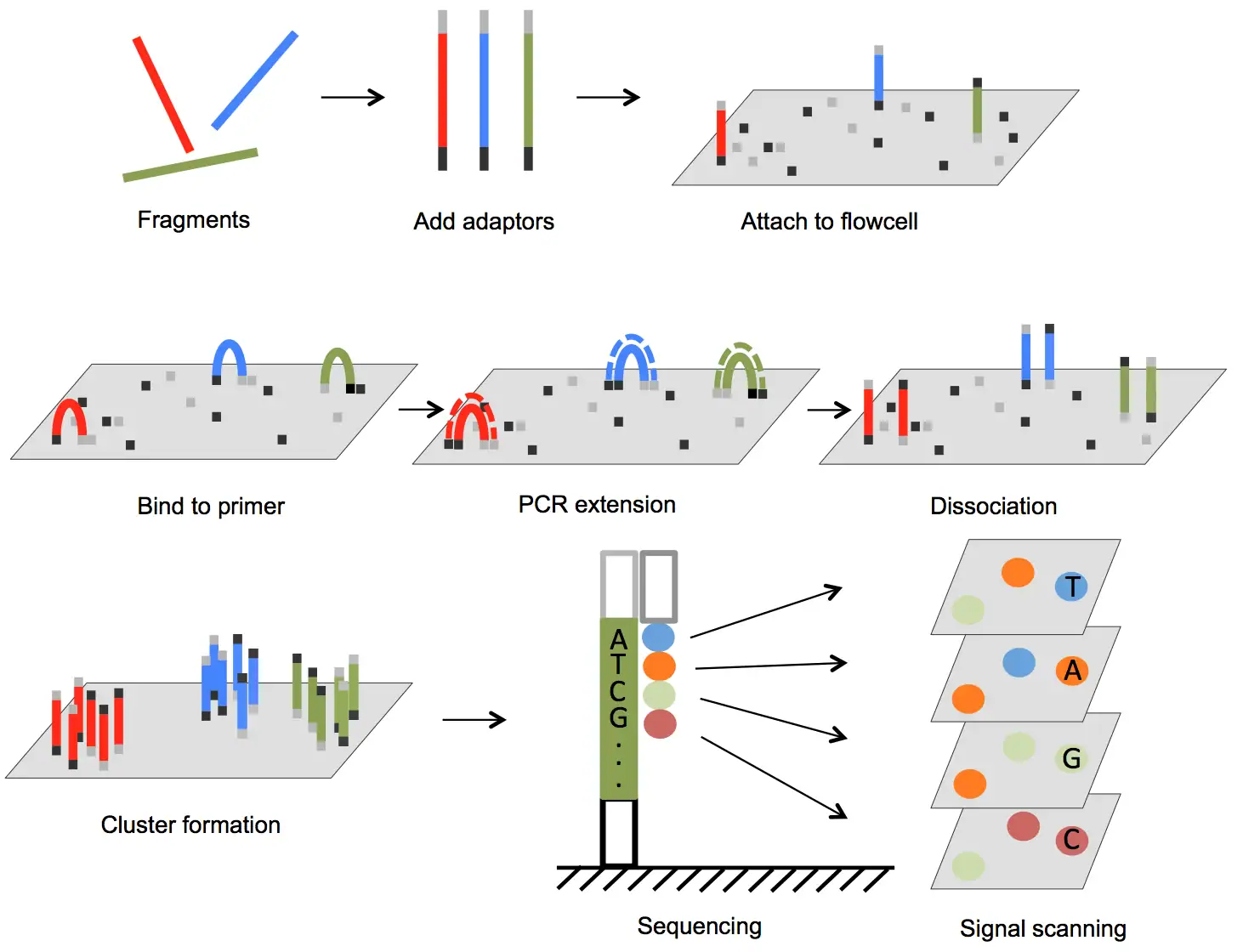
Workflow. NGS sequences millions to billions of DNA fragments simultaneously (see our overview of enzyme-based library preparation for NGS). Library preparation on Illumina platforms typically involves: end repair to blunt uneven ends and add an A-tail; ligation of adapters that carry Read 1/Read 2 primer-binding sites, a sample-distinguishing index and the P5/P7 sequences used for flow-cell anchoring; bead-based purification to remove enzymes, short fragments and adapter dimers while controlling insert size; a PCR enrichment step that completes the index and P5/P7 sequences; and a final clean-up with concentration and size QC before loading.
Sequencing then proceeds in two stages. Cluster generation: library fragments hybridize to P5/P7 oligonucleotides on the flow-cell surface, and bridge PCR amplifies each fragment into thousands of clonal copies to boost signal. Sequencing by synthesis: reversibly terminated, fluorescently labeled dNTPs are incorporated one base per cycle, imaged, and then unblocked for the next cycle; Read 1, the index and Read 2 are read in sequence, followed by base calling and FASTQ output. Platforms such as MGI (DNBSEQ) and Thermo Fisher (Ion Torrent) use different chemistries but similar workflows.
Key parameters. Mainstream read lengths are 2×150 to 2×300 bp. Quality is expressed as Q30: on the NovaSeq X series, ≥85% of bases exceed Q30 at 2×150 bp, corresponding to >99.9% per-base accuracy. The NovaSeq X Plus produces up to 16-21 Tb per dual flow cell run — roughly 128 human genomes at 30× coverage — and the $200 human genome is achievable on the 25B flow cell at list price (sequencing consumables only, assuming 100 Gb per genome).
Strengths and limitations. NGS offers unmatched throughput and the lowest cost per base, powering whole-genome and whole-exome sequencing, RNA-seq, oncology panels, non-invasive prenatal testing and metagenomics. Its limitations are equally clear: short reads (<300 bp) cannot resolve most repetitive regions and homologous sequences — studies show that short-read technologies miss more than 70% of human structural variants >50 bp, and that more than 15% of the genome (telomeres, centromeres, high-GC regions) remains difficult to assemble or cover, with coverage dropping up to ~2-fold where GC content exceeds 45%; cluster generation depends on PCR amplification, introducing amplification and GC bias; and base modifications cannot be read directly — DNA methylation typically requires bisulfite conversion or WGBS/RRBS workflows.[1]
4. Third-Generation Sequencing (Long Reads): Single-Molecule Resolution
Third-generation technologies share two features: single-molecule sequencing without PCR amplification, and direct reading of native DNA/RNA molecules with reads of tens of kilobases or more. Typical applications include de novo assembly of complex genomes, structural-variant and phasing analysis, high-GC genomes, full-length 16S/ITS microbial identification, full-length transcriptome sequencing (Iso-Seq) and methylation research.
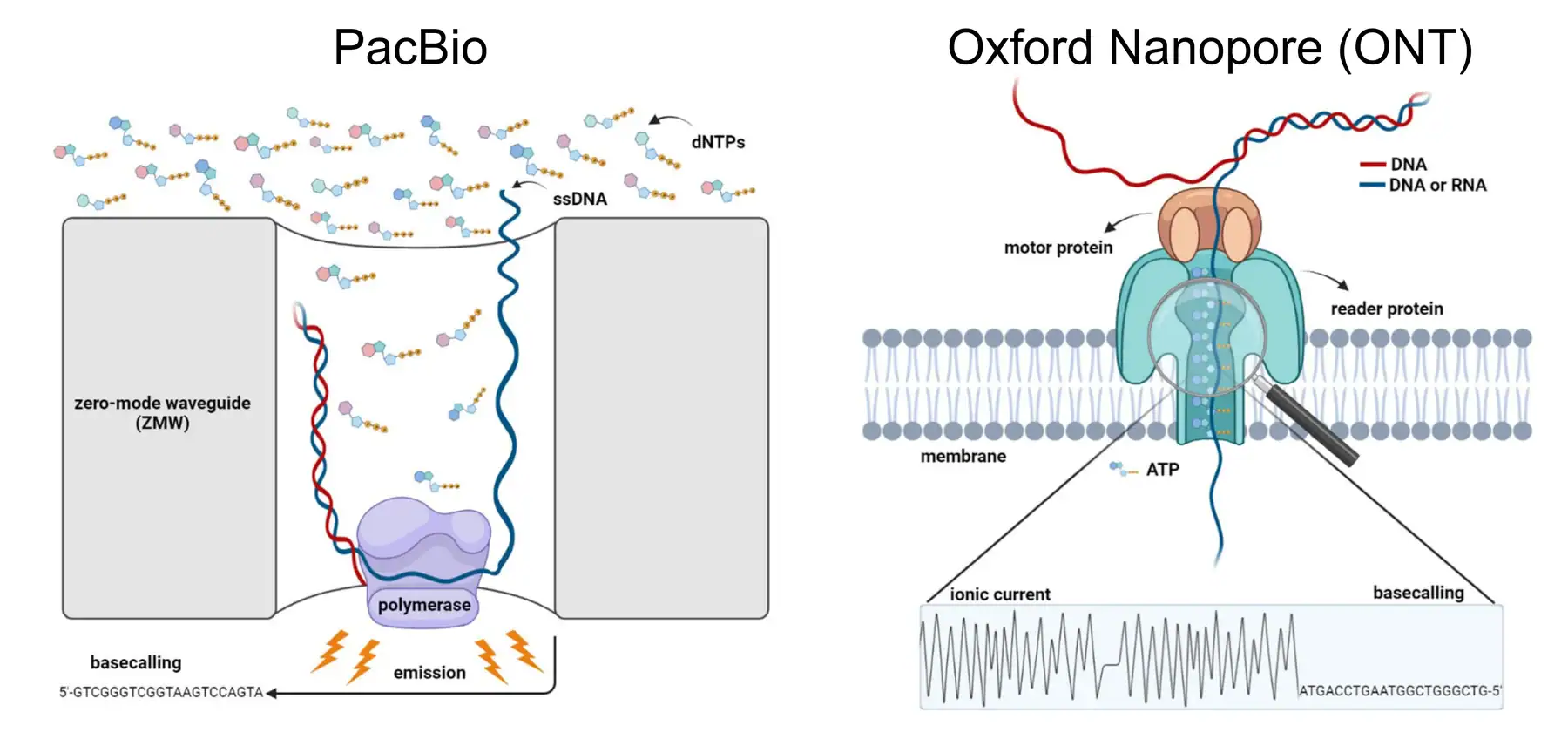
PacBio SMRT and HiFi. PacBio ligates hairpin adapters to linear DNA to form circular SMRTbell templates, anchored to a DNA polymerase at the bottom of zero-mode waveguides (ZMWs). As the polymerase synthesizes, it incorporates fluorescently labeled dNTPs; a camera records the fluorescence pulse of every incorporated base in real time.
Two data types are available. Continuous long reads (CLR) span 5-60+ kb at 87-92% single-pass accuracy, with stochastic errors that can be corrected by consensus algorithms. High-fidelity (HiFi) reads are generated by circular consensus sequencing (CCS): the polymerase reads the same molecule 10-20 times and the subreads are merged, yielding reads of 10-25 kb with median accuracy >99.9% (≥90% of bases ≥Q30). HiFi also detects base modifications such as 5mC, 5hmC and 6mA directly, without additional library preparation, via interpulse-duration (IPD) analysis. Because no PCR amplification is involved, PacBio data show no amplification bias and more uniform coverage — an advantage in difficult, high-GC regions. According to PacBio’s official website, the Revio system needs only 500 ng of DNA and produces ~120 Gb per SMRT Cell; with SPRQ-Nx chemistry a 20× human genome costs ~$345, and the Vega benchtop runs at ~$1,100 per run.[5] Remaining challenges: throughput and cost per Gb still exceed short-read NGS; polymerases can stall in high-GC regions; and long-fragment DNA preparation is demanding on sample integrity.
Oxford Nanopore (ONT). ONT threads single-stranded DNA through a protein nanopore; a motor protein controls translocation at ~400 bases per second, and each k-mer perturbs the ionic current in a characteristic way. Machine-learning models decode the “squiggle” into sequence in real time.
Strengths: read length is not limited by library size — from 20 bp to over 4 Mb — making ultra-long reads the key to telomeres, centromeres and other repeat-rich regions; real-time sequencing returns the first reads within minutes; instruments are portable (the MinION fits in a pocket); direct RNA sequencing (and modification detection) needs no reverse transcription; flow cells can be washed and reused, lowering consumable cost; and the PromethION 2 produces a typical 200-400 Gb per run (two flow cells), with the PromethION 24 reaching 2.4-4.8 Tb.[6]
Challenges: raw read accuracy is ~Q20 (99%), with homopolymers as the dominant error source, requiring higher coverage or algorithmic correction; systematic errors limit indel-calling accuracy; raw signal data (POD5/FAST5) are large, with basecalling typically requiring GPU-class compute; and ultra-long reads are sensitive to DNA integrity, demanding careful high-molecular-weight DNA preparation.
5. Side-by-Side Comparison
| Dimension | 1st Gen (Sanger) | 2nd Gen (NGS, Illumina) | 3rd Gen (PacBio HiFi) | 3rd Gen (ONT) |
|---|---|---|---|---|
| Principle | Chain termination + capillary electrophoresis | Library prep + bridge PCR + sequencing by synthesis | Single-molecule real-time + circular consensus sequencing | Nanopore ionic-current decoding |
| Representative platforms | ABI 3730 series | NovaSeq X series, NextSeq, MiSeq | Sequel IIe, Revio, Vega | MinION, GridION, PromethION |
| Read length | 600-1,000 bp | 50-300 bp (paired-end) | 10-25 kb | 20 bp to >4 Mb |
| Throughput | Low (Up to 96 reactions per run) | Very high (up to 16-21 Tb/run) | High (~120 Gb per SMRT Cell, Revio) | Medium-high (P2: 200-400 Gb; P24: up to 2.4-4.8 Tb) |
| Per-base accuracy | >99.99% | >99.9% (≥85% bases >Q30) | >99.9% (≥90% bases ≥Q30) | Raw ~Q20; improvable by consensus |
| Dominant error mode | Quality drops at both ends of the reads | Random; read-end decay | Random (eliminated by consensus) | Homopolymers; systematic errors |
| PCR amplification | Cycle sequencing (linear amplification) | Yes (bridge amplification) | No | No (PCR-free options) |
| Direct modification detection | No | No (conversion required) | Yes (5mC, 5hmC, 6mA) | Yes (e.g., 5mC) |
| Representative cost | High per base | ~$200 per human genome | ~$345-500 per human genome | ~$1,000 per human genome |
| Typical applications | Clone verification; orthogonal variant confirmation | WGS, WES, RNA-seq, panels, NIPT, metagenomics | De novo assembly, structural variants, phasing, rare disease | Ultra-long assemblies, real-time pathogen, direct RNA |
Note: Costs are list-price consumable estimates and vary by configuration, sample volume and region; Q30 denotes a base-call error rate no higher than 1 in 1,000. Sources are listed in References.
6. How to Choose: Application-Driven Selection
The first rule of platform selection is to choose by question, not by generation.
| Application scenario | Recommended combination | Rationale |
|---|---|---|
| De novo assembly / complex genomes | PacBio HiFi or ONT long reads, with NGS polishing | Long reads span repeats; balanced completeness and cost |
| Clinical diagnosis and variant confirmation | NGS discovery + Sanger orthogonal confirmation; long reads for SVs and repeat expansions | High-throughput screening complements high-accuracy verification |
| Biopharma and IVD quality control | Sanger/NGS identity testing; long reads for complex regions | Aligns with USP/WHO guidance on critical-materials identity testing, USP <1126>; USP <1046> |
| Pathogen and point-of-care | ONT real-time portable sequencing | First reads in minutes; deployable in the field |
| Full-length microbial identification (16S/ITS) | PacBio HiFi or ONT long reads | Single-molecule reads cover the full marker gene, improving genus/species resolution |
| Product development (panels/kits) | NGS-centric | Throughput and cost suit large-scale screening products |
In practice, R&D teams combine platforms according to sample volume, variant type and budget: NGS for large-scale screening and routine detection; Sanger for orthogonal confirmation of critical NGS findings; and long-read sequencing for projects involving structural variants, repeat expansions, phasing or base modifications.
7. Conclusion
Seen across nearly fifty years of development, the three generations answer different questions. Sanger sequencing remains the accuracy anchor for verification work; NGS made genome-scale screening routine through throughput and cost efficiency; and long-read platforms add what short reads cannot see — structural variants, repeat expansions and direct base-modification detection. The right platform is rarely the newest one; it is the one that fits the question you are asking and the workflow that fits your sample volume, variant types and budget. For most research, clinical and R&D teams, a combination of the three — NGS for screening, Sanger for confirmation, long reads for complex regions — is the most complete and reliable strategy.
Finally, every leap in sequencing rests on the enzymes and reagents underneath — high-fidelity polymerases, end-repair and A-tailing enzymes, and ligases for library construction; thermostable polymerases and dNTP systems for amplification; reverse transcriptases and modification enzymes for RNA and epigenetics workflows. Enzyme activity, purity, nuclease residuals and lot-to-lot consistency set the ceiling for library efficiency and data quality. As an enzyme and reagent supplier for sequencing, we aim to provide traceable, tightly QC’d raw materials to research, clinical and industrial users, and to support all three generations of workflows. This article is the opening of our technology-education series; future installments will cover library construction, different application areas, enzyme optimization and quality-control systems.
8. FAQ
What is the difference between first, second and third generation sequencing?
First-generation (Sanger, 1977) uses dideoxy chain termination read out by capillary electrophoresis: ~600–1,000 bp reads, >99.99% single-pass accuracy, but low throughput and high per-base cost. Second-generation (NGS, 2005–present; Illumina, MGI, Ion Torrent) sequences millions–billions of cloned fragments in parallel: 2×150–300 bp reads, >99.9% accuracy, Tb-scale throughput, and roughly $200 per human genome — but it depends on bridge PCR and cannot span long repeats. Third-generation (long-read, 2011–present; PacBio SMRT, Oxford Nanopore) reads single native molecules without PCR, producing reads from 10 kb to >4 Mb and resolving repeats, structural variants and base modifications directly. The three generations are complementary, not replacements — most serious genomics programs combine them.
Is Sanger sequencing still used today?
Yes. Half a century on, Sanger remains the per-base accuracy anchor (>99.99% single read) and is still indispensable for plasmid and clone confirmation, CRISPR edit verification, small-scale assays of known loci, and — critically — orthogonal confirmation of NGS-called variants. Because the error profiles of Sanger and Illumina are largely uncorrelated, a variant confirmed on both platforms carries far higher trust than one called on either alone. Most clinical NGS pipelines still route suspected positives to Sanger before reporting.
Which is more accurate, PacBio HiFi or Oxford Nanopore?
PacBio HiFi currently leads on per-base accuracy. Circular consensus sequencing reads the same SMRTbell 10–20 times and merges the subreads, yielding 10–25 kb reads at median >99.9% accuracy (≥90% of bases ≥Q30). Oxford Nanopore raw reads run at roughly Q20 (~99%) with current chemistry (earlier chemistries ran 87–98%), with homopolymers and systematic indel errors as the dominant mode; consensus polishing raises effective accuracy but does not fully eliminate the systematic component. ONT, however, wins on read length (up to >4 Mb), portability, real-time output, and direct RNA sequencing — so the choice depends on whether you need clinical-grade per-base accuracy or the longest possible molecule.
Why can’t short-read sequencing detect large structural variants?
Short reads are only 150–300 bp, and typical Illumina insert sizes are 300–500 bp. Most structural variants — deletions, duplications, inversions, translocations, and repeat expansions >50 bp — are larger than the read, and the sequence flanking them usually falls in repetitive or low-complexity DNA that maps ambiguously to the reference. Paired-end reads can only hint at SVs through discordant mapping or abnormal insert size, and published analyses show short-read platforms miss more than 70% of structural variants >50 bp. Long reads span the variant entirely, with unique flanking sequence on both sides, so they resolve it directly.
Does long-read sequencing require PCR amplification?
No. Single-molecule long-read platforms read native DNA directly, which is one of their defining differences from NGS. PacBio ligates hairpin (SMRTbell) adapters but does not PCR-amplify the insert; Oxford Nanopore offers fully PCR-free library prep. Removing PCR eliminates amplification and GC bias and enables direct detection of base modifications (5mC, 5hmC, 6mA) via inter-pulse duration (PacBio) or ionic-current signatures (ONT). For extremely low-input samples (e.g. rare single cells), a short PCR enrichment step is sometimes added, but it is optional — not a required part of the chemistry.
References
- Logsdon GA, Vollger MR, Eichler EE. Long-read human genome sequencing and its applications. Nature Reviews Genetics, 2020, 21(10):597-614. https://pmc.ncbi.nlm.nih.gov/articles/PMC7877196/
- Technology Networks. Sanger Sequencing vs NGS: When Each Method Is the Right Choice, 2026-08-31. https://www.technologynetworks.com/tn/articles/sanger-sequencing-vs-ngs-when-each-method-is-the-right-choice-415912
- Illumina. NovaSeq X Series Specifications. https://www.illumina.com/systems/sequencing-platforms/novaseq-x-plus/specifications.html
- Illumina. NovaSeq X Series Enables Broader, Deeper Sequencing. https://www.illumina.com/systems/sequencing-platforms/novaseq-x-plus/applications/broad-sequencing.html
- PacBio. Sequencing 101: Comparing Long-Read Sequencing Technologies, 2024-07-18 (updated 2026-04-16). https://www.pacb.com/blog/sequencing-101-comparing-long-read-sequencing-technologies/
- Oxford Nanopore Technologies. Platform Solution. https://nanoporetech.com/platform
- Shendure, J., Balasubramanian, S., Church, G. et al. DNA sequencing at 40: past, present and future. Nature 550, 345-353 (2017). https://doi.org/10.1038/nature24286.
- Nurk S, Koren S, Rhie A, et al. The complete sequence of a human genome. Science, 2022, 376(6588):44-53. https://www.science.org/doi/10.1126/science.abj6987
About BIORI
Established in 2012 in Zhuhai, China, BIORI (Zhuhai Biori Biotechnology Co., Ltd.) integrates protein engineering, recombinant expression, process development and application development under ISO 9001 and ISO 13485 quality systems, backed by an in-house enzyme library of 1,000+ enzymes. The company supplies enzymes, master mixes and kits across molecular diagnostics, NGS & genomics, life science, and biopharma QC & mRNA, in standard glycerol, glycerol-free, lyo-ready and lyophilized-bead formulations.