

Published by Zhuhai Biori Biotechnology Co., Ltd.
In double-stranded adapter ligation, the standard route in Illumina and MGI library prep, each fragment end needs a 5′ phosphate and a 3′ hydroxyl, and its shape has to suit the adapter: blunt, or a single 3′ A overhang for sticky-end ligation to T-overhang adapters. Blunt ends can take adapters as well, but they are prone to self-ligation and by-products. Fragmented DNA rarely meets these ligation requirements directly. End repair and dA-tailing get it there, and four enzymes do nearly all of the work: T4 polynucleotide kinase (T4 PNK), T4 DNA polymerase, Klenow fragment and Klenow exo⁻. For NGS library prep developers and sequencing labs, this article covers what fragment ends look like, what each enzyme does, BIORI’s recommended reaction conditions, FFPE and cfDNA samples, and how a single-tube module such as the AcuGenix™ Universal DNA Fragmentation Module (BR3N602) combines the steps.
What DNA Ends Look Like After Fragmentation
Few fragments are ready to ligate. Physical shearing and enzymatic cutting leave a mix of 5′ overhangs, 3′ overhangs and blunt ends, and some ends lack a 5′ phosphate, which is why library protocols blunt and phosphorylate every end before ligation.[1]
T4 DNA ligase joins a 5′ phosphate to a 3′ hydroxyl. Illumina- and MGI-compatible adapters also carry a single 3′ T overhang, so each insert end needs a single 3′ A overhang to pair with it. The end-prep step therefore has three jobs: make every end blunt, put a phosphate on every 5′ end and a hydroxyl on every 3′ end, and then add one A to each 3′ end (Figure 1). Because A cannot pair with A, or T with T, A-tailed inserts do not join to each other and the adapters do not self-ligate, which keeps chimeras and adapter dimers down.
Some samples start further from that state:
- Plasma cfDNA is cut by nucleases in the body, and one study found single-stranded jagged ends on 87.8% of plasma DNA molecules.[2]
- FFPE DNA is fragmented during fixation and storage and also carries base damage and abasic sites.[3]
- DNA digested with micrococcal nuclease, as in MNase-based chromatin work, ends in a 5′ hydroxyl and a 3′ phosphate, the opposite of what ligation needs.
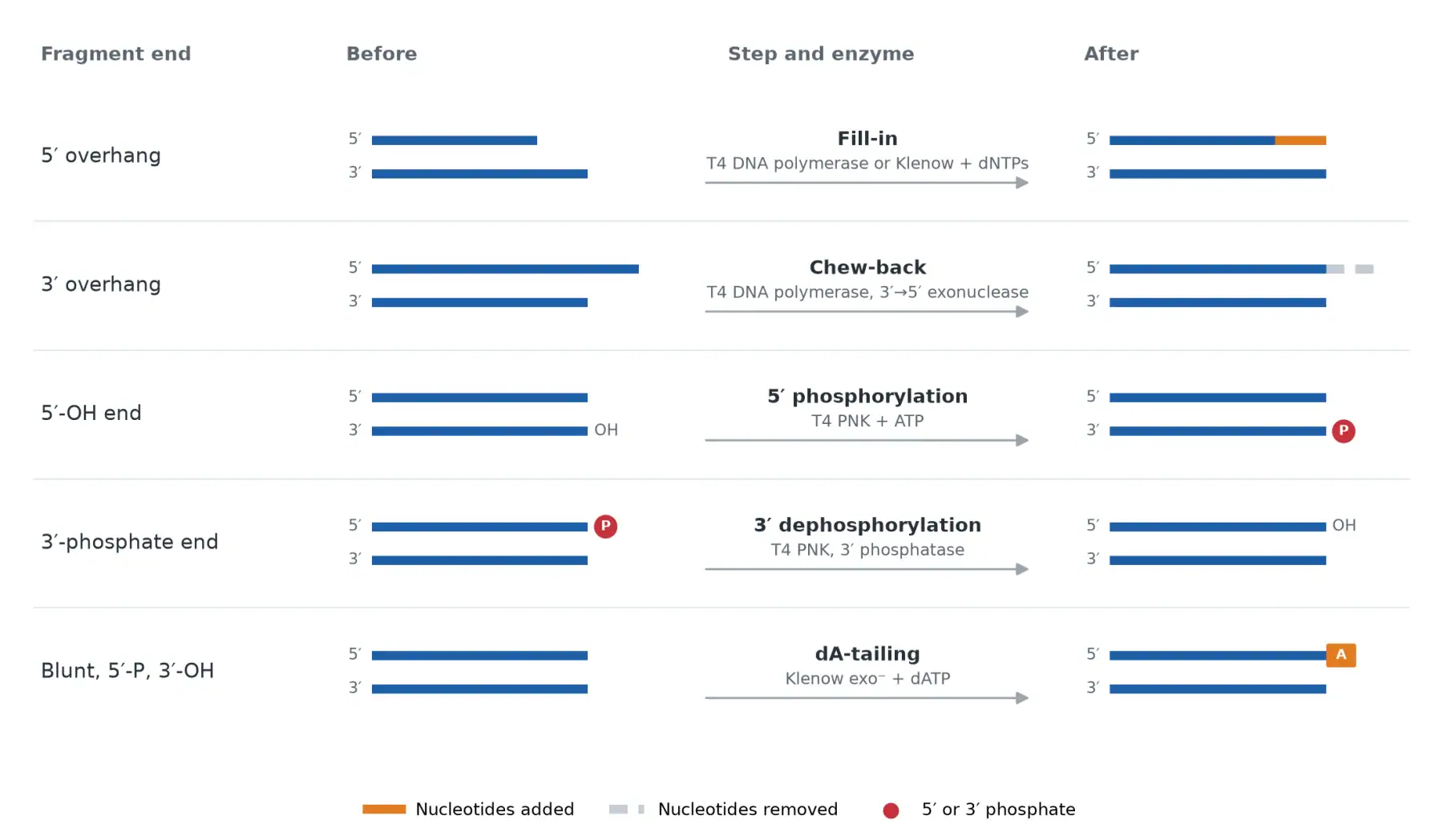
Table 1 lists the enzyme behind each step, with the reaction conditions from BIORI’s instruction manuals.
| Step | Enzyme and BIORI cat. no. | Activity used | Recommended reaction (BIORI manual) | Heat inactivation |
|---|---|---|---|---|
| 5′ phosphorylation, 3′ phosphate removal | T4 Polynucleotide Kinase (T4 PNK), BR3P303 (10 U/µL) | 5′ kinase (needs ATP); 3′ phosphatase | 10 U in 20 µL with 1 mM ATP; 37 °C, 30 min | 72 °C, 10 min |
| Fill-in and chew-back to blunt ends | T4 DNA Polymerase, BR3P302 (3 U/µL) | 5′→3′ polymerase; strong 3′→5′ exonuclease | 3 U in 25 µL with 400 µM dNTPs; 20 °C, 10 min | 72 °C, 10 min |
| Fill-in of 5′ overhangs | Klenow Fragment (DNA Polymerase I Large Fragment), BR3P305 (10 U/µL) | 5′→3′ polymerase; weaker 3′→5′ exonuclease | 5 U in 20 µL with 50 µM dNTPs; 37 °C, 10 min | 75 °C, 10 min |
| dA-tailing | Klenow Fragment (3′→5′ exo⁻), BR3P108 (5 U/µL) | 5′→3′ polymerase, no exonuclease | Up to 15 U per 50 µL; for A-tailing, dATP only (0.1 mM, 37 °C, 30 min)[4] | 75 °C, 10 min |
| All of the above, plus fragmentation, in one tube | AcuGenix™ Universal DNA Fragmentation Module, BR3N602 | Engineered enzyme mix | 5 µL buffer + 5 µL enzyme in 50 µL; 30 °C, 1–20 min (time selects insert size), then 65 °C, 30 min | None; ligation follows in the same tube |
Scale the enzyme amount to the number of DNA ends rather than to mass: the same 100 ng contains far more ends at 150 bp than at 1 kb.
T4 PNK: Three Activities Behind Polynucleotide Kinase Function
T4 PNK fixes the chemistry of the ends, not their shape. It adds the 5′ phosphate that ligase needs and removes 3′ phosphates that block both polymerases and ligase.
The T4 Polynucleotide Kinase (BR3P303) manual lists three activities:
- Forward reaction (5′ kinase). Transfers the γ-phosphate of ATP to a 5′ hydroxyl on dsDNA, ssDNA or RNA. End repair relies on this one.
- Exchange reaction. With excess ADP, it swaps an existing 5′ phosphate for a new one. This matters for end labeling, not for library prep.
- 3′ phosphatase. Removes a 3′ phosphate and leaves a 3′ hydroxyl. A polymerase cannot extend a 3′ phosphate and ligase cannot join it, so this activity rescues ends that would otherwise drop out of the library.
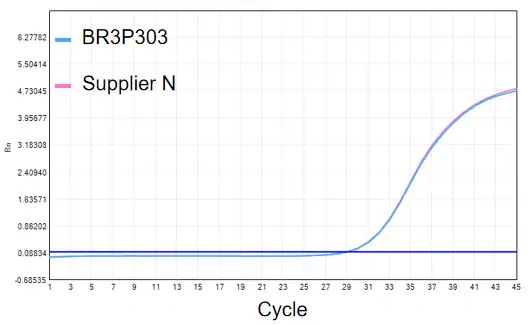
The third activity is why the kinase belongs in end repair for FFPE, cfDNA and nuclease-treated DNA, where intact molecules are scarce and every blocked end is a molecule lost before PCR. Figure 2 compares BR3P303 with a commercial enzyme by the result that matters for library prep: after end treatment with either enzyme at the same concentration, the DNA was ligated to adapters and qPCR measured the adapter-ligated product. The two enzymes give the same Ct, so the same proportion of the DNA carried adapters.
Two practical points:
- ATP must be present. T4 DNA ligase buffer contains ATP, so PNK works in it.[5]
- Watch for carry-over inhibitors. 7 mM ammonium sulfate inhibits the kinase by about 75%, and high salt and phosphate also slow it.[5] Clean up PCR products made in ammonium sulfate buffers before phosphorylating them.
T4 DNA Polymerase: Fill-In and Chew-Back to Blunt Ends
T4 DNA polymerase makes ends blunt. It fills in 5′ overhangs and trims 3′ overhangs in the same reaction.
Its 5′→3′ polymerase extends a recessed 3′ end until it is flush with the opposite strand. Its 3′→5′ exonuclease removes protruding 3′ nucleotides and is much stronger than that of Klenow fragment or E. coli DNA polymerase I. It has no 5′→3′ exonuclease, so the 5′ ends stay intact.
The two activities only balance when dNTPs are present. At a blunt end the exonuclease removes a nucleotide and the polymerase puts it back. Without dNTPs, or once they run out, the exonuclease keeps going and leaves long 5′ overhangs, which is how ligation-independent cloning uses this enzyme on purpose. For end repair with T4 DNA Polymerase (BR3P302), that means:
- Always include all four dNTPs. The BR3P302 manual uses 400 µM dNTPs with 3 U of enzyme in 25 µL.
- Keep the temperature low and the incubation short: 20 °C for 10 minutes, then 72 °C for 10 minutes to inactivate.
- Inactivate or remove the enzyme before a separate dA-tailing step. Its exonuclease removes an added A as readily as any other 3′ overhang.
Klenow and Klenow Exo Minus: Fill-In and dA-Tailing
Klenow fills in 5′ overhangs and Klenow exo⁻ adds the A tail. The two enzymes differ by a single activity, and that activity decides where each one is used.
Klenow Fragment (BR3P305) is the large fragment of E. coli DNA polymerase I. It keeps the 5′→3′ polymerase and 3′→5′ exonuclease and has no 5′→3′ exonuclease. It fills 5′ overhangs well, but its weaker exonuclease trims 3′ overhangs slowly, so classic end repair mixes pair it with T4 DNA polymerase and T4 PNK.[1] For fill-in alone, the BR3P305 manual uses 5 U in 20 µL with 50 µM dNTPs at 37 °C for 10 minutes.
Klenow exo minus, supplied as Klenow Fragment (3′→5′ exo⁻) (BR3P108), has lost the 3′→5′ exonuclease as well. With no proofreading, a nucleotide added beyond the end of the template stays in place. Given dATP and no other nucleotide, the enzyme adds a single dA to the 3′ end of each blunt fragment, which is exactly what dA-tailing needs.
- Use dATP only. With a full dNTP mix the enzyme can fill in or extend with other bases.
- Start from clean blunt DNA. In a separate-step workflow, purify after end repair, because carried-over T4 DNA polymerase strips the new A and leftover dNTPs let other bases in. A published A-tailing protocol starts from purified blunt DNA and uses 0.1 mM dATP at 37 °C for 30 minutes.[4] The BR3P108 manual allows up to 15 U per 50 µL reaction.
- Do not use it to blunt ends. Without an exonuclease it cannot remove 3′ overhangs or its own non-templated additions.
- Taq or Klenow exo⁻. Taq polymerase also adds A, and more efficiently, but it works at high temperature. Klenow exo⁻ works at 37 °C, which suits workflows that should not be heated.[1]
How a Single-Tube Module Combines End Repair and dA-Tailing
Run as separate steps, end repair and A-tailing need a cleanup in between, because T4 DNA polymerase strips A tails and the dNTPs used for fill-in interfere with A-only tailing. Every cleanup loses DNA, which hurts most at low input. A single-tube module avoids those cleanups only because its enzyme mix is formulated and validated as one reaction; putting single enzymes into one tube does not reproduce that.
BR3N602 fragments, end-repairs and A-tails DNA in one 50 µL reaction, with no intermediate purification and under 45 minutes of hands-on time:
- Setup. DNA, 5 µL of 10× FEA Buffer and 5 µL of 10× FEA Enzyme in 50 µL, assembled on ice. Run 30 °C for the fragmentation time, then 65 °C for 30 minutes, and hold at 4 °C (heated lid at 75 °C).
- Insert size by time. On high-quality 293T gDNA, 1–3 minutes at 30 °C gives about 1,000 bp, 3–5 minutes 350 bp, 5–10 minutes 150 bp and 10–20 minutes 100 bp. The default distribution is 200–500 bp.
- Input. 0.1 ng to 1 µg of gDNA, cfDNA, FFPE DNA or PCR product.
- EDTA tolerance. Up to 0.2 mM, equal to 10 µL of TE-eluted DNA in the 50 µL reaction.
- Straight to ligation. In the AcuGenix™ Universal DNA Library Prep Kit (BR3D201), adapter, ligation buffer and DNA ligase go directly into the 50 µL dA-tailed product for 15 minutes at 20 °C.
Single enzymes are still the right choice for custom work: phosphorylating adapters or oligos with T4 PNK, blunting PCR products for blunt-end cloning or blunt-end ligation workflows, repairing MNase-digested DNA, or formulating your own end-prep mix for a kit. For how enzymatic fragmentation compares with sonication, see our article on enzyme-based library preparation.
End Repair and dA-Tailing Enzymes From BIORI
BIORI supplies each enzyme in this article as a single reagent with its own 10× buffer, and as part of integrated modules. Each batch is tested for contaminating nucleases, and every product page carries the instruction manual, COA and SDS.
- T4 PNK (BR3P303), 1,000–5,000 U; T4 DNA Polymerase (BR3P302), 300–1,500 U; Klenow Fragment (BR3P305), 300–1,500 U; Klenow Fragment (3′→5′ exo⁻) (BR3P108), 100–1,000 U.
- The AcuGenix™ Universal DNA Fragmentation Module (BR3N602) (24 and 96 reactions) and the AcuGenix™ Universal DNA Library Prep Kit (BR3D201), which adds ligation and library amplification for Illumina and MGI platforms.
- For the steps that follow: T4 DNA Ligase (BR3P301) and AcuGenix™ NGS DNA Clean Beads (BR3N401).
BIORI manufactures under ISO 13485:2016 and ISO 9001:2015 certified quality systems and supplies bulk volumes and custom formulations for kit manufacturers. Our NGS enzymes and modules overview and the NGS library preparation product selection guide show how they fit together.
FAQ
Do I need to clean up T4 PNK before ligation?
Usually not, if PNK is the only enzyme in the reaction. It is active in T4 DNA ligase buffer, which supplies the ATP, so you can phosphorylate and then go straight to ligation without changing buffer. The kinase stays active during ligation unless you heat-inactivate it (72 °C for 10 minutes for BR3P303) or remove it.[5] A cleanup is needed when PNK is part of a separate end-repair step with T4 DNA polymerase and dNTPs, because those must not reach dA-tailing. In single-tube workflows such as BR3N602 and BR3D201, ligation reagents go directly into the end-prep tube.
Can end repair reverse all types of FFPE DNA damage?
No. End repair fixes the ends of each fragment: overhangs, missing 5′ phosphates and 3′ phosphates. It does not touch damage inside the molecule. Deamination turns cytosine into uracil, and 5-methylcytosine into thymine, both of which read as C>T changes, and abasic sites cause errors during amplification.[3] Uracil-DNA glycosylase treatment removes uracil but cannot correct thymine formed from 5-methylcytosine, and cross-links are only partly reversed by heating during extraction. For FFPE samples, combine end repair with damage-aware extraction, enough input and as few cleanups as possible, and confirm low-frequency C>T variants.
Can a proofreading polymerase remove an added A overhang?
Yes. The 3′→5′ exonuclease of T4 DNA polymerase, Klenow fragment and proofreading PCR enzymes removes non-templated 3′ nucleotides, including the A tail. That is why dA-tailing uses an exonuclease-deficient enzyme such as Klenow exo⁻, and why blunt DNA from end polishing or high-fidelity PCR is purified before a separate A-tailing step.[4] Once fragments are A-tailed, do not add a proofreading enzyme before ligation.
What is the difference between Klenow and Klenow exo minus?
Both are the large fragment of E. coli DNA polymerase I without the 5′→3′ exonuclease. Klenow keeps the 3′→5′ exonuclease, so it proofreads and can trim ends; use it for fill-in, blunting and second-strand cDNA synthesis. Klenow exo⁻ has lost that exonuclease too, so non-templated additions stay on; use it for dA-tailing, random-primed labeling and other reactions where 3′ ends must not be trimmed.
Request a Sample
Browse BIORI’s NGS enzymes, and tell us your sample types and input range through our contact form to receive a sample of the single enzymes or the one-tube module that fits your end-prep workflow.
NGS reagents are for research use only unless otherwise stated; bulk and custom formulations are supplied for further manufacturing use.
References
- Head SR, Komori HK, LaMere SA, et al. Library construction for next-generation sequencing: overviews and challenges. BioTechniques. 2014;56(2):61–77. doi:10.2144/000114133
- Jiang P, Xie T, Ding SC, et al. Detection and characterization of jagged ends of double-stranded DNA in plasma. Genome Res. 2020;30(8):1144–1153. doi:10.1101/gr.261396.120
- Do H, Dobrovic A. Sequence artifacts in DNA from formalin-fixed tissues: causes and strategies for minimization. Clin Chem. 2015;61(1):64–71. doi:10.1373/clinchem.2014.223040
- New England Biolabs. A-Tailing with Klenow Fragment (3′→5′ exo–). https://www.neb.com/en-us/protocols/a-tailing-with-klenow-fragment-3-5-exo
- New England Biolabs. What factors can cause incomplete phosphorylation when using T4 Polynucleotide Kinase? https://www.neb.com/en-us/faqs/what-factors-can-cause-incomplete-phosphorylation-when-using-t4-polynucleotide-kinase