


Published by Zhuhai Biori Biotechnology Co., Ltd.
PCR extension time is the amplicon length in kb multiplied by the extension rate (seconds per kb) that your polymerase’s manual specifies. There is no single rate for a polymerase type: enzymes are engineered for different goals, such as speed, processivity, fidelity or tolerance to difficult templates, and the same enzyme can need a different rate in a different buffer. Start from the manual’s rate for your enzyme, buffer and length band.
This matters most for long amplicons, such as the 5–20 kb targets amplified for long-read sequencing, full-length transcripts and amplicon panels in NGS workflows, where too short an extension loses the longest products first. The rates quoted in this guide are examples from published manufacturer protocols and BIORI’s own manuals and tests, each with its source.
Key takeaways
- Multiply the rate by the length and round up. In published protocols, a 3 kb product needs about 3 min per cycle with wild-type Taq but 45–90 s with an engineered high-fidelity enzyme.[1,2,3]
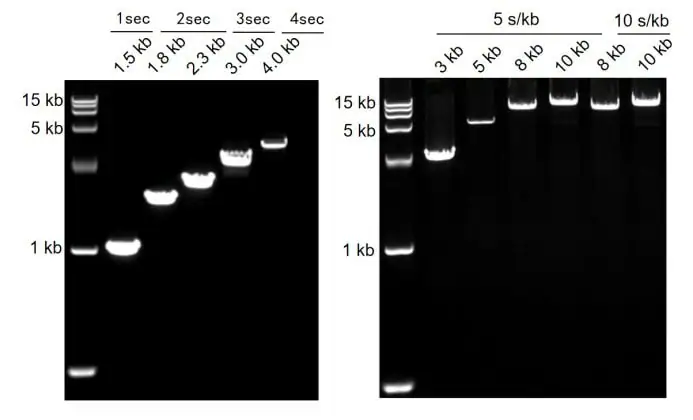
- The same enzyme can need very different times in different buffers: BIORI’s AmpHifi HS DNA Polymerase III is run at 20 s/kb in its supplied 5× HiFi Buffer III (manual recommendation) but reached 1–5 s/kb in an optimized buffer (BIORI internal data, BR3P103).
- Above about 10 kb, extension time is only one of the settings. Long-range protocols extend at 65–68 °C and add 20 s per cycle after cycle 10, but they also shorten denaturation, adjust the buffer and use polymerase blends.[4,5,6] BIORI’s BR3M121 amplifies up to 20 kb from genomic DNA at 20 s/kb.[7]
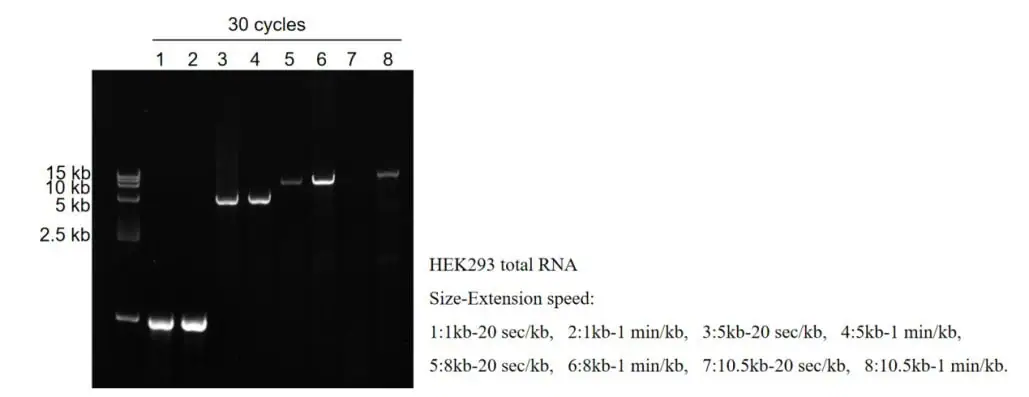
- Too short an extension loses the longest products first: with BR3M321, a 10.5 kb RT-PCR product appeared at 1 min/kb but not at 20 s/kb (BIORI internal data).
- Final extension is 2–15 min depending on the enzyme. Only non-proofreading enzymes such as Taq leave the 3′ A overhang used for TA cloning; proofreading enzymes leave blunt ends.[1,3,8]
How Long Should PCR Extension Be?
Set the PCR extension time from two numbers, the polymerase’s recommended rate in seconds per kb and the amplicon length, and round up to the next convenient step. Most protocols also set a floor for short products; one engineered Pfu enzyme, for example, uses 15 s for anything up to 1 kb.[9] Table 1 applies the rates from three published protocols to four amplicon sizes; use your own enzyme’s rate in the same way.
| Amplicon | Wild-type Taq, 1 min/kb[1] | Engineered high-fidelity, 15–30 s/kb[2,3] | Long-range blend (Taq + proofreading polymerase), 50 s/kb[10] |
|---|---|---|---|
| 1 kb | 1 min | 15–30 s | 50 s |
| 3 kb | 3 min | 45–90 s | 2.5 min |
| 5 kb | 5 min | 75–150 s | about 4 min |
| 10 kb | 10 min* | 2.5–5 min; 5–8 min for genomic DNA[2] | about 8 min |
*Most labs move to a long-range or high-fidelity enzyme well before 10 kb.
The template also changes the number. Guidance for one engineered high-fidelity enzyme is 20–30 s/kb for most templates, 30–50 s/kb for genomic DNA amplicons of 6 kb or more, and up to 40 s/kb for cDNA or long, complex templates.[2]
What Sets a Polymerase’s Rate per kb: Speed and Processivity
The amplicon length is fixed by your target, so the variable in extension time is the polymerase’s rate per kb, and that rate depends on how fast the enzyme adds bases and how many it adds before it falls off the template (processivity). Not every engineered enzyme is faster. Some are engineered for speed and processivity, others for fidelity, for tolerance to inhibitors and difficult templates, or for hot-start control, and only the first group needs less time per kb. Wang et al. fused the sequence-non-specific dsDNA-binding protein Sso7d to family A and family B polymerases; the fusions were more processive without losing activity or stability, and processivity turned out to limit PCR efficiency.[11] Enzymes built on this principle are the ones listed at 15–30 s/kb in Table 2, against about 1 min/kb for wild-type Taq.
Recommended rates also tend to include a margin. They are meant to work across many cycles and on templates that are harder to copy than a plasmid, such as genomic DNA, GC-rich regions and cDNA, so a tested minimum, such as 1 s/kb in a single gel experiment, is often lower than the rate a manual recommends; BR3M121 in Table 3 is an example.
Seconds per kb for Each Polymerase Type
Each polymerase type has its own working rate, from about 2 min/kb for native Pfu to 15 s/kb or less for engineered fusion enzymes; Table 2 lists manufacturer recommendations by enzyme type.
| Polymerase type | Extension temperature | Extension rate | Product ends | Source |
|---|---|---|---|---|
| Wild-type Taq (no proofreading) | 68 °C | 1 min/kb | 3′ A overhang | [1] |
| Native Pfu (archaeal, proofreading) | 72 °C | 2 min/kb for products up to 2 kb; longer for larger products | Blunt | [12] |
| Engineered high-fidelity (Sso7d-type fusion) | 72 °C | 15–30 s/kb; do not exceed 1 min/kb | Blunt | [2,3] |
| Engineered Pfu fusion | 72 °C (≤10 kb); 68 °C (>10 kb) | 15 s/kb up to 10 kb; 30 s/kb above 10 kb | Blunt | [9] |
| Long-range blend (Taq + proofreading polymerase) | 65 °C | 50 s/kb | Check before TA cloning | [10] |
| Fast high-fidelity master mixes | 72 °C | About 15 s/kb | Blunt | [3] |
BIORI Long-Amplicon Polymerases for NGS: Tested and Recommended Extension Rates
BIORI’s polymerases for long and NGS amplicons run at 1 s/kb to 1 min/kb depending on product, buffer and amplicon length. Two are high-fidelity DNA polymerases for long targets; the third is a one-step RT-PCR kit, in which the RNA is first reverse transcribed and the extension rate then applies to amplifying the cDNA. Table 3 gives the manual recommendations and the tested rates, kept separate from the industry figures above.
| Product | Extension temperature | Recommended extension (manual) | Tested rate (BIORI internal data) | Final extension |
|---|---|---|---|---|
| AcuGenix™ LongR Super-Fidelity Master Mix, BR3M121 | 72 °C | 1–5 s/kb (1–4 kb); 10 s/kb (4–8 kb); 10–15 s/kb (8–12 kb); 20 s/kb (>12 kb) | 1 s/kb below 4 kb; 5 s/kb for 4–10 kb | 72 °C, 3–5 min |
| AmpHifi HS DNA Polymerase III, BR3P103 | 72 °C | 20 s/kb with 5× HiFi Buffer III; 30 s/kb in a two-step program when primer Tm ≥ 72 °C | 1–5 s/kb in an optimized buffer (same extension-rate dataset as BR3M121, 1.5–10 kb); 1–20 kb in a separate length test | 72 °C, 3–5 min |
| AcuGenix™ LongR One-Step RT-PCR Kit, BR3M321 | RT at 50 °C for 30 min; extension at 72 °C | 20 s to 1 min/kb | 20 s/kb up to 5 kb; 1 min/kb above 5 kb; 1–10.5 kb from HEK293 total RNA | Not specified |
BR3M121 and BR3P103 use the same parent polymerase with different buffers, which is why their recommended rates differ by up to 20-fold. BR3M121 amplifies up to 30 kb from λ DNA or plasmids and up to 20 kb from genomic DNA, with fidelity about 154 times that of wild-type Taq. For targets above 12 kb, its manual recommends 20 s/kb and primers longer than 26 nt.[7] Figure 1 shows the extension-rate test behind its rates.
Long Range PCR Above 10 kb: Extension Time Is Only One of the Settings
Above about 10 kb, the right extension time is necessary but not sufficient, even with an engineered polymerase that is fast and highly processive: whether the full-length product forms also depends on denaturation, the buffer, the enzyme system and the template. The first long-PCR protocols changed all of these together. Cheng et al. amplified 22 kb from human genomic DNA and 42 kb from λ DNA by shortening denaturation and lengthening extension, but also by raising the pH, adding glycerol and DMSO, and including a second polymerase with proofreading activity.[4] Table 4 separates the extension settings from the rest of the long-range setup.
| Part of the setup | Typical choice | Why it matters | Source |
|---|---|---|---|
| Extension temperature | 68 °C; one engineered enzyme drops from 72 °C to 68 °C above 10 kb | Standard in long-range protocols | [5,9] |
| Extension time | 8 min for 10 kb, 15 min for 20 kb, 20 min for 30 kb (Taq-based blend) | Long products need more time per cycle | [5] |
| Extension increment | +20 s per cycle from cycle 11 | Gradually longer extension raises the yield of long products | [5] |
| Denaturation | 10–15 s at 92–94 °C | Less time at high temperature means less heat damage (depurination) to long templates | [4,5] |
| Buffer | Higher pH, with glycerol and DMSO; use the buffer supplied for the long-range protocol | Higher pH limits template damage during cycling, and the cosolvents help long strands separate; the same polymerase can need very different times in different buffers (BR3M121 and BR3P103, Table 3) | [4,7,13] |
| Enzyme system | A high level of a non-proofreading polymerase with a very low level of a proofreading polymerase | Barnes found a length limit with the non-proofreading enzyme alone; the blend overcame it and reached 35 kb from 1 ng of λ DNA | [6] |
| Accessory proteins | A dsDNA-binding domain fused to the polymerase (Sso7d type); dUTPase in archaeal-polymerase mixes | The binding domain keeps the enzyme on the template (higher processivity); dUTPase removes the dUTP that forms from dCTP during cycling and would otherwise inhibit archaeal polymerases, which lets them amplify longer targets | [11,15] |
| Template | Intact, high-molecular-weight DNA; more genomic DNA input above 15 kb | Success above 20 kb largely depends on template quality and primer sequences | [10] |
| Thermal cycler | Keep the same instrument | Long PCR is sensitive to small differences in ramp rate and heat transfer | [5] |
So when a long product is missing, check denaturation, buffer and template as well as the time per kb.
BIORI’s AcuGenix™ LongR Super-Fidelity Master Mix, BR3M121, is built for these lengths: up to 30 kb from λ DNA or plasmids and up to 20 kb from genomic DNA, with fidelity about 154 times that of wild-type Taq, which keeps errors low in long products that go on to sequencing. As a 2× master mix, it comes with the enzyme and buffer already matched. It extends at 72 °C and its manual recommends 20 s/kb above 12 kb, so a 20 kb target takes about 7 min per cycle, compared with 15 min in the Taq-based blend protocol in Table 4. For targets above 12 kb the manual also recommends primers longer than 26 nt.[7] For long RNA targets, BR3M321 amplified up to 10.5 kb from HEK293 total RNA in one tube at 1 min/kb (Figure 2).
PCR Extension Temperature: 72 °C or 68 °C?
Use the PCR extension temperature your polymerase’s protocol specifies: 72 °C for most high-fidelity enzymes, 68 °C for wild-type Taq in one widely used protocol and for many long-range programs, and 65 °C for some long-range Taq–proofreading blends.[1,2,10] In rapid-cycle experiments on a 536 bp product, an elongation temperature of 75–79 °C gave the highest yield.[16] For long products, the lower temperature is a trade-off that favors template integrity over speed.
When the primer annealing temperature is close to the extension temperature, the two steps can be combined. One wild-type Taq protocol uses a combined 65–68 °C step for primers that anneal above 65 °C.[1] BR3M121 allows a two-step program at 65–68 °C, and BR3P103 allows one when primer Tm is 72 °C or higher, with the extension set to 30 s/kb.
Final Extension in PCR and A-Tailing
A final extension in PCR of 2–15 min completes unfinished products and, for Taq, gives time to add the 3′ A overhang used in TA cloning; proofreading enzymes leave blunt ends however long the step is. Taq adds a non-templated nucleotide, mainly A, to the 3′ ends of blunt duplex products.[8,17] How much of the product is adenylated depends on the sequence: putting GTTTCTT at the 5′ end of the reverse primer gave nearly 100% adenylation, which helps genotyping that reads fragment length.[17]
| Polymerase | Final extension | Product ends | Source |
|---|---|---|---|
| Wild-type Taq | 68 °C, 5 min | 3′ A overhang | [1] |
| Native Pfu | 72 °C, 5–15 min | Blunt | [12] |
| Engineered high-fidelity | 72 °C, 2 min (some protocols 5–10 min) | Blunt | [2,3] |
| Long-range blend (Taq + proofreading polymerase) | 65 °C, 10 min | Check before TA cloning | [10] |
| Taq-based long-template blend | 68 °C, 7 min | Check before TA cloning | [5] |
For BIORI’s BR3M121 and BR3P103, the manuals specify a final extension of 72 °C for 3–5 min (Table 3).
To TA-clone a product made with a proofreading enzyme, purify it (our SPRI bead ratio guide covers cleanup) and add the A in a separate step with Taq or Klenow exo⁻; our guide to end repair and dA-tailing covers the reaction. Blends of Taq with a small amount of proofreading polymerase sit between the two: fidelity is higher than with Taq alone, and part of the product may still carry the 3′ A, so check the manual before choosing TA cloning.
Fast Polymerases: Does a Shorter Extension Cost Specificity?
Within the length a polymerase has been validated for, a shorter extension usually does not reduce specificity; going below the enzyme’s rate costs yield at the long end. In rapid-cycle PCR, specificity improved mainly through annealing of 1 s or less at 54–56 °C and fast transitions between temperatures, while longer elongation times increased yield.[16] Longer is not unlimited either: one high-fidelity enzyme guide sets an upper limit of 1 min/kb.[3]
Data from BIORI’s one-step RT-PCR kit, BR3M321, show what too short an extension looks like (Figure 2). From HEK293 total RNA, 1 kb and 5 kb products were similar at 20 s/kb and 1 min/kb. At 8 kb the band was weaker at 20 s/kb, and at 10.5 kb no product formed at 20 s/kb while 1 min/kb gave a clear band. Specificity itself depends mostly on annealing temperature, hot start and primer design; see our 12 golden rules for PCR primer design.
Troubleshooting PCR Extension Time
Most extension-time problems show up as a missing long product or a smear, and each has a specific fix (Table 6).
| What you see | Likely cause | What to change |
|---|---|---|
| Short targets work, long targets give no product | Extension below the enzyme’s rate for that length, or a setup not suited to long targets | Move to the manual’s rate for the longer length band; above 10 kb, add 20 s per cycle after cycle 10[5] and check denaturation, buffer and template (Table 4) |
| Long product present but faint | Extension at the lower limit | Increase the time one step (for example 20 s/kb to 1 min/kb for BR3M321 above 5 kb) or add cycles or template |
| Smear above the expected band | Extension, cycle number or enzyme amount too high | Return to the recommended rate; reduce cycles or template |
| Extra bands shorter than the target | Mispriming more often than short extension | Raise the annealing temperature or use a touchdown or two-step program |
| TA cloning fails | Blunt ends from a proofreading enzyme | A-tail the purified product before ligation |
Scope and Limitations
The rates in this article are manufacturer recommendations for specific enzyme–buffer combinations, not kinetic constants, and the same enzyme can need 1–5 s/kb in one buffer and 20 s/kb in another. Ramp rates differ between thermal cyclers, and long-range programs in particular may need adjusting when you change instruments.[5] GC-rich templates, cDNA and crude samples often need more time than plasmid DNA. The reverse transcription step of RT-PCR follows separate rules and is covered here only for BR3M321. BIORI’s tested rates come from defined templates; confirm the rate on your own targets before you shorten a validated program.
FAQ
What is extension in PCR?
Extension is the step in each PCR cycle in which the DNA polymerase adds nucleotides to the annealed primers and copies the template, usually at 68–72 °C. Its length depends on the polymerase and the amplicon size. The final extension is a single longer step after the last cycle that completes unfinished products and, with Taq, adds the 3′ A overhang.[1]
When can annealing and extension be combined into one step?
You can combine them when the primers anneal at or near the extension temperature. One wild-type Taq protocol uses a combined 65–68 °C step for primers that anneal above 65 °C.[1] BIORI’s BR3P103 manual allows a two-step program when primer Tm is 72 °C or higher, with 30 s/kb, and BR3M121 allows one at 65–68 °C.
Does final extension make every PCR product suitable for TA cloning?
No. Only polymerases without 3′→5′ proofreading, such as Taq, leave a single 3′ A overhang. Proofreading high-fidelity enzymes remove overhangs and produce blunt ends however long the final extension runs.[3] To TA-clone a high-fidelity product, purify it and add the A in a separate step with Taq or Klenow exo⁻.
How long should the extension be for a 10 kb amplicon?
Plan on about 1.5 to 8 min per cycle, depending on the enzyme. A long-range Taq–proofreading blend at 50 s/kb and a Taq-based long-template protocol both need about 8 min,[5,10] an engineered high-fidelity enzyme 2.5–5 min (5–8 min for genomic DNA),[2] and BR3M121 100–150 s at 10–15 s/kb. Above 10 kb, also add time in the later cycles.
Is a longer extension time always safer?
No. Extra time can raise yield up to a point,[16] but beyond what the enzyme needs it mainly lengthens the run, and one high-fidelity enzyme guide says not to exceed 1 min/kb.[3] Start at the manufacturer’s rate for your length band and lengthen it only when the longest products drop out.
Request a Sample
Send us your target lengths, template types and current cycling program through the BR3M121 product page or our contact form, and we will suggest an extension program and send a sample. To compare BIORI’s polymerases and master mixes, use the life science product selection guide. For an overview of PCR methods, see PCR vs qPCR vs RT-PCR vs dPCR.
Reagents are for research use only unless otherwise stated; bulk and custom formulations are supplied for further manufacturing use.
References
- New England Biolabs. PCR protocol for Taq DNA Polymerase with Standard Taq Buffer (M0273). https://www.neb.com/en-us/protocols/taq-dna-polymerase-with-standard-taq-buffer-m0273
- New England Biolabs. PCR using Q5® High-Fidelity DNA Polymerase (M0491). https://www.neb.com/en-us/protocols/pcr-using-q5-high-fidelity-dna-polymerase-m0491
- Thermo Fisher Scientific. Phusion High-Fidelity DNA Polymerases lab aid. https://assets.thermofisher.com/TFS-Assets/BID/Reference-Materials/phusion-dna-polymerases-labaid.pdf
- Cheng S, Fockler C, Barnes WM, Higuchi R. Effective amplification of long targets from cloned inserts and human genomic DNA. Proc Natl Acad Sci USA. 1994;91(12):5695–5699. https://doi.org/10.1073/pnas.91.12.5695
- Roche. Expand Long Template PCR System, instruction manual (Cat. No. 11681834001). https://www.sigmaaldrich.com/US/en/product/roche/elongro
- Barnes WM. PCR amplification of up to 35-kb DNA with high fidelity and high yield from lambda bacteriophage templates. Proc Natl Acad Sci USA. 1994;91(6):2216–2220. https://doi.org/10.1073/pnas.91.6.2216
- BIORI. AcuGenix™ LongR Super-Fidelity Master Mix (BR3M121) instruction manual, V01. https://biori-en.com/product/acugenix-super-fidelity-master-mix-br3m121/
- Clark JM. Novel non-templated nucleotide addition reactions catalyzed by procaryotic and eucaryotic DNA polymerases. Nucleic Acids Res. 1988;16(20):9677–9686. https://doi.org/10.1093/nar/16.20.9677
- Agilent Technologies. PfuUltra II Fusion HS DNA Polymerase instruction manual (Cat. 600670). https://www.chem-agilent.com/pdf/strata/600670.pdf
- New England Biolabs. PCR protocol for LongAmp® Taq DNA Polymerase (M0323). https://www.neb.com/en-us/protocols/m0323-longamp-taq-dna-polymerase-protocol
- Wang Y, Prosen DE, Mei L, Sullivan JC, Finney M, Vander Horn PB. A novel strategy to engineer DNA polymerases for enhanced processivity and improved performance in vitro. Nucleic Acids Res. 2004;32(3):1197–1207. https://doi.org/10.1093/nar/gkh271
- Thermo Fisher Scientific. Pfu DNA Polymerase user guide (MAN0012033). https://assets.thermofisher.com/TFS-Assets/LSG/manuals/MAN0012033_Pfu_DNAPolymerase_UG.pdf
- BIORI. AmpHifi HS DNA Polymerase III (BR3P103) instruction manual, V01. https://biori-en.com/product/amphifi-hs-dna-polymerase-v3-br3p103/
- BIORI. AcuGenix™ LongR One-Step RT-PCR Kit (BR3M321) instruction manual, V01. https://biori-en.com/product/neoscript-one-step-rt-pcr-kit-br3m321/
- Hogrefe HH, Hansen CJ, Scott BR, Nielson KB. Archaeal dUTPase enhances PCR amplifications with archaeal DNA polymerases by preventing dUTP incorporation. Proc Natl Acad Sci USA. 2002;99(2):596–601. https://doi.org/10.1073/pnas.012372799
- Wittwer CT, Garling DJ. Rapid cycle DNA amplification: time and temperature optimization. BioTechniques. 1991;10(1):76–83. https://pubmed.ncbi.nlm.nih.gov/2003928/
- Brownstein MJ, Carpten JD, Smith JR. Modulation of non-templated nucleotide addition by Taq DNA polymerase: primer modifications that facilitate genotyping. BioTechniques. 1996;20(6):1004–1010. https://doi.org/10.2144/96206st01