

Published by Zhuhai Biori Biotechnology Co., Ltd.
A standard RIPA buffer recipe is 50 mM Tris-HCl (pH 8.0), 150 mM NaCl, 1% NP-40, 0.5% sodium deoxycholate and 0.1% SDS, with protease and phosphatase inhibitors added just before lysis.[1,2] The strength of a RIPA buffer is set by its ionic detergents: more deoxycholate and SDS extract more membrane and nuclear protein but also break more protein–protein interactions.[3] Pick the strength by the downstream experiment: the classic medium recipe for routine Western blots, a strong buffer when the target is a membrane or nuclear protein, and a weak buffer when the lysate goes into co-immunoprecipitation.
Key takeaways
- RIPA buffer combines a non-ionic detergent (NP-40 or Triton X-100), an ionic bile salt (sodium deoxycholate) and a small amount of SDS in Tris-buffered saline. Published “standard” recipes differ in Tris, deoxycholate and EDTA content.[1,4]
- BIORI’s three strengths differ in deoxycholate (0.75%, 0.5% and 0.05%) and SDS (0.1%, 0.1% and none); the medium strength has the same detergent levels as the classic recipe (BIORI instruction manuals, BR4C101–104).
- Add inhibitors at 1× (1:100 from a 100× stock) within minutes of use. Lysates prepared without them lose protein to proteolysis and lose phosphorylation.[2]
- Quantify RIPA lysates with BCA or a detergent-tolerant Bradford kit, not at 280 nm. RIPA absorbs strongly at 280 nm, and a standard Coomassie (Bradford) assay tolerates RIPA only after a 1:10 dilution.[1,2]
- RIPA does not extract everything: extracellular matrix proteins stay almost entirely in the RIPA-insoluble pellet.[3]
What Is in RIPA Buffer and What Does Each Component Do?
Each component of RIPA buffer has one job: Tris and NaCl hold pH and ionic strength, the non-ionic detergent opens membranes, and deoxycholate and SDS solubilize nuclear and membrane proteins and break up complexes. Table 1 lists the RIPA buffer composition used as the reference formulation in Thermo Fisher’s protein assay compatibility tables.[1]
| Component | Standard concentration[1] | Role |
|---|---|---|
| Tris-HCl, pH 8.0 | 50 mM | Buffers the lysate |
| NaCl | 150 mM | Physiological ionic strength; reduces non-specific binding |
| NP-40 (or Triton X-100) | 1% | Non-ionic; dissolves lipid membranes without denaturing most proteins |
| Sodium deoxycholate | 0.5% | Ionic bile salt; solubilizes membrane and nuclear proteins, disrupts protein–protein contacts |
| SDS | 0.1% | Strong anionic detergent; completes solubilization |
| Protease and phosphatase inhibitors | 1×, added fresh[2] | Stop degradation and dephosphorylation |
Formulations sold as RIPA are not identical. One widely used commercial version is 20 mM Tris-HCl (pH 7.5) with 1% NP-40 and 1% sodium deoxycholate, no SDS, and 1 mM EDTA, 1 mM EGTA and phosphatase inhibitors already included.[4] Check the formulation before you compare results between labs or switch suppliers.
How to Make RIPA Buffer: 100 mL From Stock Solutions
To make 100 mL of RIPA buffer, combine 5 mL of 1 M Tris-HCl (pH 8.0), 3 mL of 5 M NaCl, 1 mL of NP-40, 5 mL of 10% sodium deoxycholate and 1 mL of 10% SDS, bring to volume with water and store at 4 °C; add inhibitors only to the aliquot you are about to use. This RIPA buffer recipe gives the standard 50 mM Tris, 150 mM NaCl, 1% NP-40, 0.5% deoxycholate and 0.1% SDS. To scale it to another volume, use the Molarity & Dilution Calculator.
| Stock solution | Volume | Final concentration |
|---|---|---|
| 1 M Tris-HCl, pH 8.0 | 5 mL | 50 mM |
| 5 M NaCl | 3 mL | 150 mM |
| NP-40 (100%) | 1 mL | 1% |
| 10% sodium deoxycholate | 5 mL | 0.5% |
| 10% SDS | 1 mL | 0.1% |
| Ultrapure water | to 100 mL | – |
| Protease / phosphatase inhibitor cocktail (100×) | 10 µL per mL, just before use | 1× |
SDS can come out of solution in the cold; if the buffer looks cloudy after storage at 4 °C, bring it to room temperature and mix before use. Table 2 already gives the medium detergent levels. For weak levels, use 0.5 mL of 10% deoxycholate and no SDS; for strong levels, use 7.5 mL of 10% deoxycholate and 1 mL of Triton X-100 instead of NP-40 (Table 3). This matches detergent levels only, not BIORI’s full formulations.
Strong, Medium or Weak RIPA: How the Three Strengths Differ
The three RIPA strengths differ mainly in ionic detergent: the strong buffer extracts the most membrane and nuclear protein, and the weak buffer, with almost no deoxycholate and no SDS, is the only one gentle enough for co-immunoprecipitation. Table 3 shows the effective lysis components and the extraction ratings from BIORI’s instruction manuals.
| Strong (BR4C101) | Medium (BR4C102) | Weak (BR4C103) | |
|---|---|---|---|
| Non-ionic detergent | 1% Triton X-100 | 1% NP-40 | 1% NP-40 |
| Sodium deoxycholate | 0.75% | 0.5% | 0.05% |
| SDS | 0.1% | 0.1% | None |
| Membrane protein extraction | Excellent | Good | Average |
| Cytoplasmic protein extraction | Excellent | Excellent | Excellent |
| Nuclear protein extraction | Excellent | Good | Good |
| Main applications | WB, IP | WB, IP | WB, IP, co-IP |
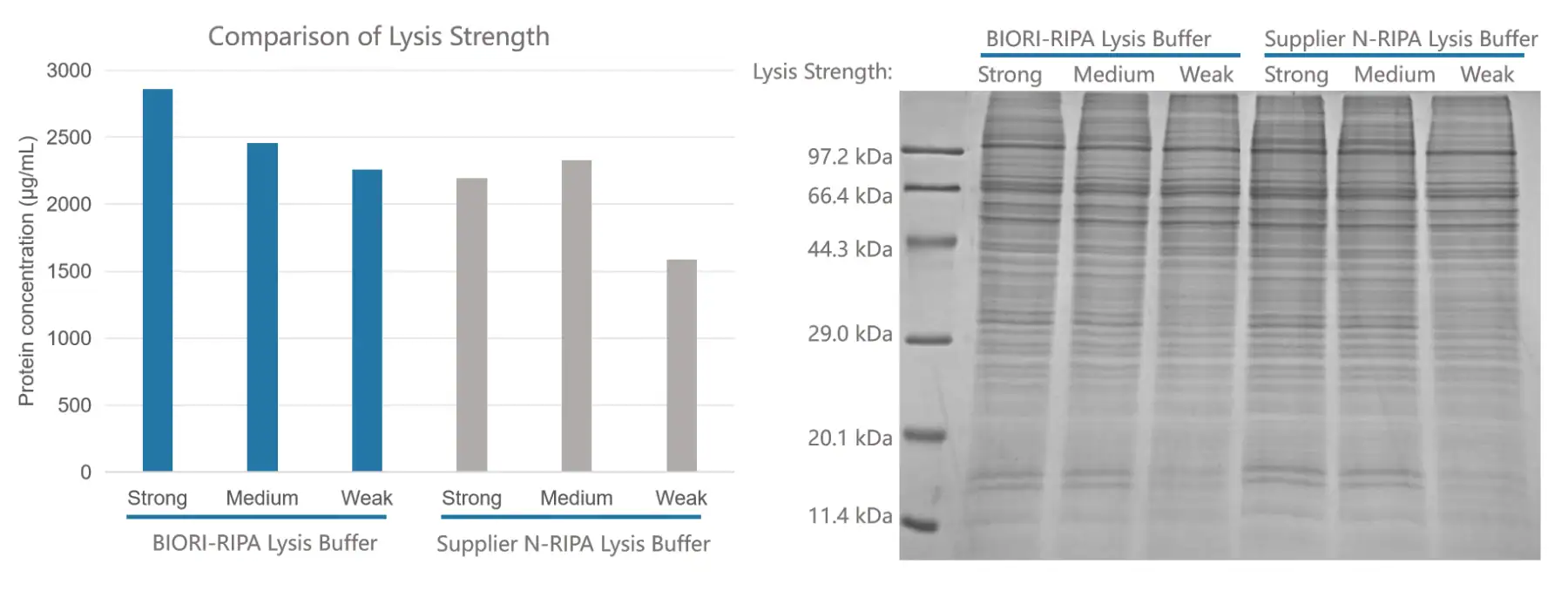
In a side-by-side test with 100 µL of buffer per 10⁶ HEK293 cells, the three BIORI strengths gave a clear concentration gradient from the same cells, highest with the strong buffer and lowest with the weak one (Figure 1; BIORI internal data, BR4C101–104). All six lysates in Figure 1 show intact bands from about 11 to 97 kDa, so the weaker buffers give lower yield, not degraded protein. The typical yields in the instruction manuals apply to all three strengths: about 2–4 mg/mL from 10⁶ animal cells in 100 µL, and about 15–25 mg/mL from 20 mg of frozen mouse liver in 200 µL, varying with cell type and tissue (BIORI instruction manuals, BR4C101–104).
Which RIPA Strength Should You Use?
Choose the RIPA strength by the downstream experiment, not by the sample type: medium for routine Western blots, strong when the blot targets a membrane or nuclear protein, any strength for immunoprecipitation, and weak for co-immunoprecipitation. Table 4 summarizes the choice; when a target is new, lysing one plate with all three strengths shows which gives the best balance of yield and band quality.
| Downstream experiment | Start with | Reason |
|---|---|---|
| Routine Western blot, cytoplasmic or total protein | Medium | Classic RIPA detergent levels; all three strengths extract cytoplasmic protein well |
| Western blot of a membrane or nuclear protein | Strong | Highest deoxycholate; rated excellent for membrane and nuclear extraction |
| Western blot of a phosphorylated protein | Same strength as for the total protein, with phosphatase inhibitors | Phospho-epitopes survive denaturation; inhibitors are what protect them |
| Immunoprecipitation of a single protein | Any of the three | The instruction manuals list all three strengths for IP; compare them if the antibody has no prior data |
| Co-immunoprecipitation | Weak | No SDS and 0.05% deoxycholate leave more complexes intact |
| Enzyme activity or other native-function assays | A non-denaturing buffer, not RIPA | RIPA detergents can denature the target (see When RIPA Buffer Is Not Enough) |
Sample type changes how you prepare the lysate, not which strength you choose. Tissue is homogenized or ground first; bacteria and yeast can be digested with lysozyme and lyticase, respectively, for better lysis; and plant, bacterial and yeast samples are lysed on ice for 2–10 minutes (BIORI instruction manuals, BR4C101–104).
A small amount of clear, gel-like material in a RIPA lysate is normal: it is genomic DNA and the proteins bound to it. Spin it down if your target is not DNA-bound; for proteins tightly bound to genomic DNA, sonicate before centrifugation to release them, although common transcription factors such as NF-κB or p53 typically do not need it (BIORI instruction manuals, BR4C101–104). Step-by-step cell, tissue, bacterial and yeast lysis is in the instruction manual on each product page.
When to Add Protease and Phosphatase Inhibitors
Add protease inhibitors to every RIPA lysis, and phosphatase inhibitors whenever you will detect a phosphorylated protein, at 1× and within minutes of use. Lysis releases endogenous proteases and phosphatases along with the target; proteolysis in a RIPA lysate indicates that protease inhibitors were not added, and low phosphorylation is usually due to phosphatase activity in a lysate without phosphatase inhibitors.[2] Do not store lysis buffer that already contains inhibitors; make up only what you need (BIORI instruction manuals, BR4C121–123).
| Cocktail | Inhibitors | Covers | Use when |
|---|---|---|---|
| Protease Inhibitor Cocktail, EDTA-Free (100×), BR4C121 | AEBSF, aprotinin, bestatin, E-64, leupeptin, pepstatin A | Serine, cysteine and aspartic proteases; aminopeptidases | Total protein, non-phospho targets |
| Phosphatase Inhibitor Cocktail (100×), BR4C122 | Sodium fluoride, β-glycerophosphate, sodium orthovanadate | Acid, serine/threonine, alkaline and tyrosine phosphatases | Added to a protease cocktail for phospho-blots |
| Protease and Phosphatase Inhibitor Cocktail, EDTA-Free (100×), BR4C123 | Both sets above in one stock | Proteases and phosphatases | Phospho-protein Western blots with a single addition |
AEBSF is a water-soluble replacement for PMSF with similar inhibition constants and better stability in aqueous solution, so there is no need for a separate PMSF stock in ethanol or isopropanol. Neither BIORI’s RIPA Lysis Buffers nor its EDTA-free cocktails (BR4C121, BR4C123) contain EDTA. To inhibit metalloproteases, add EDTA separately; if you need to preserve metalloprotease activity, do not add it.
How to Measure Protein in a RIPA Lysate
Measure protein in a RIPA lysate with a BCA assay or a detergent-tolerant Bradford assay, not at 280 nm. RIPA absorbs strongly at 280 nm, so A280 readings on a microvolume spectrophotometer over- or underestimate concentration.[2] For BCA, one supplier’s standard kit tolerates undiluted RIPA buffer, while its Micro BCA kit needs a 1:10 dilution.[1] BIORI has tested the BCA Protein Assay Kit (BR4C201) with RIPA lysates. Its standards run 20–300 µg/mL, so a lysate at 2–4 mg/mL needs at least a 7- to 14-fold dilution.
Coomassie (Bradford) reagents differ more in detergent tolerance: one supplier’s standard Coomassie assay tolerates only 0.05% sodium deoxycholate and needs RIPA diluted 1:10, and its detergent-compatible version still requires a 1:4 dilution.[1] BIORI has also tested the Bradford Protein Assay Kit (BR4C202) with RIPA lysates. The BR4C202 manual asks for detergents below 2%, which all three strengths meet, and its protocol dilutes samples 2-, 4- or 8-fold into the 100–500 µg/mL working range, so a lysate at 2–4 mg/mL needs at least a 4- to 8-fold dilution.
When RIPA Buffer Is Not Enough
RIPA buffer extracts most cytoplasmic, nuclear and mitochondrial proteins but leaves some protein classes behind, and its denaturing detergents rule it out for some downstream assays. In a proteomic study of breast tumors, nearly all extracellular matrix proteins were found in the urea-soluble fraction of the RIPA-insoluble pellet, and cytoskeletal and extracellular-region proteins were also more soluble in urea than in RIPA.[3] If your target is a matrix or cytoskeletal protein, extract the RIPA pellet with a urea-based buffer before concluding that the protein is absent.
RIPA is also a poor choice when you need native function, because it can denature kinases.[3] Enzyme activity assays, conformational antibodies and weak or transient interactions need a non-denaturing buffer with a non-ionic detergent only; the weak strength helps for robust complexes, but not for every interaction.
BIORI RIPA Lysis Buffers and Inhibitor Cocktails
BIORI supplies the three RIPA strengths ready to use, either separately or as a set for testing a new target, together with the inhibitor cocktails and protein assays used downstream. RIPA Lysis Buffer (Strong), BR4C101, Medium, BR4C102 and Weak, BR4C103 come in 100 mL; the RIPA Lysis Buffer Set, BR4C104 contains 50 mL of each strength. All are stored at 2–8 °C. The 100× inhibitor cocktails (BR4C121–123) are supplied as 1 mL stocks, enough for 100 mL of lysis buffer, and stored at −20 °C. A Cell Total Protein Extraction Kit (BR4C131) and the rest of the Western blot workflow are listed under Protein Research. Instruction manuals and COAs are on each product page.
| Cat. No. | Product | Description | Recommended use |
|---|---|---|---|
| BR4C101 | RIPA Lysis Buffer (Strong) | Strong-strength RIPA lysis buffer | Thorough cell and tissue lysis for Western blot |
| BR4C102 | RIPA Lysis Buffer (Medium) | Medium-strength RIPA lysis buffer | Cell and tissue lysis for Western blot |
| BR4C103 | RIPA Lysis Buffer (Weak) | Weak-strength RIPA lysis buffer | Gentle cell and tissue lysis |
| BR4C104 | RIPA Lysis Buffer Set | Strong, medium and weak RIPA buffers in one set | Cell and tissue lysis at the strength you need |
| BR4C121 | Protease Inhibitor Cocktail, EDTA-Free (100×) | EDTA-free 100× protease inhibitor cocktail | Preventing protein degradation in lysates |
| BR4C122 | Phosphatase Inhibitor Cocktail (100×) | 100× phosphatase inhibitor cocktail | Preserving protein phosphorylation in lysates |
| BR4C123 | Protease and Phosphatase Inhibitor Cocktail, EDTA-Free (100×) | Protease and phosphatase inhibitors in one EDTA-free 100× cocktail | Protecting proteins and phosphorylation in lysates |
FAQ
Can RIPA buffer be used for co-immunoprecipitation?
Only a weak RIPA, and only for stable complexes. Standard RIPA contains 0.5% deoxycholate and 0.1% SDS, which break many protein–protein interactions;[3] a weak formulation such as BR4C103 (1% NP-40, 0.05% deoxycholate, no SDS) keeps more complexes intact. For weak or transient interactions, use a buffer with a non-ionic detergent only.
Does RIPA buffer already contain protease inhibitors?
Usually not. Many RIPA buffers, including Thermo Fisher’s[2] and BIORI’s, are supplied without inhibitors so that you can add a fresh cocktail at 1× just before lysis. Buffer that already contains inhibitors should be used immediately rather than stored (BIORI instruction manuals, BR4C121–123). Some commercial formulations do include phosphatase inhibitors and leupeptin,[4] so check the label before adding more.
Can I measure protein at 280 nm in RIPA buffer?
No. RIPA buffer absorbs strongly at 280 nm, which distorts both the concentration and the 260/280 purity ratio.[2] Use a BCA or detergent-tolerant Bradford assay instead, with the lysate diluted as the kit manual specifies.
Request the RIPA Lysis Buffer Set
Tell us your target protein and downstream assay through the RIPA Lysis Buffer Set page or our contact form, and we will suggest a starting strength and inhibitor combination.
Products are for research use only.
References
- Thermo Fisher Scientific. Protein quantitation assay compatibility table (Tech Tip TR0068). https://assets.thermofisher.com/TFS-Assets/LSG/Application-Notes/TR0068-Protein-assay-compatibility.pdf
- Thermo Fisher Scientific. RIPA Lysis and Extraction Buffer (Cat. No. 89900), product page and FAQs. https://www.thermofisher.com/order/catalog/product/89900
- Ngoka LC. Sample prep for proteomics of breast cancer: proteomics and gene ontology reveal dramatic differences in protein solubilization preferences of radioimmunoprecipitation assay and urea lysis buffers. Proteome Sci. 2008;6:30. doi:10.1186/1477-5956-6-30
- Cell Signaling Technology. RIPA Buffer (10X) #9806, product information. https://www.cellsignal.com/products/buffers-dyes/ripa-buffer-10x/9806