

Published by Zhuhai Biori Biotechnology Co., Ltd.
Source: Luo G, Song J, Fu Y, …, Wu Q, Tan W. SPARK-seq: A high-throughput platform for aptamer discovery and kinetic profiling. Science. 2026;391(6780):eadv6127. doi:10.1126/science.adv6127
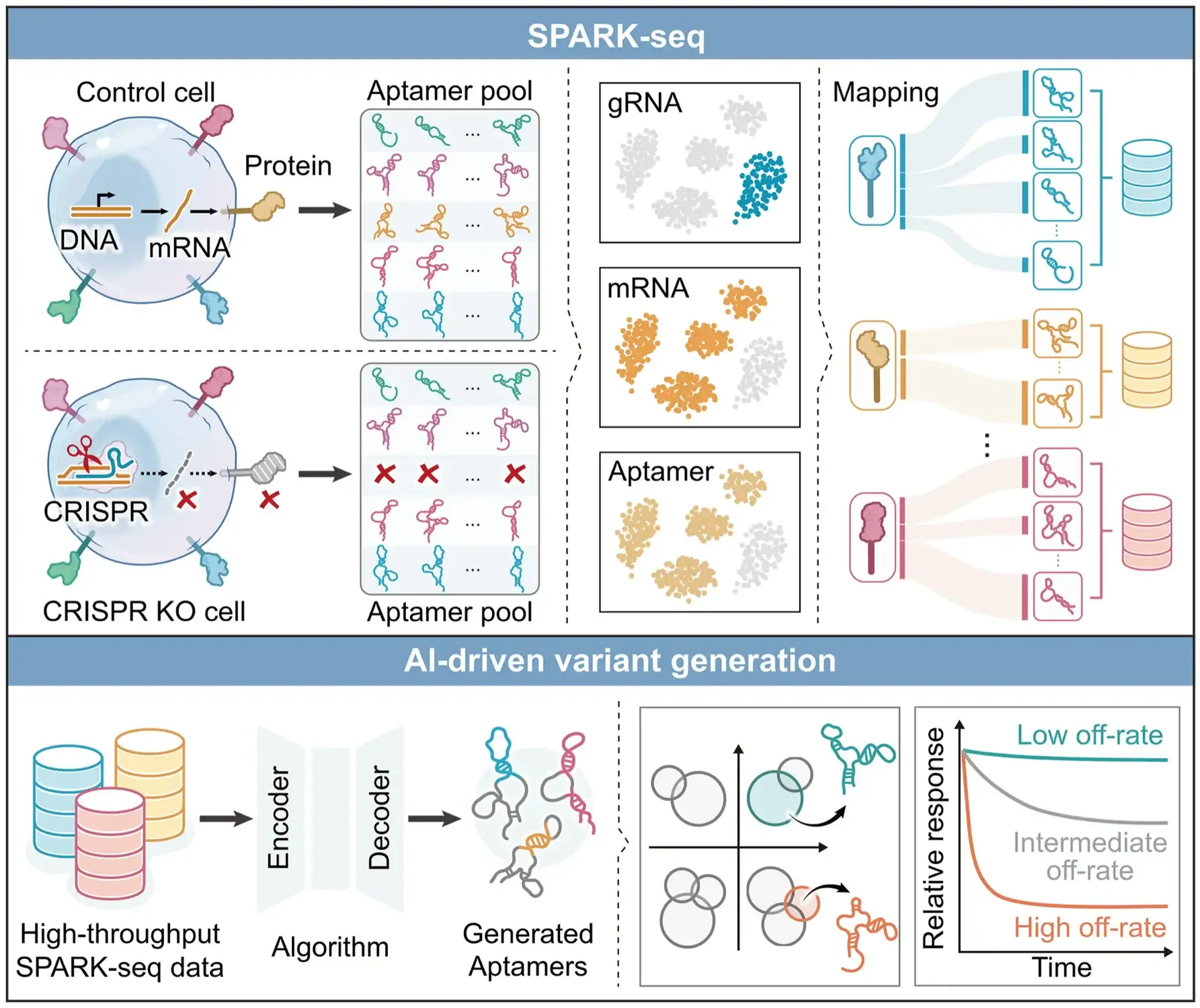
A research team led by Prof. Weihong Tan (Chinese Academy of Sciences, Hangzhou Institute of Medicine; College of Chemistry and Chemical Engineering, Hunan University) and Prof. Qin Wu has developed SPARK-seq (Single-cell Perturbation-driven Aptamer Recognition and Kinetics sequencing), an aptamer discovery platform that fuses multiplexed CRISPR knockout, 10x Genomics 5′ single-cell multiomics, and DNA-aptamer pool screening into one droplet. Coupled with the companion computational pipeline SPARTA (Single-cell Perturbation-Aptamer Recognition and targeted Aptamer-generation Algorithm), the system maps aptamer–target interactions directly on native cell membranes and, crucially, enriches for slow-dissociating binders rather than merely high-affinity ones—opening a new field the authors call “Aptomics”.
Key Findings
Aptamers are folded single-stranded DNA/RNA ligands selected against cell-surface biomarkers. Although conventional Cell-SELEX preserves native conformations, it is limited by low throughput and the inability to determine the target protein of each aptamer; furthermore, it rarely delivers the slow-off-rate kinetics required for in vivo imaging, therapeutics, and probe development. SPARK-seq resolves these bottlenecks by:
- Pooling CRISPR-knockout cells against 13 surface proteins and incubating them with a 4-round Cell-SELEX-enriched aptamer library before loading the cells into 10x Genomics 5′ droplets;
- Simultaneously capturing, in each single cell, the expressed gRNA (genetic perturbation), the endogenous mRNA transcriptome, and the cell-bound aptamer sequences;
- Using SPARTA to cluster 10,000 unique aptamers into 1,906 families and call 5,535 aptamers mapped to 8 surface proteins from 8,466 high-quality cells;
- Resolving multi-paralog binders (e.g., an integrin aptamer recognizing ITGA3/ITGB1, and a single aptamer binding multiple PTPR paralogs) and distinguishing near-identical NRP1 vs. NRP2 without cross-reactivity;
- Demonstrating that binding fold-change (−log₂FC) correlates strongly with koff (R² = 0.8–0.9) but not with equilibrium KD—i.e., SPARK-seq intrinsically selects for residence time, the kinetic property that matters most for in vivo probes;
- Training a CNN classifier (~97% accuracy on PTK7-binding sequences) and a generative module that outputs functional aptamer variants with improved off-rates.
Research Highlights
- SPARK-seq co-profiles CRISPR perturbation, transcriptome, and aptamer binding in thousands of single cells in one experiment;
- From a single screen, 5,535 aptamers were assigned to 8 membrane proteins, spanning >2 orders of magnitude in target abundance—including low-copy receptors that defeat traditional SELEX;
- Orthogonal validation by flow cytometry, surface plasmon resonance (SPR), and microscale thermophoresis (MST) confirmed nanomolar affinity and paralog-level specificity;
- The platform’s kinetic bias toward slow koff binders, decoupled from KD, provides a direct route to long-residence-time aptamers for diagnostic and therapeutic use;
- Deep-learning variant generation closes the loop from discovery to rational optimization, establishing a data foundation for Aptomics.
Key Research Points
1. Large-Scale Screening: 5,535 Aptamers Mapped to 8 Surface Proteins
After four rounds of Cell-SELEX enrichment, the aptamer library was incubated with a pooled CRISPR cell population targeting 13 surface proteins. Post-QC, 8,466 high-quality single cells were retained. SPARTA clustered the top 10,000 unique aptamer sequences into 1,906 families and, by comparing aptamer UMI abundance between gRNA-defined knockout cells and non-targeting controls, assigned 5,535 aptamers to 8 distinct membrane proteins. The pipeline also flagged unusual multi-target binders—aptamers recognizing ITGA3/ITGB1 heterodimers or multiple PTPR paralogs simultaneously—events that bulk SELEX would average out and miss.
2. Orthogonal Validation and Paralog-Level Specificity
Representative aptamers were validated by flow cytometry (KO vs. WT cell binding), SPR and MST (equilibrium KD and kinetic constants), and co-immunoprecipitation coupled with orthogonal readouts to filter indirect interactors. Competition assays and cross-protein SPR further showed that selected aptamers do not cross-react. Notably, even for the highly homologous NRP1/NRP2 pair, the platform yielded non-cross-reacting aptamers, some of which directly occlude the VEGF-binding epitope—functional inhibition that bulk enrichment rarely surfaces.
3. The Kinetic Discovery: SPARK-seq Naturally Enriches Slow-koff Aptamers
Across multiple targets, differential binding (−log₂FC) showed strong correlation with the dissociation rate constant koff (R² = 0.8–0.9) but essentially no correlation with equilibrium KD. In other words, SPARK-seq does not simply recover the most abundant or tightest-binding sequences—it preferentially captures aptamers that stay on target after the free-ligand wash step inherent to the droplet and wash workflow. Because residence time, rather than KD, governs in vivo half-life on cell surfaces, tumor-retention, and therapeutic efficacy, this intrinsic kinetic bias is arguably the platform’s most translationally valuable feature.
4. Deep-Learning Closing the Loop: SPARTA-Guided Variant Generation
Using the SPARK-seq dataset as training material, the authors built a CNN-based classifier reaching ~97% accuracy on PTK7-binding sequence prediction. A generative module then output novel aptamer variants, several of which displayed improved slow-off-rate behavior in wet-lab testing. This converts a one-off screening campaign into a self-improving design engine—an explicit argument for treating aptamer–target interactions as a multi-omics data resource (“Aptomics”) rather than a serial biochemical screen.
Conclusions
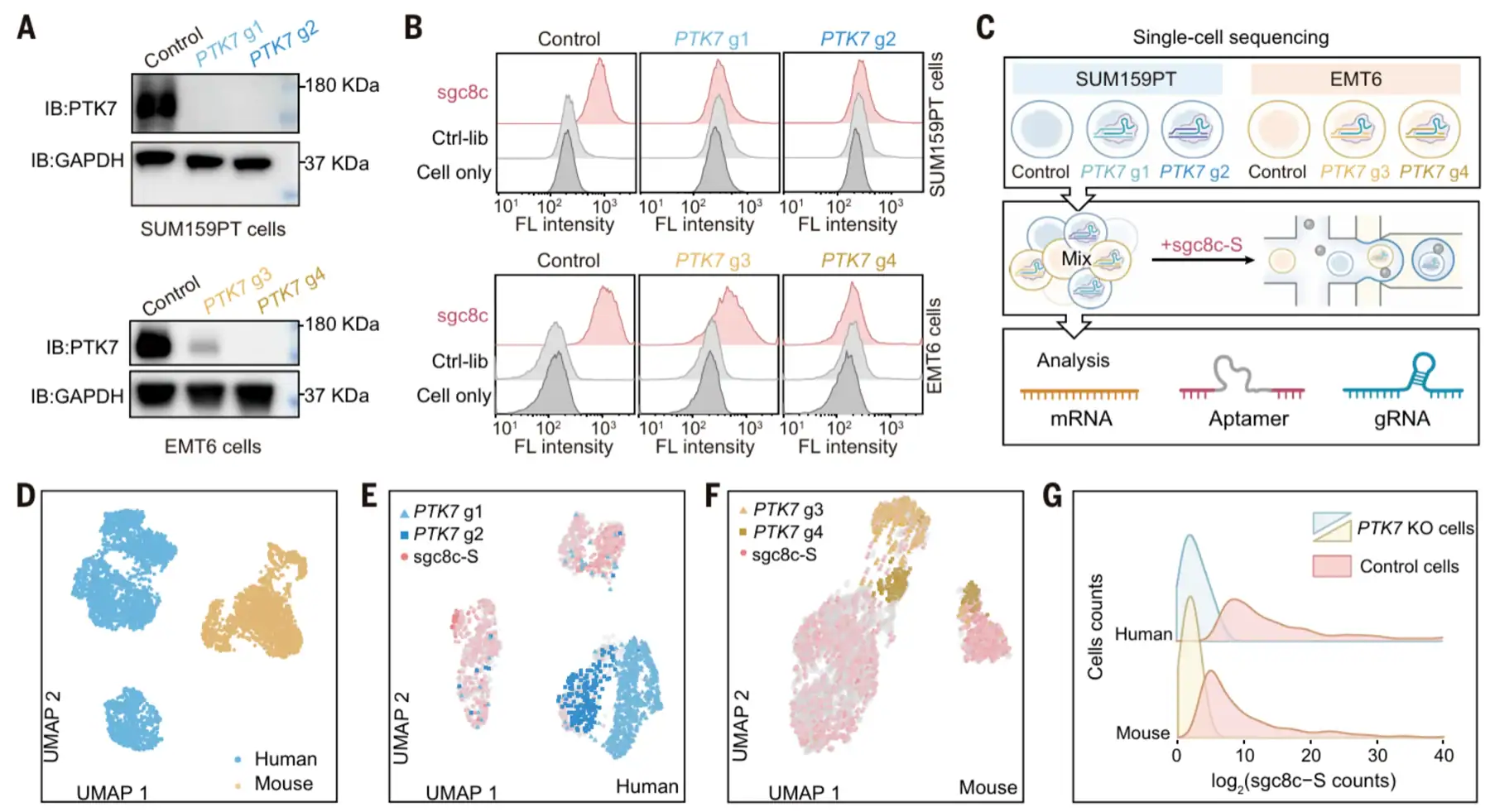
The authors first confirmed that differential aptamer signal across a CRISPR pool can serve as a direct readout of the on-target protein and set up the concept validation with the canonical sgc8c/PTK7 pair. By layering CRISPR perturbation, single-cell mRNA, and aptamer-sequence capture inside the same droplet, SPARK-seq converts millions of discrete binding events into a high-dimensional matrix anchored to genotype and transcriptome. The study’s mechanistic cascade is: Cell-SELEX enriches the pool → CRISPR KO pools create on/off target states → 10x Genomics 5′ multiomics reads out perturbation, transcriptome, and aptamer in each cell → SPARTA calls aptamer–target pairs at family resolution → kinetic analysis prioritizes slow-koff binders → deep learning generates improved variants. The platform extends the dynamic range to low-abundance, conformation-sensitive membrane proteins that have historically defeated purified-protein SELEX, and it directly supplies the long-residence-time ligands demanded by imaging, cell-targeting, and oligonucleotide-therapeutic development.
Enzymes for Aptamer Selection and Single-Cell Library Workflows
The SPARK-seq protocol can be decomposed into four enzymatic steps, each a known pain point in single-cell and CRISPR-screen workflows:
1. CRISPR sgRNA pool preparation — pooled sgRNA expression cassettes require in-vitro transcription from T7-promoter PCR templates. Yield, dsRNA by-product, and batch consistency directly affect knockout efficiency.
2. Single-cell 5′ reverse transcription — after droplet breakage, poly(dT)- and template-switching-primed cDNA must be synthesized from picogram-level mRNA alongside gRNA-derived and aptamer-derived templates. A processive, RNase H–minus reverse transcriptase with high yield across structured RNA is the rate-limiting reagent.
3. cDNA and aptamer-library amplification — low-input cDNA and the enriched aptamer pool both need uniform, high-fidelity PCR with low bias across GC extremes and high replicate reproducibility. Detailed information can be found in our article on enzyme-based library preparation.
4. Carryover contamination control — multiplexed amplicon workflows and recurring library PCR steps require dU-containing master mixes and UNG-based decontamination to prevent cross-sample read-through.
BIORI supplies upstream raw-material enzymes engineered for these exact steps. Representative products are listed below; each is produced under ISO 9001 / ISO 13485 quality systems and available as OEM bulk material for kit integrators.
Related Products
| Cat. No. | Product Name | Workflow Stage |
|---|---|---|
| Coming soon | First-Strand cDNA Synthesis Kit (not yet launched, contact us for product information) | Single-cell 5′ RT (mRNA / gRNA / aptamer first-strand synthesis) |
| E43 | Neoscript Hot Start Reverse Transcriptase-V2 | High-temperature RT on structured RNA secondary structures |
| BR3M121 | AcuGenix™ LongR Super-Fidelity Master Mix | High-fidelity aptamer-pool PCR between Cell-SELEX rounds |
| BR3M303 | AcuGenix™ Mul-PCR Mix for DNA&RNA | 20–1,000-plex panel amplification, multiplexed sgRNA / aptamer panels |
| GMP-BP-E11 | T7 RNA Polymerase 3.0 GMP-grade (low dsRNA) | In-vitro transcription of pooled sgRNA cassettes |
| E01 | AcuGenix™ Uracil-DNA Glycosylase (UNG/UDG) | dU-based carryover decontamination in multiplexed library PCR |
| Coming soon | T4 Gene 32 Protein (not yet launched, contact us for product information) | ssDNA-binding accessory protein for low-input PCR / library construction |
For bulk OEM inquiries, or custom enzyme development, please contact BIORI product engineering via the official website at biori-en.com.
FAQ
What is SPARK-seq and how does it work?
SPARK-seq (Single-cell Perturbation-driven Aptamer Recognition and Kinetics sequencing) integrates a CRISPR-knockout cell pool, a Cell-SELEX-enriched aptamer library, and 10x 5′ single-cell multiomics inside one microfluidic droplet. In each cell it simultaneously captures the gRNA (genetic perturbation), the endogenous mRNA transcriptome, and the bead-bound aptamer sequences; the companion SPARTA algorithm then links differential aptamer binding to specific gene knockouts.
How is SPARK-seq different from conventional Cell-SELEX?
Conventional Cell-SELEX screens in bulk, is low-throughput, can disrupt native membrane-protein conformation, and does not directly identify the target protein. SPARK-seq operates at single-cell resolution, couples binding to CRISPR perturbation for direct target deconvolution, works on low-abundance membrane proteins, and outputs kinetic rather than merely enrichment data.
Why does SPARK-seq favor aptamers with slow off-rates?
The droplet-and-wash workflow imposes a stringent dissociation step: fast-dissociating aptamers are washed away, while slow-off-rate binders stay cell-associated and are recovered. SPARK-seq therefore intrinsically enriches for long-residence-time ligands—the kinetic property that most directly governs in vivo tumor retention and probe half-life.
How many aptamers did SPARK-seq identify in the Science study?
From 8,466 high-quality single cells, SPARTA clustered the top 10,000 unique aptamer sequences into 1,906 families and identified 5,535 aptamers mapped to 8 surface proteins (out of 13 CRISPR-targeted).
What enzymes are used in Cell-SELEX aptamer selection?
Key enzymatic steps include: (1) a high-fidelity DNA polymerase for PCR amplification of the aptamer pool; (2) a reverse transcriptase when RNA aptamers are selected; (3) T7 RNA polymerase for in-vitro transcription of RNA pools; and (4) UNG in dU-containing master mixes to control carryover. BIORI supplies Celarscript® RTase, AcuGenix™ LongR Super-Fidelity Master Mix, and T7 RNA Polymerase 3.0 for these steps.
Reference
- Luo G, Song J, Fu Y, et al. SPARK-seq: a high-throughput platform for aptamer discovery and kinetic profiling. Science. 2026;391(6780):eadv6127. doi:10.1126/science.adv6127.