



Published by Zhuhai Biori Biotechnology Co., Ltd.
A genome-wide structural variant study from Hong Kong links a common CCG repeat in the FAM193B promoter to Alzheimer’s disease — a repeat that SNP arrays and short reads alone could not see.
Key takeaways
- Study design. Eleven Chinese genomes were read with PacBio HiFi long reads and reduced to 44,122 high-confidence structural variants; those variants were then genotyped in 3,190 people by Illumina short reads, with Mendelian-error and HiFi checks confirming the calls.
- Main result. A CCG repeat in the FAM193B promoter ran from 4 to more than 30 copies, and each 10 extra copies carried an odds ratio of 2.20 for AD (P = 5.5 × 10⁻¹³); the UK Biobank replicated it at a smaller effect. SV scores barely overlapped with SNP scores, and together they raised explained variance to R² 0.098 (0.056 for SVs, 0.046 for SNPs).
- Why the hybrid works. A 150 bp read cannot span a repeat tract, so its true length never reaches the alignment; long reads can, but cost keeps them out of cohort scale. Discovery on a small long-read set plus genotyping on the full short-read cohort gives both resolution and sample size.
- For sequencing labs. Repeats and structural variants now belong in AD study design: library prep that holds up across repeat regions, long-range PCR to confirm candidate expansions, multiplex repeat panels for screening cohorts, and mRNA or single-cell readouts to connect genotype to expression.
1. Alzheimer’s disease: a genetic story with a missing chapter
Alzheimer’s disease (AD) is the most common cause of dementia, accounting for an estimated 60–80% of all dementia cases [2]. It is also highly heritable: twin studies estimate its heritability at roughly 70% [4]. Over the past three decades, genome-wide association studies (GWAS) have mapped much of this risk, delivering more than 75 AD susceptibility loci [3,4]. APOE ε4 — discovered in 1993 — remains the strongest common risk factor, raising risk three- to four-fold [3,4].
Yet a large share of AD heritability is still unexplained. One reason is that GWAS variants are overwhelmingly single-nucleotide polymorphisms (SNPs). Structural variants (SVs) — deletions, insertions, inversions and tandem repeats — are largely invisible to SNP arrays, and short-read sequencing resolves them poorly. A 2022 review in Frontiers in Aging Neuroscience argued that SVs are a major candidate for the “missing heritability” of AD, yet they remain largely unexplored because accurate detection from array and short-read data is still far from perfect [5].
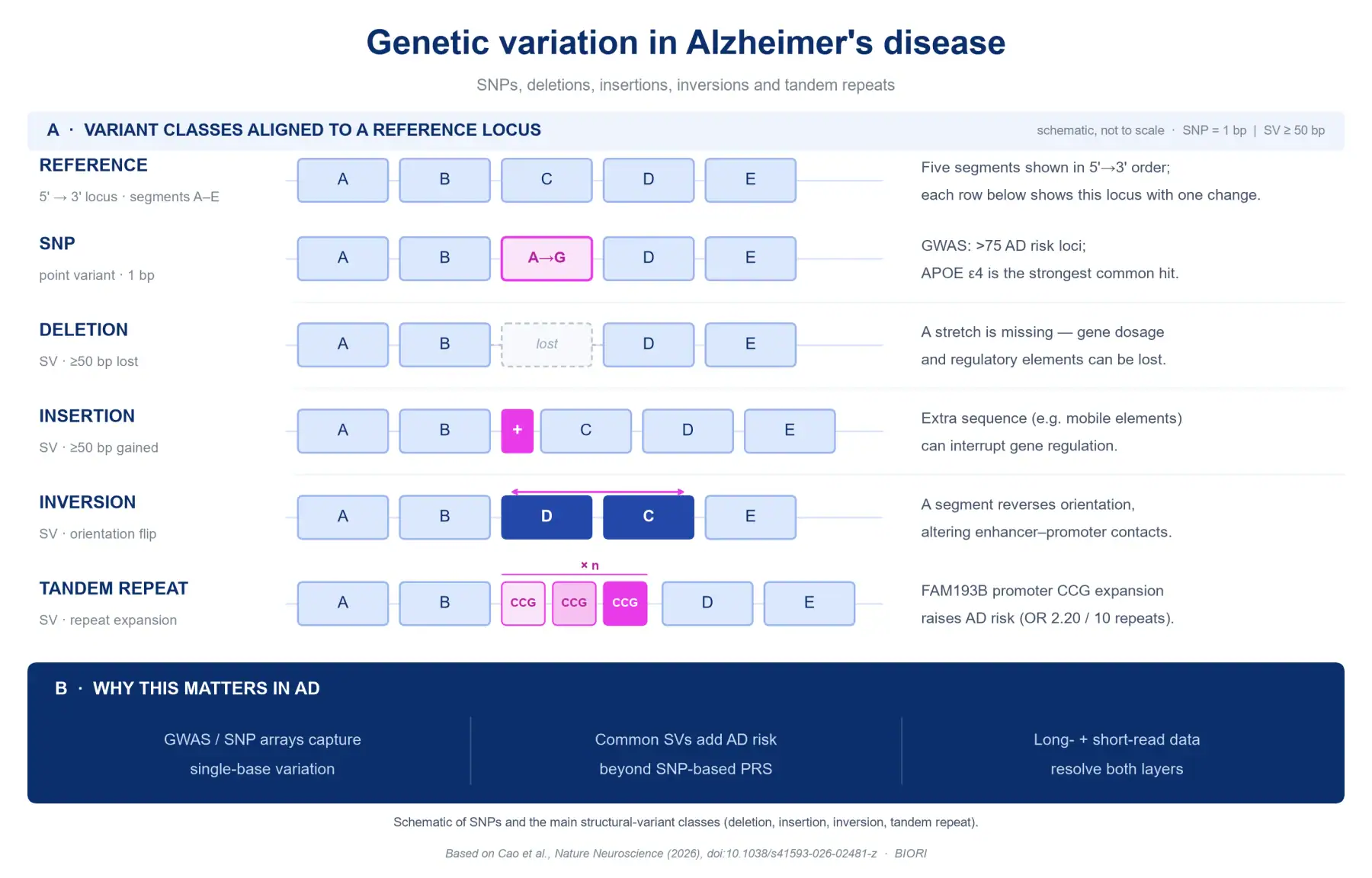
2. The discovery: a regulatory FAM193B CCG repeat
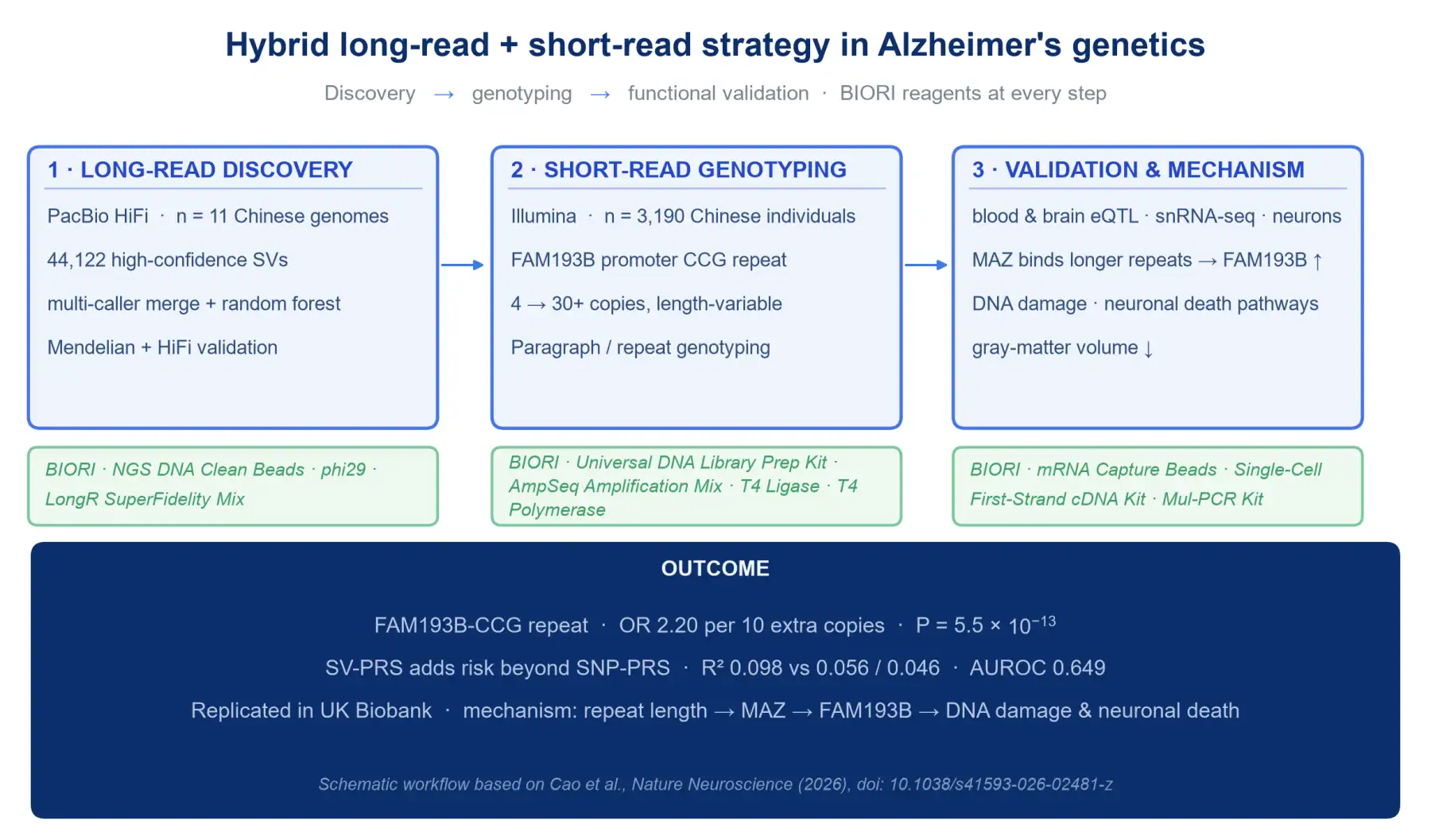
In October 2026, a Hong Kong–based team (HKUST, with UCL and other collaborators) published a genome-wide SV study in Nature Neuroscience that turned this gap into a concrete finding [1]. The design was deliberately hybrid:
Long-read discovery. Eleven Chinese genomes were sequenced with PacBio HiFi long reads. Multiple aligners and callers were merged, then filtered by a random forest, to produce 44,122 high-confidence SVs.
Short-read genotyping at scale. These SVs were genotyped across 3,190 Chinese individuals by short-read (Illumina) sequencing, with Mendelian-error and HiFi checks confirming the calls.
A repeat that matters. The top hit was a length-variable CCG repeat in the FAM193B promoter, ranging from 4 to more than 30 copies. Each 10-repeat increase was associated with an odds ratio of 2.20 for AD (P = 5.5 × 10⁻¹³), with replication in the UK Biobank at a smaller effect size [1].
Risk beyond SNPs. SV-based polygenic scores performed slightly better than SNP-based scores and correlated only weakly with them; combining both explained more AD variance (R² = 0.098, versus 0.056 for SVs and 0.046 for SNPs alone; AUROC 0.649). Common SVs therefore carry risk that SNPs do not capture — an independent layer of AD heritability [1].
The study went on to trace the mechanism: longer repeats strengthen binding of the transcription factor MAZ, raise FAM193B expression, and — in postmortem brains, single-nucleus RNA-seq and cultured neurons — connect to DNA-damage and neuronal-death pathways, with longer repeats associated with lower gray-matter volume [1].
3. Why use hybrid long-read and short-read sequencing?
Short reads remain the workhorse of population genetics: they are accurate, cheap and scalable. But a ~150 bp read cannot span a large deletion, a segmental duplication or a long repeat tract, and repetitive sequence collapses during alignment — precisely where disease-relevant variation hides. Long reads resolve those regions, yet cost and throughput still limit how many genomes a cohort study can afford.
The study’s playbook — small-scale long-read discovery followed by large-scale short-read genotyping — is increasingly used in neurodegeneration genetics, and other recent findings point the same way. A 2026 short-tandem-repeat GWAS in about 330,000 UK Biobank participants estimates that repeats account for at least ~3% of AD phenotypic variance [8]. A CASP8 intronic expansion (GGGAGA) was linked to AD risk by long-read amplicon sequencing (PNAS, 2025) [6]. And long-read surveys of the “dark genome” continue to uncover structural and epigenetic variation in AD brains [7]. Structural variants and repeat expansions can only be genotyped by sequencing; SNP arrays cannot measure them.
4. What this means for your AD workflow
For sequencing labs, clinical genetics teams and kit developers, the practical take-aways are concrete:
Population-scale short-read WGS with reproducible, low-input library prep — the backbone for genotyping SVs and repeats across large cohorts.
Repeat-friendly workflows — long-range PCR or amplification-based enrichment to confirm candidate expansions by long-read sequencing.
Functional validation reagents — mRNA isolation and full-length cDNA synthesis, including single-nucleus and single-cell formats, to connect genotype to expression.
Multiplex panels for genotyping known risk repeats across many samples (tNGS-style assays).
5. BIORI reagents for every step of the workflow
BIORI is an ISO 13485 / ISO 9001-certified enzyme engineering and OEM manufacturer. Its AcuGenix™ NGS & genomics line covers exactly the steps above — from library construction and amplification, to repeat-friendly long-range PCR, to single-cell RNA-seq cDNA synthesis. Glycerol-free and lyophilized-ready formats are available on selected products and exact formulation is listed on each product page. Custom and OEM options are available for kit builders (Figure 2).
| Workflow step | BIORI products | Catalog No. |
|---|---|---|
| DNA purification & size selection | NGS DNA Clean Beads | BR3N401 |
| Short-read WGS library construction (Illumina & MGI) | Universal DNA Library Prep Kit | BR3D201 |
| Fragmentation, end repair & A-tailing in one tube | Universal DNA Fragmentation Module | BR3N602 |
| High-fidelity library amplification | AmpSeq Library Amplification Mix / AmpHifi HS DNA Polymerase I & III | BR3M105 / BR3P101, BR3P103 |
| Adapter ligation & end modification | T4 DNA Ligase / T4 PNK / T4 DNA Polymerase / Klenow | BR3P301, BR3P303, BR3P302, BR3P305 |
| Limited-input or whole-genome amplification | phi29 DNA Polymerase | BR3P104 |
| Long-range PCR of repeat regions (long-read confirmation) | LongR Super-Fidelity Master Mix | BR3M121 |
| mRNA isolation (bulk / single-cell / spatial RNA-seq) | mRNA Capture Beads | BR3R101 |
| First-strand cDNA for single-cell 3′ RNA-seq | First-Strand cDNA Synthesis Kit | BR3N801 |
| Multiplex repeat / STR genotyping panels | Mul-PCR Kit / custom tNGS panels on request | BR3M106 |
Catalog numbers above are taken from the BIORI English website (biori-en.com); specifications, protocols and certificates of analysis are available on each product page. Suitability for a specific AD workflow should be confirmed with the BIORI team, which offers pilot evaluation quantities. For research use only. Not for use in diagnostic procedures.
FAQ
Why can’t short-read sequencing alone detect these variants?
Reads of ~150 bp align uniquely across most of the genome, but repeats and large SVs collapse or map ambiguously, so the true length and structure are lost. SNP arrays never genotype SVs at all. Long reads span these regions; short reads can then genotype the discovered variants across thousands of samples.
Why not sequence everyone with long reads?
Long reads provide the resolution but at higher cost and lower throughput. The hybrid design — long-read discovery on a small set, short-read genotyping on the full cohort — delivers both resolution and scale, with targeted long-read confirmation for carriers.
What is a CCG repeat, and why does its length matter?
It is a tandem repeat of “CCG” units in the FAM193B promoter. In the study, copy numbers ranged from 4 to more than 30; each additional 10 copies was associated with a 2.2-fold increase in the odds of AD (OR 2.20, P = 5.5 × 10⁻¹³). Longer repeats bound the transcription factor MAZ more strongly and drove higher FAM193B expression.
How does the FAM193B repeat raise AD risk?
The data point to a mechanism: longer repeat → stronger MAZ binding → higher FAM193B expression → DNA-damage and neuronal-death pathways, together with reduced gray-matter volume in carriers. The repeat thus links a common genetic variant to a cellular phenotype.
Is this finding relevant outside Chinese populations?
The repeat was identified in the Chinese population and replicated in the UK Biobank with a smaller effect size. Because common SVs are often population-specific, the finding underlines the need for diverse, sequencing-based cohorts — and for assays that can genotype repeats, not just SNPs.
How can I try BIORI reagents for these workflows?
Evaluation quantities are available for research and assay development, alongside bulk fills, glycerol-free or custom-buffer formulations, lyophilization and full OEM service. Contact the BIORI team.
References
- Cao H, Fu Y, Zhou X, et al. Genome-wide analysis of common structural variants in Alzheimer’s disease identifies a risk-associated regulatory CCG repeat in FAM193B. Nature Neuroscience (2026). doi:10.1038/s41593-026-02481-z. https://pubmed.ncbi.nlm.nih.gov/42864446/
- 2026 Alzheimer’s disease facts and figures. Alzheimer’s & Dementia, 22, 7. https://doi.org/10.1002/alz.71345
- Bellenguez C, et al. New insights into the genetic etiology of Alzheimer’s disease and related dementias. Nature Genetics 54, 412–436 (2022). doi:10.1038/s41588-022-01024-z. https://doi.org/10.1038/s41588-022-01024-z
- Andrews SJ, et al. The complex genetic architecture of Alzheimer’s disease: novel insights and future directions. eBioMedicine, 90, 2023, 104511. https://doi.org/10.1016/j.ebiom.2023.104511
- Wang H, et al. The role of structural variations in Alzheimer’s disease and other neurodegenerative diseases. Frontiers in Aging Neuroscience (2022). doi:10.3389/fnagi.2022.1073905. https://doi.org/10.3389/fnagi.2022.1073905
- Nguyen L, et al. CASP8 intronic expansion identified by poly-glycine-arginine pathology increases Alzheimer’s disease risk. Proc. Natl. Acad. Sci. U.S.A. 122 (7) e2416885122. https://www.pnas.org/doi/10.1073/pnas.2416885122
- Ramirez P, Sun W, Dehkordi SK, et al. Long-read sequencing reveals genomic and epigenomic variation in the dark genome of human Alzheimer’s disease. Alzheimer’s Dement. 2025; 21:e70852. https://doi.org/10.1002/alz.70852
- Gmelin D, Ohlei O, Aslam MM, et al. GWAS on short tandem repeats identifies genetic mechanisms in Alzheimer’s disease. Nat Commun 17, 4968 (2026). https://doi.org/10.1038/s41467-026-73902-7
About BIORI
Established in 2012 in Zhuhai, China, BIORI (Zhuhai Biori Biotechnology Co., Ltd.) integrates protein engineering, recombinant expression, process development and application development under ISO 9001 and ISO 13485 quality systems, backed by an in-house enzyme library of 1,000+ enzymes. The company supplies enzymes, master mixes and kits across molecular diagnostics, NGS & genomics, life science, and biopharma QC & mRNA, in standard glycerol, glycerol-free, lyo-ready and lyophilized-bead formulations.