

Published by Zhuhai Biori Biotechnology Co., Ltd.
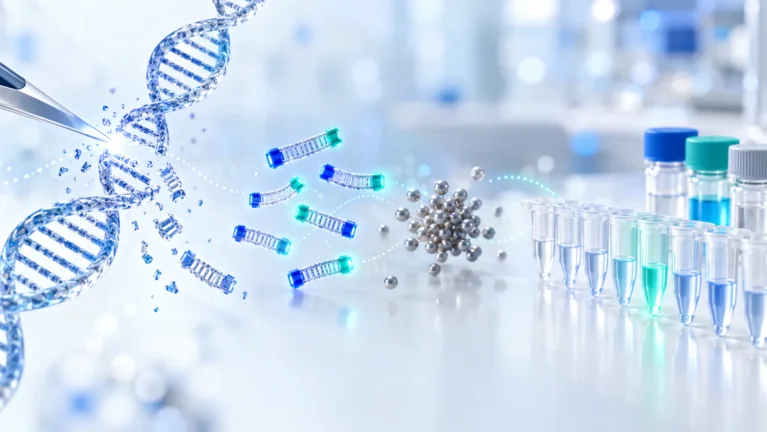
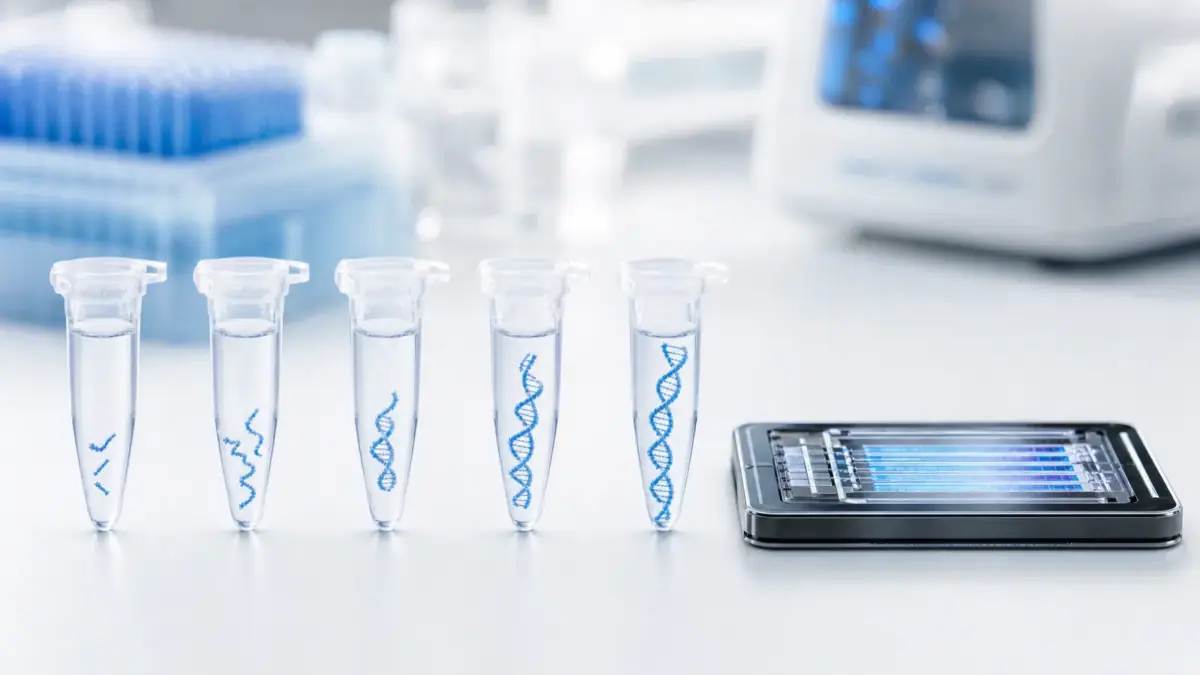
NGS library preparation turns purified DNA into short fragments within a defined size distribution, each carrying sequencing adapters on both ends, so the sequencer can capture, amplify and read each molecule [1, 2]. For short-read DNA libraries the work happens in five steps: fragmentation, end repair and dA-tailing, adapter ligation, library amplification (skipped in PCR-free workflows) and bead cleanup with size selection, followed by QC before loading for sequencing [1, 2]. Each step uses its own enzyme or reagent, and each one leaves a mark in the sequencing report, from target insert range to duplicate rate.
Key takeaways
- Fragmentation sets the target insert range. With enzymatic fragmentation, incubation time controls the size, and input mass between 0.1 ng and 1,000 ng has little effect [9].
- Ligation efficiency decides how much of your DNA becomes sequenceable library. Extra adapter mostly adds adapter dimers, not yield [2, 9].
- PCR is a principal source of GC bias in PCR-amplified Illumina fragment libraries, so run the fewest cycles that give enough library [2, 3].
- Illumina and MGI libraries share the same insert chemistry. They differ in adapters and in how the library is loaded: clusters on a flow cell versus circularized DNA nanoballs [1, 7].
- Quantify by qPCR when accuracy matters, and always for PCR-free libraries, because dye-based methods also count fragments that lack adapters on both ends [4, 9].
NGS library preparation workflow at a glance: what each step controls
For DNA library prep on Illumina-style platforms, the table maps each step of the standard NGS workflow to its enzyme, the library property it sets, and the check that shows whether it worked [1, 2].
| Step | Enzyme or reagent | What it decides | How you check it |
|---|---|---|---|
| 1. Fragmentation | Fragmentation enzyme mix, or mechanical shearing | Target insert range and size spread | Bioanalyzer trace or 2% agarose gel |
| 2. End repair and dA-tailing | T4 DNA polymerase, T4 PNK, Klenow exo⁻ | Share of fragments with ligatable ends | Indirectly, through ligation yield |
| 3. Adapter ligation | T4 DNA ligase, adapters with a 3′ T | Conversion rate, adapter dimers | Small adapter-dimer peak at about 120–170 bp on the trace [10] |
| 4. Library amplification | High-fidelity hot-start polymerase | Yield, duplication rate, GC coverage | Yield (ng); duplicate reads after sequencing |
| 5. Cleanup and size selection | SPRI magnetic beads | Removal of adapters, dimers and primers; final size window | Trace shape; molar concentration by qPCR |
The five steps of NGS library prep and the enzymes behind each
Each of the five steps relies on its own enzyme or reagent, and a weak step has to be made up later, usually with extra PCR cycles. Poor end repair in step 2, for example, shows up later as low ligation yield or as extra PCR cycles needed to reach the target amount.
Step 1: Fragmentation sets the target insert range
Fragmentation breaks genomic DNA into pieces short enough for the read length, typically a few hundred base pairs for Illumina applications [1]. Labs use physical methods such as acoustic shearing and sonication, or enzymatic methods such as endonuclease cocktails and transposase tagmentation [2]. Mechanical shearing gives less biased and more consistent fragments. Enzymatic fragmentation needs less input and can run in the same tube as the next steps, which saves time and sample [1]. Transposon-based kits fragment the DNA and add adapter sequence in one reaction, so they skip separate end repair and ligation [2]. That workflow is not covered here.
With an enzyme mix, incubation time sets the fragment size. The BR3D201 kit manual gives a default distribution of 150–350 bp for paired-end sequencing on Illumina and MGI [9]. That is the kit’s final range, which also depends on its bead size selection. BR3N602 is supplied as the enzyme module alone and its manual gives its own default size range; follow the manual of the product you run. Its fragmentation times for high-quality 293T genomic DNA run from 1–3 min for fragments around 1,000 bp to 10–20 min for fragments around 100 bp, and the size distribution stays consistent from 0.1 ng to 1,000 ng input under identical conditions [9]. The fragmentation enzyme is temperature sensitive. Set the reaction up on ice, add the DNA or enzyme last and move the tube straight into a pre-heated thermal cycler [9]. EDTA carried over from TE buffer can inhibit the enzyme. In BIORI’s EDTA test for BR3D201, size profiles stayed the same up to 0.2 mM EDTA, which corresponds to 10 µL of DNA eluted in TE (10 mM Tris, 1 mM EDTA, pH 8.0) in a 50 µL reaction (BIORI internal data, BR3D201) [14]. Enzymatic and mechanical fragmentation are compared in more detail in Enzyme-Based Library Preparation: The Genetic Scissors Driving the NGS Revolution.
Step 2: End repair and dA-tailing make the ends ligatable
Fragmented DNA has a mix of 5′ and 3′ overhangs. Before an adapter can ligate, the ends must be blunted, phosphorylated at the 5′ end and given a single 3′ A [1, 2]. T4 DNA polymerase or the Klenow fragment fills in 5′ overhangs, and the 3′→5′ exonuclease of T4 DNA polymerase trims 3′ overhangs. T4 polynucleotide kinase (T4 PNK) adds the 5′ phosphate, and Klenow exo⁻ or Taq polymerase adds the A tail [1]. T4 PNK also removes 3′ phosphates, which block ligation at ends produced by shearing or left on damaged templates such as FFPE DNA [19]. The single A pairs with the 3′ T overhang on Illumina-type adapters and stops fragments from ligating to each other.
Many current kits run fragmentation, end repair and dA-tailing in one tube with no cleanup in between. The AcuGenix™ Universal DNA Fragmentation Module (BR3N602) combines all three, uses Klenow exo⁻ for the A tail and keeps total hands-on time under 45 minutes [15]. Fewer transfers help most with cfDNA, FFPE DNA and other low-input samples, where every cleanup loses material [15]. The molecular detail for each enzyme is in End Repair and dA-Tailing: T4 PNK, T4 DNA Polymerase and Klenow.
Step 3: Adapter ligation decides how much DNA becomes library
Adapter ligation joins a pair of partly complementary oligonucleotides to both ends of each fragment. Its efficiency sets the conversion rate and the final yield [1]. Illumina-type adapters are about 60–75 nt per end, adding roughly 120–150 bp to each insert. They carry the P5 and P7 sites that bind the flow cell oligos, the sequencing primer sites and, in most designs, an index of 6–10 nt that identifies the sample when libraries are pooled [1, 12]. Each end of the insert has two nicks to close. One sits between the 3′ T of one adapter strand and the 5′ phosphate of the insert, the other between the 3′ A of the insert and the 5′ phosphate of the opposite adapter strand, and T4 DNA ligase seals both. BIORI’s T4 DNA Ligase (BR3P301) ligates blunt and cohesive ends and is tested free of detectable exonuclease activity [16].
Ligation needs a molar excess of adapter, and the right excess depends on input. The BR3D201 manual recommends a DNA to adapter molar ratio of 1:20 for 250–1,000 ng input and 1:5 below 250 ng, with the adapter diluted from 10 µM down to 0.1 µM as input falls [9]. It also warns against raising adapter concentration to boost yield, because the extra adapter mostly forms adapter dimers [9]. Head and colleagues report the same effect [2]. To convert input mass to moles, divide grams by (base pairs × 660 g/mol/bp), or use the DNA/RNA Copy Number Calculator [9]. Free adapter left in the library also increases index hopping, so Illumina recommends removing it and using unique dual index kits for multiplexed runs [11]. In a two-year analysis of pooled runs on HiSeq X, HiSeq 4000/3000 and NovaSeq, all of which use ExAmp chemistry on patterned flow cells, Costello and colleagues measured mean index swap rates of 0.2–6% and showed that non-redundant dual indexes let the swapped reads be filtered out [13].
Step 4: Library amplification trades yield against duplicates and GC bias
Library PCR enriches fragments that carry adapters on both ends and adds yield [2]. It is also a principal source of base-composition bias in PCR-amplified Illumina libraries. Aird and colleagues traced sequences from 6% to 90% GC through library preparation and found PCR to be the principal source of under-representation at extreme GC [3]. Any amplification lowers library complexity, which shows up as duplicate reads, so more starting DNA and fewer cycles give a more complex library [2]. Run the minimum number of cycles that gives enough library [1]. For BR3D201 that is 5–7 cycles at 100 ng and 13–15 cycles at 100 pg (see the input table below) [9].
PCR-free libraries avoid amplification bias and suit whole-genome variant calling and GC- or AT-rich regions, but they need more input and are harder to quantify [1]. In the BR3D201 workflow, libraries made with full-length adapters can go to the sequencer without PCR, while libraries made with universal short adapters need at least two cycles to complete the adapter sequence [9]. The fidelity data for BR3M105 (Figure 3 on its product page) show an error rate low enough that amplification adds few errors (BIORI internal data, BR3M105) [17]. The AcuGenix™ AmpSeq Library Amplification Mix (BR3M105) is a 2× hot-start high-fidelity master mix for inputs from 0.1 ng to 1 µg [17]. High-Fidelity PCR: When to Reach for It, and When Standard Taq Is Enough covers when proofreading matters.
Step 5: Bead cleanup and size selection remove adapters and dimers
SPRI bead cleanup after ligation and after PCR removes free adapters, adapter dimers and primers, and size selection narrows the insert range [1, 2]. Adapter dimers contain full-length adapter sequence, so they bind and cluster on the flow cell like library molecules. Illumina recommends keeping them at 0.5% or less of the library on patterned flow cells and 5% or less on non-patterned flow cells [10]. The bead to sample ratio sets the size cutoff. A lower ratio keeps only longer fragments, and a two-step (double-sided) selection keeps a window [1]. The BR3D201 manual, for example, uses 0.6× for a standard post-ligation cleanup, notes that ratios above 0.7× raise the risk of adapter carry-over, and gives 0.55× then 0.15× to select 350 bp inserts made with full-length adapters [9]. Size selection costs yield, so the same manual adds 2–3 PCR cycles when you size-select after ligation [9].
AcuGenix™ NGS DNA Clean Beads (BR3N401) use the same protocol as AMPure XP beads across 0.6×–1.8× ratios [18]. In BIORI’s comparison, where the same amplified DNA substrate was purified with BR3N401 and four other commercial bead sets, BR3N401 recovered more than 85% (BIORI internal data, BR3N401) [18]. A full ratio table is in SPRI Beads: Cleanup and Size Selection Ratio Table With Recovery Data.
Library QC: check size and molar concentration before loading
Before loading, you need the library’s size distribution and its molar concentration. Too much library overclusters the flow cell, and too little wastes output [1]. The BR3D201 manual uses a bioanalyzer such as the Agilent 2100 to measure the size range accurately and a 2% agarose gel for a quick qualitative check [9]. For concentration, qPCR with adapter-specific primers counts only molecules that can cluster. Dye-based fluorometry is quick, but it measures all double-stranded DNA and can misjudge PCR-free or over-amplified libraries [4, 9]. qPCR also amplifies adapter dimers, so read it together with the size trace [1].
Illumina vs MGI: same insert chemistry, different adapters and loading
The first steps of library preparation for next generation sequencing are the same on Illumina and MGI (DNBSEQ) platforms. The platforms differ in adapter sequences and in how the library is loaded. Illumina libraries are linear molecules whose P5 and P7 ends bind oligos on the flow cell [1]. MGI’s DNBSEQ chemistry denatures the adapter-tagged library, circularizes the single strand with a splint oligo and DNA ligase, and then uses rolling circle amplification to make DNA nanoballs of up to 1,000 copies that load onto a patterned array [7].
| Illumina | MGI / DNBSEQ | |
|---|---|---|
| Fragmentation, end repair, dA-tailing | Same workflow on both platforms | |
| Adapters | P5/P7 adapters, single or dual index | MGI adapters |
| Step after the library is made | Denature and load; clusters form on the flow cell | Single-strand circularization, then rolling circle amplification to DNA nanoballs |
| Using an Illumina-format library | Native format | Convert first with a library conversion kit (PCR-free or PCR-based) |
A dual-platform kit keeps the insert chemistry fixed and lets you choose the adapter set. BR3D201 is validated for Illumina and MGI and accepts single-index, dual-index and universal short adapters [9, 14]. MGI-side conversion kits turn linear third-party libraries, Illumina-format ones included, into DNBs or single-strand circles [8]. Validate converted libraries on your own samples before switching a routine assay.
Choosing DNA input: what changes from 100 pg to 1 µg
Lower input means more PCR cycles, and more cycles mean more duplicates and lower library complexity, so use as much good-quality DNA as the sample allows [2]. The BR3D201 manual treats 100 ng of high-quality DNA as enough for most applications, 10–50 ng for simple microbial genomes and up to 200 ng for FFPE DNA or workflows with size selection. It asks for an A260/A280 of 1.8–2.0 and less than 10 µL of TE-eluted sample per reaction [9]. Its recommended cycle numbers for 293T genomic DNA fragmented for 10 min, with a 1,000 ng target yield, are below [9].
| DNA input | PCR cycles (target 1,000 ng library) |
|---|---|
| 1,000 ng | 2–3 |
| 500 ng | 3–5 |
| 100 ng | 5–7 |
| 10 ng | 9–11 |
| 1 ng | 11–13 |
| 0.1 ng (100 pg) | 13–15 |
For inputs below 100 ng, the manual moves size selection to after amplification [9], which avoids losing scarce molecules before PCR. PCR-free libraries sit at the high end of the input range because no amplification makes up for losses [1].
Modular reagents vs all-in-one kits
An all-in-one library prep kit suits labs that want a validated, fixed workflow. Separate modules suit kit developers and core labs that need to change one step without touching the others.
| Question | All-in-one kit (e.g. BR3D201) | Separate modules (e.g. BR3N602, BR3P301, BR3M105, BR3N401) |
|---|---|---|
| Validation | Components validated together | You validate each combination |
| Adapters and indexes | Bring your own adapters (BR3D201 accepts Illumina and MGI formats) | Free choice |
| Changing one step | Limited | Swap the ligase, polymerase or beads independently |
| Typical user | Sequencing labs, routine WGS and panels | Kit developers, OEM and custom workflows |
You can also combine the two. The fragmentation module inside BR3D201 is sold on its own as BR3N602 [15], so a developer can prototype with the kit and then source the same chemistry as modules. To compare options step by step, use the NGS Library Preparation Product Selection page.
Scope and limits
This guide covers ligation-based short-read DNA libraries. RNA-seq, amplicon (tNGS), hybrid-capture, transposon-based and long-read libraries add or replace steps. The numbers above come from the cited protocols and product data, not from your sample, so confirm insert range, cycle number and bead ratios on your own DNA before a run that matters.
What BIORI provides
BIORI supplies each step of the workflow as a research-use reagent, in catalog packs and in bulk for kit manufacturers: the AcuGenix™ Universal DNA Library Prep Kit (BR3D201), the AcuGenix™ Universal DNA Fragmentation Module (BR3N602), T4 DNA Ligase (BR3P301), the AcuGenix™ AmpSeq Library Amplification Mix (BR3M105) and AcuGenix™ NGS DNA Clean Beads (BR3N401). Manuals and COAs are on each product page. Browse the full NGS range or contact our NGS team with your input range, platform and throughput.
FAQ
How do I quantify PCR-free libraries?
Use qPCR. NEB states that only qPCR-based methods quantify PCR-free libraries accurately, because other methods also count fragments without adapters on both ends, which will not cluster [4]. Bioanalyzer and TapeStation traces still show residual adapters and adapter dimers, but NEB notes that size estimates and quantitation from these instruments are not accurate for PCR-free libraries [5].
Are adapters and sample indexes the same thing?
No. The index is a short part of the adapter. An Illumina-type adapter carries the flow cell binding site (P5 or P7), a sequencing primer site and, usually, an index sequence of 6–10 nt that marks which sample a read came from [1, 12]. Illumina’s UD indexes use 10 bp index codes, while other Illumina index adapters use 8 bp codes [12]. With unique dual indexes, no index 1 or index 2 sequence is used twice in a pool, so index-hopped reads can be removed during demultiplexing [11, 13].
Can different library types be pooled in the same sequencing run?
Usually not. Illumina recommends pooling only libraries made with the same preparation workflow [6]. Library types differ in size, index design and clustering efficiency, so shorter libraries take more than their share of reads, read lengths may exceed the shorter inserts, and mixed index strategies make demultiplexing ambiguous [6]. On flow cells with individual lane loading, different types can go in separate lanes, but the whole run uses one read-length setting [6].
How many PCR cycles does an NGS library need?
As few as give enough library for loading. Cycle number scales with input: the BR3D201 manual gives 2–3 cycles for 1,000 ng and 13–15 cycles for 100 pg to reach about 1,000 ng of library [9]. Extra cycles add GC bias and duplicates [2, 3], and the manual also lists mutation accumulation and large-fragment contamination [9].
NGS reagents are for research use only unless otherwise stated; bulk and custom formulations are supplied for further manufacturing use.
References
- Thermo Fisher Scientific. Preparation of DNA Sequencing Libraries for Illumina Systems: 6 Key Steps in the Workflow. Invitrogen School of Molecular Biology. https://www.thermofisher.com/us/en/home/life-science/cloning/cloning-learning-center/invitrogen-school-of-molecular-biology/next-generation-sequencing/dna-sequencing-preparation-illumina.html
- Head SR, Komori HK, LaMere SA, et al. Library construction for next-generation sequencing: overviews and challenges. BioTechniques. 2014;56(2):61–77. https://doi.org/10.2144/000114133
- Aird D, Ross MG, Chen WS, et al. Analyzing and minimizing PCR amplification bias in Illumina sequencing libraries. Genome Biology. 2011;12:R18. https://doi.org/10.1186/gb-2011-12-2-r18
- New England Biolabs. FAQ: How do I quantify my PCR-free libraries? https://www.neb.com/en/faqs/how-do-i-quantify-my-pcr-free-libraries
- New England Biolabs. FAQ: Can I assess PCR-free library quality on a BioAnalyzer and/or TapeStation? https://www.neb.com/en/faqs/can-i-assess-pcr-free-library-quality-on-a-bioanalyzer-and-or-tapestation
- Illumina Knowledge. Is it possible to pool different library types in the same sequencing run? Article 000003284. https://knowledge.illumina.com/library-preparation/general-library-prep/library-preparation-general-library-prep-reference_material-list/000003284
- MGI Tech. DNBSEQ™ Technology. https://global-mgitech.com/technologies/dnbseq-technology/
- Complete Genomics. Library Conversion Kits. https://www.completegenomics.com/products/kits-reagents/library-preparation-kits/library-conversion-kits
- BIORI. AcuGenix™ Universal DNA Library Prep Kit (BR3D201) Instruction Manual, V01. https://biori-en.com/wp-content/uploads/2026/09/BR3D201_AcuGenix-Universal-DNA-Library-Prep-Kit_Instruction-Manual-1.pdf
- Illumina Knowledge. Adapter dimers: causes, effects, and how to remove them. Article 000001911. https://knowledge.illumina.com/library-preparation/general-library-prep/library-preparation-general-library-prep-reference_material-list/000001911
- Illumina Knowledge. How to mitigate index hopping. Article 000001928. https://knowledge.illumina.com/library-preparation/general-library-prep/library-preparation-general-library-prep-reference_material-list/000001928
- Illumina. Illumina DNA Prep with Exome 2.0 Plus Enrichment Reference Guide. Document 1000000157112 v03, May 2023. https://emea.support.illumina.com/content/dam/illumina-support/documents/documentation/chemistry_documentation/illumina_prep/1000000157112_03_illumina-dna-prep-exome-v2-enrichment-reference-guide.pdf
- Costello M, Fleharty M, Abreu J, et al. Characterization and remediation of sample index swaps by non-redundant dual indexing on massively parallel sequencing platforms. BMC Genomics. 2018;19:332. https://doi.org/10.1186/s12864-018-4703-0
- BIORI. AcuGenix™ Universal DNA Library Prep Kit (BR3D201), product page. https://biori-en.com/product/acugenix-universal-dna-library-prep-kit-br3d201/
- BIORI. AcuGenix™ Universal DNA Fragmentation Module (BR3N602), product page. https://biori-en.com/product/acugenix-universal-dna-fragmentation-module-br3n602/
- BIORI. T4 DNA Ligase (BR3P301), product page. https://biori-en.com/product/t4-dna-ligase-br3p301/
- BIORI. AcuGenix™ AmpSeq Library Amplification Mix (BR3M105), product page. https://biori-en.com/product/acugenix-ampseq-library-amplification-mix-br3m105/
- BIORI. AcuGenix™ NGS DNA Clean Beads (BR3N401), product page. https://biori-en.com/product/acugenix-ngs-dna-clean-beads-br3n401/
- New England Biolabs. T4 Polynucleotide Kinase (M0201). https://www.neb.com/en-us/products/m0201-t4-polynucleotide-kinase