


Published by Zhuhai Biori Biotechnology Co., Ltd.
Next-generation sequencing (NGS) has become indispensable across oncology, reproductive genetics, pathogen detection, and basic research. But for labs and IVD developers, the real bottleneck is rarely the sequencer. The products provide a complete set of enzymes for the workflow. Library construction chains together fragmentation, end repair, dA-tailing, ligation, amplification, and cleanup, each step depending on a different raw-material enzyme. Sourcing, qualifying, and batch-controlling enzymes from multiple vendors lengthens development cycles, complicates change control, and puts reproducibility at risk.
BIORI’s AcuGenix™ portfolio is built around directed-evolution polymerases, an engineered template-switching reverse transcriptase, and superparamagnetic cleanup beads. Every product below is benchmarked against the workflows you already run: Illumina and MGI sequencing, AMPure XP-style cleanup, and single-cell RNA sequencing. The three lanes cover normal NGS library prep, tNGS, and single-cell.
Lane A — Normal NGS Library Prep, end to end
WGS, WES, cfDNA liquid biopsy, FFPE retrospective studies, ChIP-seq, and microbial mNGS all need the same chain to behave whether the input is 1 µg of blood gDNA or 100 pg of FFPE. AcuGenix covers that chain.
How Lane A chemistry works
Enzymatic fragmentation uses a nuclease cocktail to randomly shear high-molecular-weight DNA into 200–500 bp fragments with ragged ends. End repair is a two-enzyme step: T4 DNA Polymerase fills in 5′ overhangs and chews back 3′ overhangs to produce blunt termini, while T4 PNK phosphorylates the 5′ ends—without a 5′-phosphate, T4 DNA Ligase cannot seal the nick. Klenow exo- then adds a single 3′-dA overhang so fragments ligate directionally to dT-tailed Illumina/MGI adapters, suppressing adapter self-ligation. Between each step, carboxyl paramagnetic beads bind DNA at defined PEG/NaCl ratios for size-selective cleanup, and a high-fidelity hot-start polymerase adds sample indices during final enrichment. The result is a single-tube pre-ligation reaction followed by bead-mediated cleanups, with no intermediate purification.
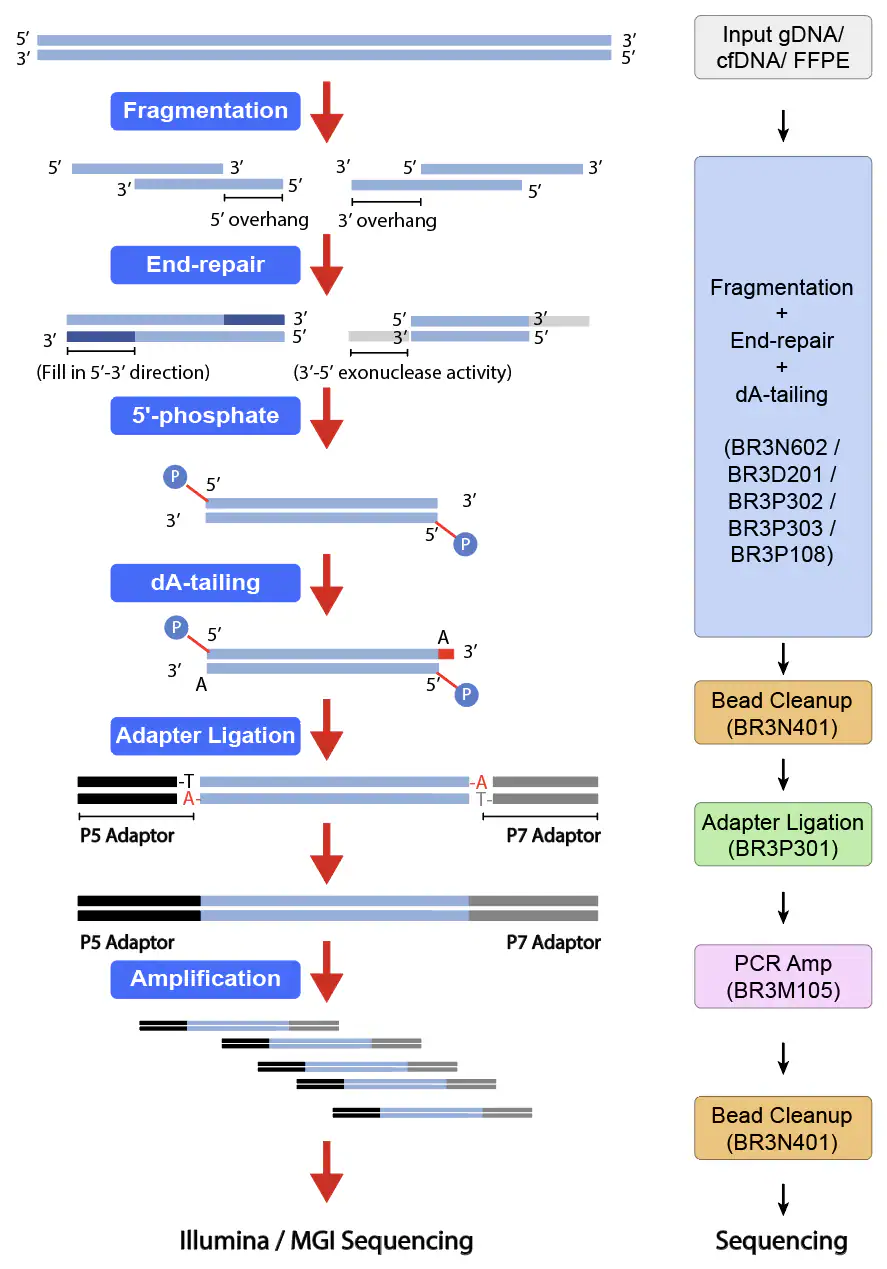
Step 1 — Fragmentation, end repair & dA-tailing in one tube
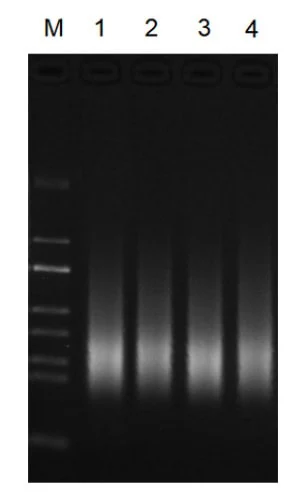
Mechanical shearing needs hardware; separate fragmentation, end repair, and dA-tailing reactions mean three purifications and three chances to lose low-input material. The AcuGenix™ Universal DNA Fragmentation Module (BR3N602) collapses all three pre-ligation steps into one tube in under 45 minutes, with no intermediate cleanup. Default distribution is a uniform 200–500 bp, tunable by time rather than input mass, validated from 1 pg to 1 µg across gDNA, cfDNA, FFPE, and PCR products. On clinical swab, sputum, BAL, and blood DNA, library profiles stayed even (Figure 2). The module tolerates up to 0.2 mM residual EDTA, and a separate Frag Enhancer (available on request) rescues samples contaminated with guanidine, urea, or phenol without pre-purification.
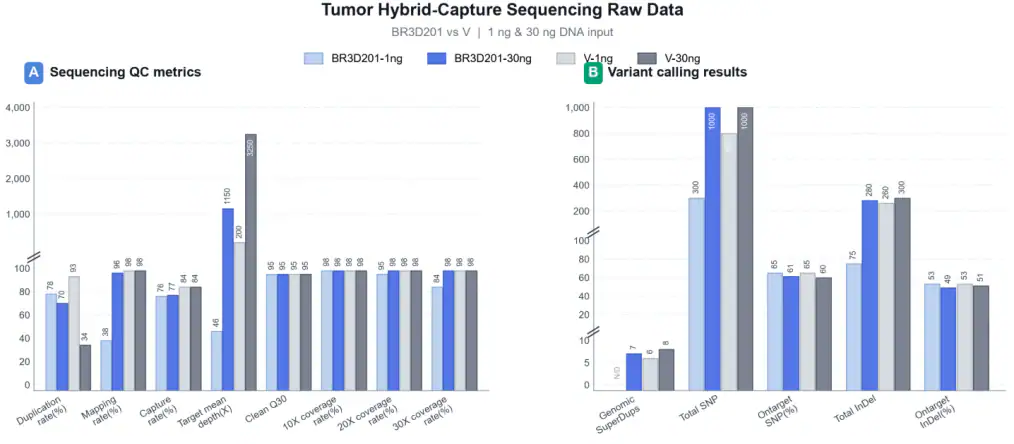
For the complete box, the AcuGenix™ Universal DNA Library Prep Kit (BR3D201) bundles fragmentation, end repair, dA-tailing, ligation, and amplification into one workflow sequenced directly on Illumina and MGI instruments. Input range is 100 pg–1 µg, under an hour of hands-on time, with a 150–350 bp insert. It handles animal and plant gDNA, microbial gDNA, FFPE DNA, cfDNA, and ChIP-DNA. Because the pre-ligation steps share one tube, reaching 1 µg of library takes 1–3 cycles at 1 µg input and 13–15 cycles at 100 pg. Against a leading Supplier V on 1–30 ng pan-cancer reference material, BR3D201 matched pre-capture profiles while cutting off-target false positives, with comparable SNP/InDel recovery (Figure 3).
Step 2 — Cleanup and size selection
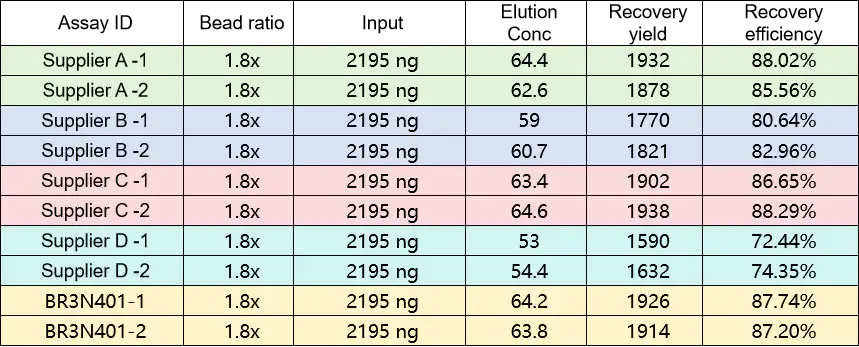
Cleanup plays a decisive role in every DNA library prep: post-fragmentation, post-ligation, post-amplification. The AcuGenix™ NGS DNA Clean Beads (BR3N401) follow the exact AMPure XP protocol at 0.6×–1.8× ratios, so there is no SOP re-optimization. Recovery exceeds 85% (Figure 4), with size-selection parity to the gold standard across 100–2000 ng inputs. They run identically on the bench and on automated liquid-handling stations, and one lot covers WGS, WES, RNA-seq, and targeted size selection.
Step 3 — Library amplification
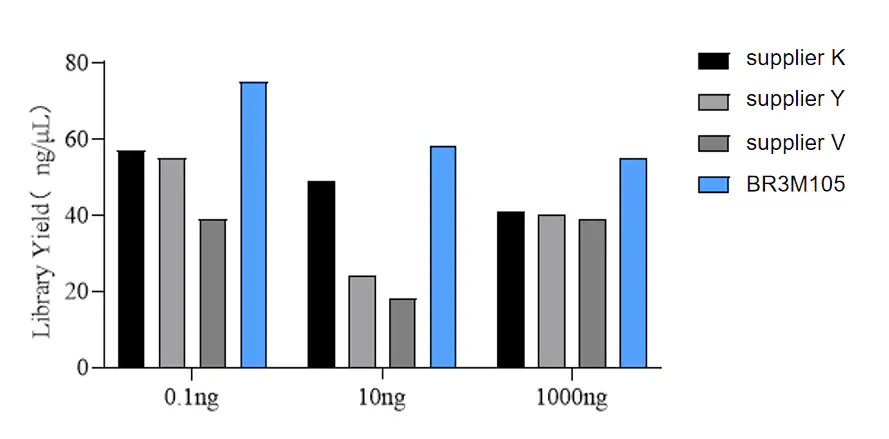
Library complexity depends on the amplification polymerase. The AcuGenix™ AmpSeq Library Amplification Mix (BR3M105) is a 2× hot-start master mix built on the directed-evolution AmpHifi HS polymerase. Across 0.1 ng–1 µg inputs it produced ~30% more than Supplier K at 0.1 ng; 2.4–3.2× Suppliers Y/V at 10 ng (Figure 5), while matching gold-standard fidelity at an error rate of 1.7×10⁻⁵ in a sequencing-based assay, equal to Supplier K. Fewer cycles mean lower duplicates and more usable data.
Standalone raw enzymes for custom cocktails
Prefer to build your own master mix? The same enzymes that power the modules are sold individually. The fragmentation / end-repair / dA-tailing enzyme blend is packaged as BR3N602; for adapter ligation, T4 DNA Ligase (BR3P301) is an ATP-dependent ligase with blunt-end efficiency well above E. coli DNA ligase, batch-validated free of exonuclease and nick-translation activity, and shown to produce a higher 150–300 bp insert fraction with fewer adapter dimers than Supplier A at 1 ng input. T4 DNA Polymerase (BR3P302), T4 PNK (BR3P303), and Klenow exo- (BR3P108) round out the end-modification set, so IVD developers and kit integrators can qualify each enzyme independently. For bulk packs or custom formulations, see our OEM service.
Lane B — tNGS: multiplex DNA+RNA, and long-range targets
How Lane B chemistry works
Multiplex PCR amplifies hundreds of target loci in one reaction from a pooled primer set. A chemically modified hot-start polymerase prevents non-specific extension at room-temperature setup, while proprietary multiplex enhancers balance primer efficiencies across a 400+ plex panel and suppress primer-dimer formation. When the target includes RNA, a directed-evolution thermostable reverse transcriptase performs cDNA synthesis in the same tube before PCR, so DNA and RNA targets are covered without a separate RT step. The first-round amplicons carry only partial adapter tails; a short second indexing PCR then appends the full P5/P7 flowcell adapters and sample barcodes (using BR3M105), and bead cleanup yields the final tNGS library ready for sequencing. Long-range PCR, by contrast, uses a highly processive polymerase with 3′→5′ proofreading and validated with a 400+ plex tNGS panel with no obvious primer dimers.
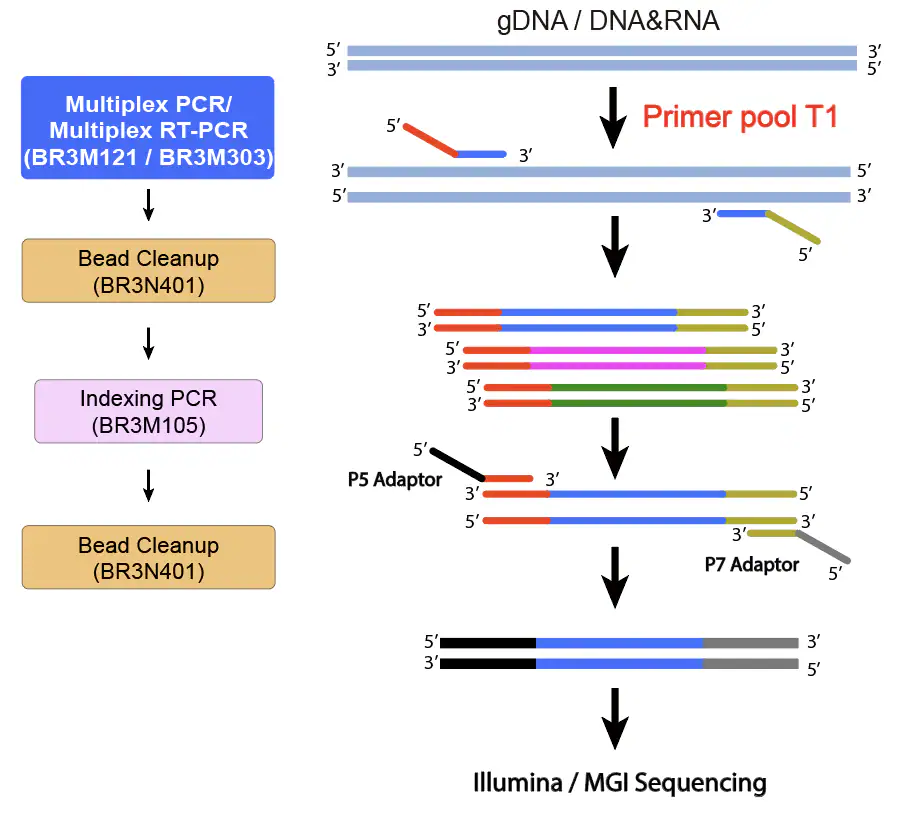

Targeted sequencing has two enzyme-shaped common challenges: primer balance across hundreds of amplicons, and high-fidelity amplification of long or hard templates. The AcuGenix™ Mul-PCR Mix for DNA&RNA (BR3M303) puts reverse transcription and multiplex PCR in one closed tube, pairing a hot-start DNA polymerase with a directed-evolution thermostable reverse transcriptase. DNA and RNA targets amplify together without buffer re-optimization, which matters for respiratory pathogen panels that must call DNA and RNA viruses in the same run. On a 400+ plex tNGS panel, primer-dimer accumulation stayed negligible. Users only need to supply template, primers, and water.
For long clones, long-read prep, or direct PCR, the AcuGenix™ LongR Super-Fidelity Master Mix (BR3M121) offers ~154× the fidelity of wild-type Taq, amplifies up to 30 kb from simple templates and 20 kb from genomic DNA, extends at ~1 sec/kb below 4 kb, and tolerates crude inputs such as whole blood, maize, and yeast without extraction. It spans 25–67% GC and feeds PacBio and Oxford Nanopore libraries, BAC clones, and haplotype phasing.
Lane C — Single-cell and isothermal
How Lane C chemistry works
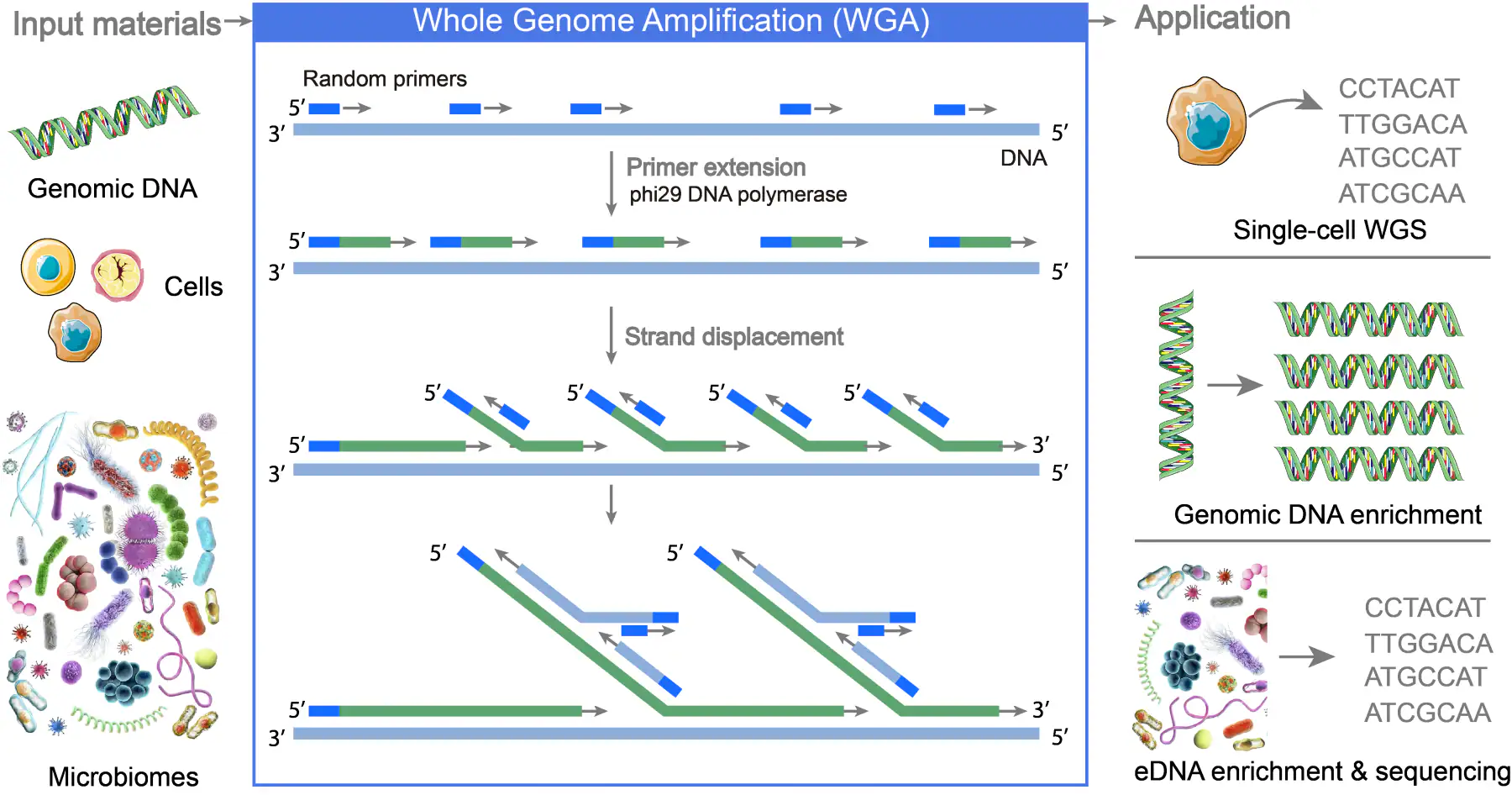
Template-switching reverse transcription primes mRNA via oligo(dT). When the engineered reverse transcriptase reaches the 5′ mRNA end it adds a short non-template CCC tail; the Template-Switching Oligo (TSO), terminated by GGG, base-pairs with that tail and the RT switches template to copy the TSO sequence onto the cDNA 3′ end. This preserves full-length 5′ mRNA information and yields cDNA with defined ends ready for amplification and library construction. phi29 DNA polymerase, by contrast, uses strand-displacement activity to synthesize DNA at a constant 30°C without thermal cycling: on circular templates it performs rolling-circle amplification (RCA), and on random-primed genomic DNA it performs multiple displacement amplification (MDA), producing >70 kb products with built-in proofreading.
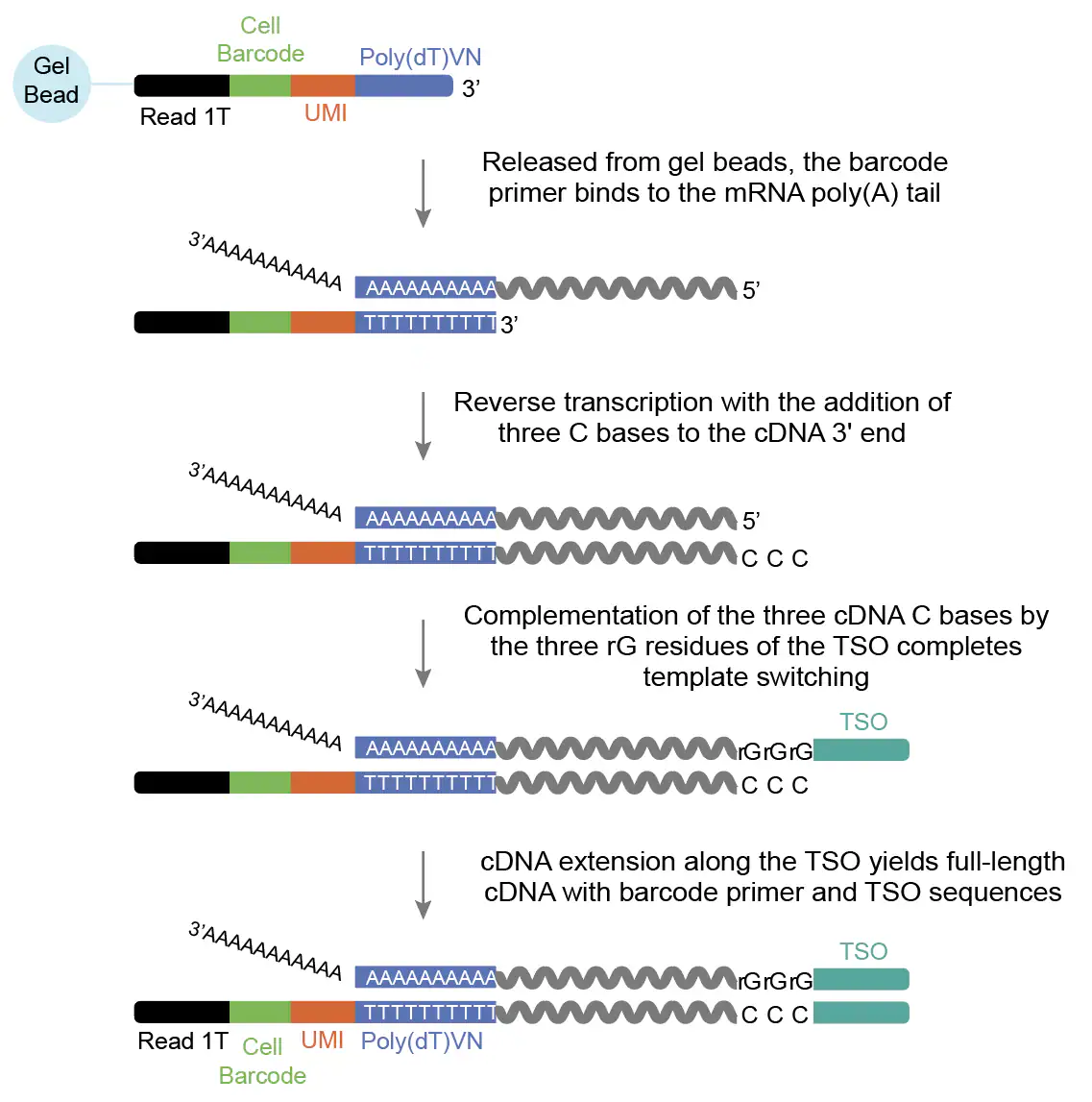

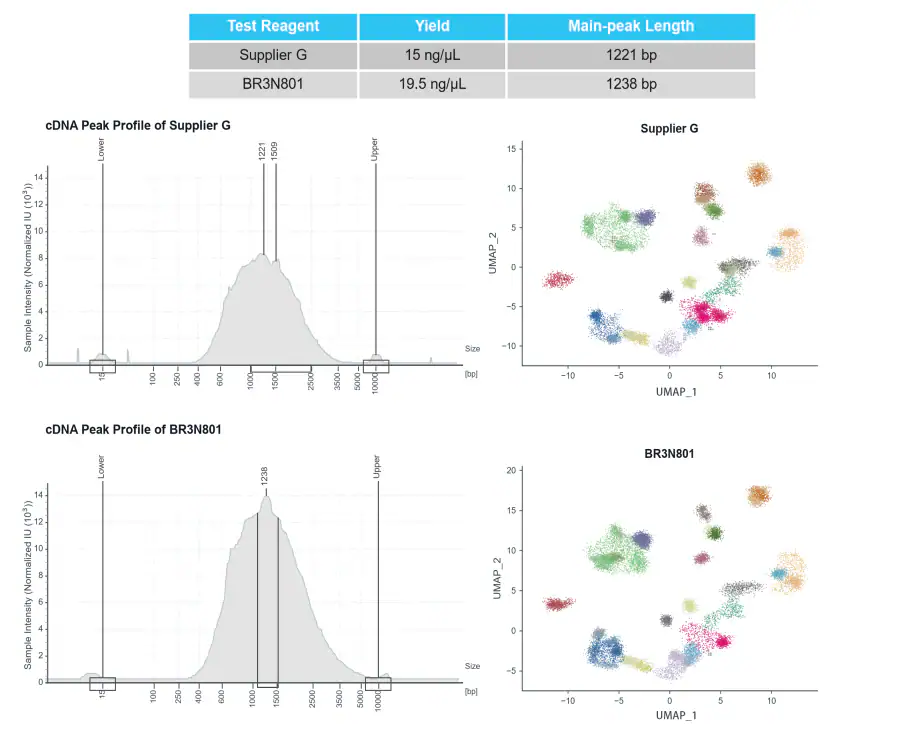
Single-cell 3′ RNA-seq lives or dies at the reverse-transcription step. The AcuGenix™ First-Strand cDNA Synthesis Kit (BR3N801) pairs an engineered reverse transcriptase with template-switching chemistry. The CCC-tail / TSO-GGG capture yields full-length cDNA with defined ends, validated from 10 pg to 1 µg of poly(A)+ RNA. It matches a leading Supplier T on thermal stability (with an edge at 55°C), clearly beats it on an 88% GC stem-loop template (ΔCt 0.42 vs 1.67), and swapped straight into the Supplier G workflow without protocol changes—delivering more genes per cell, higher complexity, and more UMIs while keeping cell clusters concordant (Figure 11).
For whole-genome amplification, rolling-circle amplification, and low-input isothermal work, phi29 DNA Polymerase (BR3P104) brings native strand displacement, >70 kb processivity in one binding event, and intrinsic 3′→5′ proofreading. At 0.1 ng gDNA input—about 15 diploid copies—it delivers higher RCA yield than a leading competitor, powering single-cell WGA and metagenomic prep without a thermal cycler.
Manufacturing, quality and supply
We hold ISO 13485:2016 and ISO 9001:2015 certifications. With in-house expression and purification facilities in Zhuhai, we scale production from pilot runs to standard bulk manufacturing, providing a Certificate of Analysis (CoA) for every batch.
FAQ
How do I choose the right NGS library preparation reagents for my workflow?
Start from three inputs: your sample and input mass, your target platform, and whether you want a pre-bundled kit or raw enzymes for a custom cocktail. For routine WGS, WES, cfDNA, FFPE or ChIP-seq on Illumina or MGI, the AcuGenix™ Universal DNA Library Prep Kit (BR3D201) is the fastest path — fragmentation, end-repair, dA-tailing, ligation and amplification in one workflow. If you are an IVD developer or kit integrator qualifying your own master mix, pick the raw components instead: fragmentation / end-repair / dA-tailing module (BR3N602), T4 DNA ligase (BR3P301), NGS DNA clean beads (BR3N401), and AmpSeq amplification mix (BR3M105). For targeted panels, use BR3M303 for single-tube DNA+RNA multiplex PCR or BR3M121 for long-range / direct PCR; for 3′ scRNA-seq use BR3N801; for WGA, RCA or low-input isothermal work use BR3P104. Whichever route you choose, request a free trial aliquot and run it head-to-head against your current supplier on your own matrix before committing to a lot.
Does a certificate of analysis (CoA) validate an entire sequencing workflow?
No. A CoA confirms that a single lot meets its release specifications — enzyme activity, concentration, purity, and absence of detectable nuclease or extraneous nucleic acid — but it does not guarantee performance on your specific sample type, primer panel or instrument. Real workflow validation is a side-by-side qualification: your input, your primers, your instrument, comparing library yield, size distribution, duplication rate, Q30, and variant concordance against the incumbent supplier. We ship matched controls with every trial so you can run that comparison in your own lab without paying for a full lot.
Can adapters from another supplier be used with an AcuGenix library prep module?
Yes, in most cases. The fragmentation / end-repair / dA-tailing chemistry in BR3N602 and BR3D201 produces standard dA-tailed fragments that ligate efficiently to any Y-adapter carrying a 3′-dT overhang — Illumina P5/P7 adapters, MGI adapters, IDT-for-Illumina adapters, and most custom-barcoded adapters all work. If you are using proprietary adapters with unusual overhangs, modified ends, or non-standard concentrations, send us the adapter sequence and concentration before you run a full experiment; we will confirm ligation compatibility on a test aliquot.
Can BIORI supply NGS enzymes in bulk or custom formats?
Yes. Beyond catalog pack sizes, BIORI supplies bulk packaging to IVD manufacturers and kit integrators in standard glycerol, glycerol-free, lyo-ready, and lyophilized-bead formats, manufactured under ISO 9001 and ISO 13485. We also support custom buffer optimization, master-mix co-packaging, private-label fill, and lot-reserved supply for long-term development programs. Contact marketing@biori-en.com with your target application, annual volume, and required format, and we will route you to the right product-development contact.
Try it on your samples
Every lot is released against predefined specifications with a lot-specific CoA. Whether you are standardizing a WGS workflow, locking down a 400+ plex tNGS panel, or scaling single-cell runs, you can qualify one vendor across the whole chain instead of re-optimizing at every step.
Request a quote or samples: Contact us
- Product pages & datasheets: click any product name in this article
- Sales: marketing@biori-en.com (Get-in-touch)
- Ask for a side-by-side run against your current supplier—we provide matched controls
AcuGenix™ NGS quick-reference
| Lane | Step | Product (click to view) | Cat. No. | Headline spec |
|---|---|---|---|---|
| Normal NGS | Fragmentation / ER / dA-tailing | AcuGenix™ Universal DNA Fragmentation Module | BR3N602 | 3-in-1 single tube, <45 min, 1 pg–1 µg |
| Full library prep (Illumina+MGI) | AcuGenix™ Universal DNA Library Prep Kit | BR3D201 | Dual-platform, 100 pg–1 µg, WGS/WES/cfDNA/FFPE/ChIP | |
| Cleanup & size selection | AcuGenix™ NGS DNA Clean Beads | BR3N401 | >85% recovery, AMPure XP-equivalent protocol | |
| Adapter ligation (raw enzyme) | T4 DNA Ligase | BR3P301 | High blunt-end efficiency, no exonuclease, low adapter dimer | |
| Library amplification | AcuGenix™ AmpSeq Library Amplification Mix | BR3M105 | 30–40% more yield vs Supplier K at low input | |
| tNGS | Multiplex DNA+RNA PCR | AcuGenix™ Mul-PCR Mix for DNA&RNA | BR3M303 | Single-tube RT-multiplex, 400+ plex |
| tNGS / Long-read | Long-range / direct PCR | AcuGenix™ LongR Super-Fidelity Master Mix | BR3M121 | ~154× Taq fidelity, up to 30 kb |
| Single-Cell & Isothermal | 3′ scRNA-seq cDNA | AcuGenix™ First-Strand cDNA Synthesis Kit (for Single-Cell 3′ RNA-Seq) | BR3N801 | Template-switching RT, drop-in vs Supplier G |
| Single-Cell & Isothermal | WGA / RCA / MDA | phi29 DNA Polymerase | BR3P104 | >70 kb processivity, strand displacement |
For Research Use Only. Not for use in diagnostic procedures. Product performance data as published on biori-en.com.