

Published by Zhuhai Biori Biotechnology Co., Ltd.
Full-length cDNA coverage with 5′ UMI counting — what it adds to single-cell research, and the enzyme bench behind it.
Most single-cell projects start and end with gene lists. Cells are clustered, populations are named, and the readout is which genes move. The follow-up questions are usually structural: which isoform of a resistance gene drives this signature? Did the treatment change splicing rather than expression levels? Is the signal from one allele or both?
Droplet-based platforms count 5′ or 3′ tags from tens of thousands of cells and handle the gene-list stage well, but they stop at the gene list. Full-length single-cell RNA-seq was built for the structural questions above, and Smart-seq3 adds quantitative molecular counting to that full-length coverage.
What Full-Length Single-Cell RNA-Seq Adds to a Research Project
The difference is information per cell. Tag-counting methods return a gene-by-cell matrix and nothing beyond it. Full-length methods keep cDNA across the transcript body, so one library can be read for expression, isoform usage, splicing, and allele origin — a real advantage when cells are rare and samples are precious.
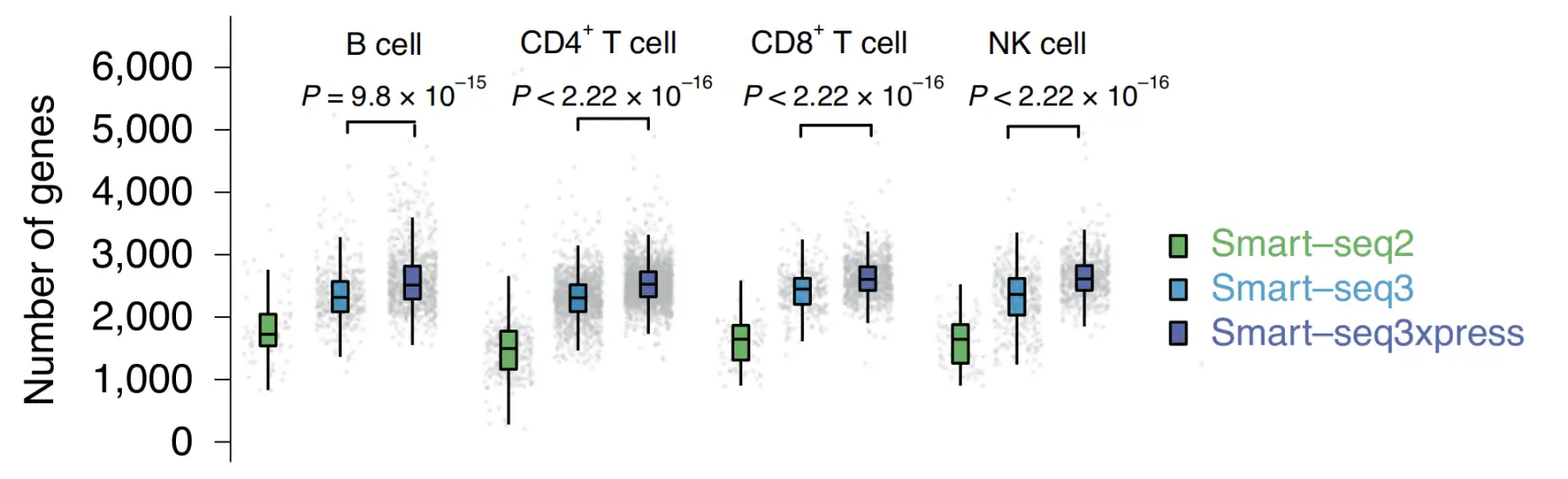
More genes per cell, including the cells that usually lose out. In the original Smart-seq3 study, which profiled the Human Cell Atlas benchmarking sample [3], Smart-seq3 detected more genes than Smart-seq2 in every cell type except CD14+ monocytes, and the largest gain was in T and B cells, which carry little mRNA: roughly 1,000 additional genes per cell. The original study also separated naive and memory B-cell states that earlier protocols could not resolve.
Isoform-level answers. A gene can produce several transcripts with different functions. Tag-based data report gene-level on/off. Smart-seq3’s internal reads, reassembled through UMIs, allow molecules to be assigned to specific transcripts: 30–50% of counted and reconstructed molecules in the original study. Where splicing drives the phenotype — drug resistance, immune activation, development — this is the difference between seeing the switch and missing it.
Allele origin without inference. Reads that cross SNP sites carry the allele. In CAST/EiJ × C57BL/6J hybrid fibroblasts, 61% of molecules were assigned directly to an allele, and 2,172 genes showed strain-specific isoform expression. Imprinting, parental-origin, and genotype–splicing studies benefit directly.
A front-end for long reads. Long-read platforms (PacBio, Oxford Nanopore) resolve complete transcripts but need full-length single-cell cDNA as input. Smart-seq3 produces exactly that. With re-optimized adapters, PCR, and informatics, isoform structures and splicing patterns can be read from single cells in full length.
Smart-seq: Low-Input RNA-seq by Design
Most RNA-seq protocols assume abundant starting material. Smart-seq was designed for the opposite end: profiling from a single cell, or from total RNA measured in picograms. That is what makes it a low-input RNA-seq method — the library is built from what one cell actually contains, not from pooled bulk RNA.
That low-input capability changes the experiments you can run. Rare cells can be profiled one at a time; development and differentiation can be followed across small populations; samples that cannot be pooled — sorted fractions, microdissected regions, small biopsies — become usable. The method does not depend on a minimum amount of RNA to start; it depends on a chemistry sensitive enough to begin from almost nothing.
That sensitivity is engineered, not assumed. To capture transcripts present at only a few copies per cell, reverse transcription must work from picogram input and the subsequent amplification has to add complexity without adding bias. This is why the enzyme choices discussed later in this article matter more for Smart-seq than they do for bulk NGS.
How Smart-seq3 Works: 5′ UMI Reads and Internal Reads
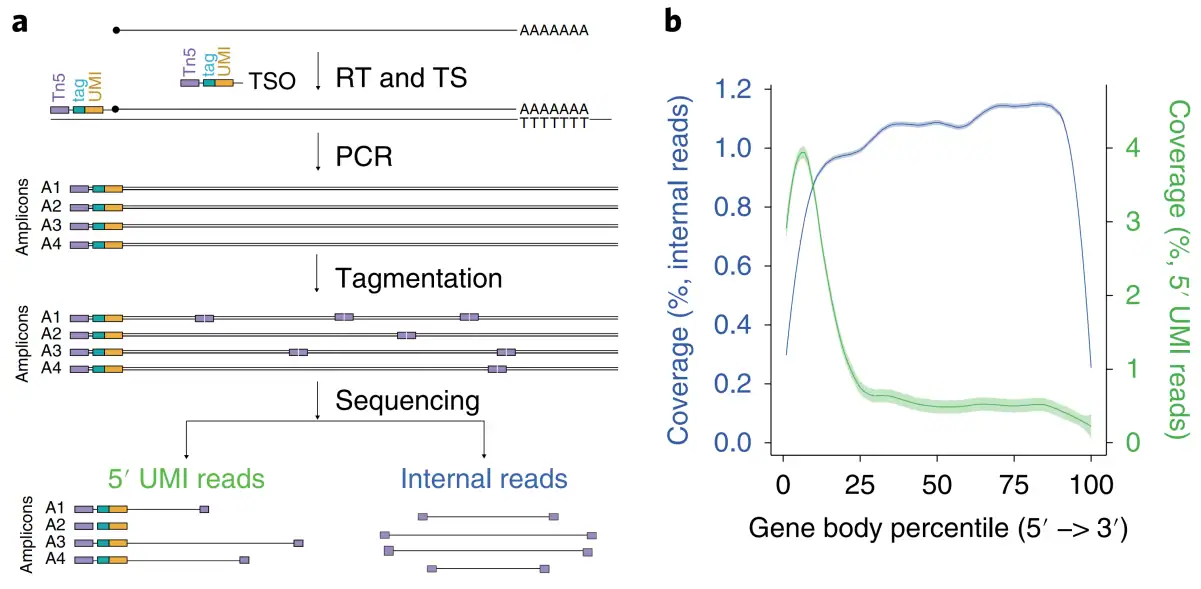
Smart-seq3 [1] keeps the Smart-seq2 [2] workflow — single-cell sorting, oligo-dT capture of poly(A)+ RNA, reverse transcription with template switching, full-length cDNA amplification, Tn5 tagmentation, and sequencing — but the chemistry behind it was rebuilt. Three changes matter most for anyone sourcing enzymes: a different reverse transcriptase, a reformulated RT buffer, and a redesigned template-switching oligo (TSO) that carries a partial Tn5 motif, an 11-bp tag, an 8-bp UMI, and three riboguanosines.
The reverse transcriptase was swapped to Maxima H-minus. In the paper’s screen of hundreds of reaction conditions, Maxima delivered the highest transcript sensitivity, which is why it replaced the enzyme used in Smart-seq2. The buffer was rebalanced around it: the salt was switched from KCl to NaCl (or CsCl), a change that most improved detection of GC-rich transcripts and lifted overall sensitivity in single-cell reactions; 5% PEG was added to improve cDNA yield through molecular crowding; and GTP was added to stabilize or promote template switching. The result is not Smart-seq2’s buffer with a new enzyme — it is a buffer system engineered around the enzyme, and a replacement RT must work in this exact mix. BIORI supplies a gene-engineered reverse transcriptase whose enhanced terminal-transferase (template-switching) activity is built to tolerate complex reaction systems — rebalanced salts, crowding agents, and nanoliter formats alike.
The tag splits the reads into two classes. Reads that start at the tag are 5′ UMI reads: they trace back to individual RNA molecules, so counting survives PCR bias. Reads that start inside the transcript are internal reads: they carry the exon junctions, splice sites, and SNPs needed to identify isoforms. Because library construction is Tn5-based, fragments from the same molecule share a UMI and can be reassembled in silico.
Smart-seq3xpress: Scaling Full-Length scRNA-seq Without Losing Depth
Smart-seq3xpress [4] keeps the Smart-seq3 chemistry and scales it.
Measured results: 26,260 PBMCs at ~258,000 reads per cell resolved into 27 clusters, including rare MAIT and γδ T cells. Gene detection was higher than Smart-seq2 and Smart-seq3 across major cell types; against 3′-end droplet data, more SNP sites were covered (9.2M vs 2.1M positions) and 968 cell-type-specific differentially spliced exons were identified by BRIE2. Full-length information scales.
How it is scaled: miniaturize lysis/RT/PCR to ~1 µl under 3 µl Vapor-Lock (300 nl lysis + 100 nl RT + 600 nl PCR); skip cDNA cleanup and QC — dilute cDNA straight into tagmentation; cut Tn5 about 5-fold (0.1 µl per cell); switch to a PCR polymerase whose buffer is compatible with direct tagmentation; redesign the TSO to suppress strand-invasion artifacts. The chemistry must hold at these extremes — faithful template switching in a 1 µl droplet, an amplification enzyme that tolerates RT-mix carryover, and a Tn5 with a wide usable window. Enzyme quality, not sequencing depth, decides how far Smart-seq can scale.
When to Choose Smart-seq3 over Droplet-Based scRNA-seq
Smart-seq3 earns its keep when cells are few and per-cell information is the goal: clinical biopsies, tumor micro-regions, early embryos, organoid niches, FACS-sorted rare populations. Use it when the endpoint is structural — isoform, splicing, allele origin, immune-receptor transcripts — or after a droplet run has narrowed down the population worth deep profiling. For large cohorts that only need a gene-level answer, droplet-based methods remain the better price-per-cell option.
The Smart-seq3 Wet-Lab Workflow
The wet lab runs through eight stages before data analysis. Each stage puts a specific demand on the enzyme bench — sensitivity at picogram input, faithful template switching, high-fidelity amplification, and gentle handling of long cDNA. The numbered steps below map the chain; the table that follows lists the BIORI products available for each stage.
- Cell lysis and RNA release
- Reverse transcription with template switching
- Full-length cDNA amplification
- Cleanup and size selection
- Library construction — Tn5 tagmentation, or the classic route: fragmentation, end repair + A-tailing, adapter ligation
- Library amplification
- Cleanup and size selection
- Sequencing
The Enzyme Bench Behind Smart-seq Data Quality
The protocol looks simple on a slide. Three enzyme decisions set the outcome: the reverse transcriptase that carries out template switching from picogram inputs, the high-fidelity polymerase that amplifies full-length cDNA without losing complexity, and the library-construction chemistry that handles the cDNA gently. BIORI’s portfolio answers each decision directly.
| Smart-seq wet-lab step | What the wet lab needs | BIORI products | Cat. No. |
|---|---|---|---|
| Cell lysis → first-strand RT & template switching | RNase-free handling; template-switching RTase with high sensitivity at 10 pg–1 ng poly(A)-containing total RNA; TSO compatibility | AcuGenix™ First-Strand cDNA Synthesis Kit for Single-Cell 3′ RNA-Seq (engineered template-switching RT; validated 10 pg–1 µg poly(A)-containing total RNA; drop-in equivalence to a leading 3′ scRNA-seq system; full-length cDNA synthesis) | BR3N801 |
| RNA protection during lysis & RT | Contaminant-free RNase inhibitor | AcuGenix™ RNase Inhibitor | AS05 BR1D901 |
| Full-length cDNA amplification | High-fidelity, low-bias hot-start polymerase; high yield at picogram input; low duplicates | AcuGenix™ AmpSeq Library Amplification Mix | BR3M105 |
| Post-RT / post-PCR cleanup & size selection | SPRI bead cleanup, AMPure XP-compatible protocol | AcuGenix™ NGS DNA Clean Beads (>85% recovery; 0.6×–1.8× ratios; liquid-handler compatible) | BR3N401 |
| Library construction | Smart-seq3: Tn5 tagmentation; alternatively end-repair/ligation from amplified cDNA | Tn5-based tagmentation solutions (available on enquiry); for ligation-based routes: AcuGenix™ Universal DNA Fragmentation Module (fragmentation/ER/dA in one tube) + T4 DNA Ligase |
Contact us / BR3N602, BR3P301 |
| RT & PCR substrates | High-purity, nuclease-free dNTPs | AcuGenix™ dNTP Mix (10 mM) | AS08-10-1234 |
FAQ
What is the difference between Smart-seq2 and Smart-seq3?
Smart-seq2 (Picelli et al., 2014) established full-length single-cell coverage: oligo-dT priming, template switching, high-fidelity amplification, Tn5 tagmentation. What it lacked was a way to count original molecules. Smart-seq3 keeps that workflow, rebuilds the RT chemistry, and adds an 8-bp UMI plus an 11-bp tag in the TSO. The UMI tags every assembled full-length molecule; it does not raise gene detection by itself, but it changes how reads are counted downstream — PCR duplicates collapse into true molecular counts, correcting quantification for amplification bias. The wider per-cell gene detection comes mainly from the reverse-transcription stage: a template-switching RTase chosen for sensitivity and an RT buffer rebuilt with NaCl, PEG, and GTP raise first-strand yield and full-length synthesis, so more transcripts are captured to begin with. The internal reads that cover the transcript body then make isoform and allele assignment possible.
“Full-length” single-cell RNA-seq with short reads — do we read complete transcripts?
No. “Full-length” describes coverage, not read length. The library keeps cDNA spanning the transcript body; reads tile across it, and isoform usage, exon junctions, and SNP origin are reconstructed computationally. For one continuous read per transcript, combine with long-read sequencing; full-length single-cell cDNA is the input that makes that possible.
Smart-seq3 versus droplet-based 3′/5′ methods (e.g., 10x Chromium) — which should I use?
They answer different questions. Droplet platforms profile tens of thousands of cells cheaply for clustering and marker discovery. Smart-seq3 gives more information per cell — isoform, splicing, allele origin, immune-receptor reads — at lower throughput. The standard workflow is droplet discovery first, then Smart-seq3 on the population of interest.
Can Smart-seq3 be combined with long-read sequencing?
Yes, with deliberate adaptation. Skip the Tn5 fragmentation, redesign adapters and UMIs for PacBio or Oxford Nanopore, retune PCR and library conditions. Chemistry and informatics both change, so treat it as an integration project rather than a plug-and-play protocol.
Which step is most sensitive to enzyme quality, and how do I validate a replacement?
Reverse transcription with template switching. It decides whether full-length 5′ information exists and how faithfully UMIs map back to molecules. Validate on your own matrix: cDNA yield and size, genes and UMIs per cell, cluster concordance against your incumbent.
Can I drop BIORI BR3N801 into an existing Smart-seq2/3 protocol without re-optimization?
BR3N801 is a first-strand synthesis kit built around an engineered template-switching RTase, validated from 10 pg to 1 µg poly(A)-containing total RNA. The kit has been validated across the full 3′-end single-cell sequencing workflow: full-length cDNA is synthesized first, then the terminal-transferase (template-switching) activity appends the TSO at the end of the cDNA; at library construction, only the 3′ end is selected to complete the downstream library prep and sequencing. Smart-seq uses the same oligo-dT + TSO chemistry, so the kit is designed to drop into that step; still, run your own side-by-side on your TSO and cycling profile before scaling.
Can BIORI supply these enzymes in bulk or custom formats?
Yes. BIORI supplies bulk enzymes in glycerol, glycerol-free, lyo-ready, and lyophilized-bead formats under ISO 9001 and ISO 13485, with custom buffers, master-mix co-packaging, and private-label fill. Write to marketing@biori-en.com with your application, volumes, and required format.
References
- Hagemann-Jensen M, Ziegenhain C, Chen P, et al. Single-cell RNA counting at allele and isoform resolution using Smart-seq3. Nature Biotechnology. 2020;38:708–714. doi:10.1038/s41587-020-0497-0
- Picelli S, Faridani OR, Björklund ÅK, et al. Full-length RNA-seq from single cells using Smart-seq2. Nature Protocols. 2014;9:171–181. doi:10.1038/nprot.2014.006
- Mereu E, Lafzi A, Moutinho C, et al. Benchmarking single-cell RNA-sequencing protocols for cell atlas projects. Nature Biotechnology. 2020;38:747–755. doi:10.1038/s41587-020-0469-4
- Hagemann-Jensen M, Ziegenhain C, Sandberg R. Scalable single-cell RNA sequencing from full transcripts with Smart-seq3xpress. Nature Biotechnology. 2022;40:1452–1457. doi:10.1038/s41587-022-01311-4
About BIORI
Established in 2012 in Zhuhai, China, BIORI (Zhuhai Biori Biotechnology Co., Ltd.) integrates protein engineering, recombinant expression, process development and application development under ISO 9001 and ISO 13485 quality systems, backed by an in-house enzyme library of 1,000+ enzymes. The company supplies enzymes, master mixes and kits across molecular diagnostics, NGS & genomics, life science, and biopharma QC & mRNA, in standard glycerol, glycerol-free, lyo-ready and lyophilized-bead formulations.